
An Indian company can invest Indian rupees into another Indian company, and the law can still call that money foreign. That is downstream investment in one line. This guide unlocks the whole idea in seven short levels, each with one “aha” to collect.
The puzzle that starts it all
Meet three companies:
| Company | Where | What happens |
| NorthStar Pte. Ltd. | Singapore | Owns 75% of Mango India |
| Mango India Pvt. Ltd. | India | Invests INR 10 crore for 40% of Beta |
| Beta Technologies Pvt. Ltd. | India | Receives the money |
The Mango-to-Beta deal is fully Indian. Indian company, Indian company, Indian bank accounts.
So Beta got domestic money, right?
Not necessarily. India’s foreign investment law looks through Mango and says: that 40% in Beta is foreign too.
Twist number two: Beta’s indirect foreign investment is 40%, not 30%. You do not multiply 75% x 40%. Hold that thought; Level 3 explains why.
The big idea in one sentence. What cannot be done directly should not be done indirectly. If a foreign investor is capped at 74% in a sector, it cannot set up an Indian holding company and use it to grab 80%.
That anti-shortcut principle is the entire reason this regime exists. Everything below is just the machinery.
The 60-second version
Short on time? These five questions solve most downstream investment problems. Ask them in this order.
Who is investing? An Indian company, LLP or investment vehicle?
Does that investor have any foreign investment? If no, stop. The regime generally does not apply.
Who owns and who controls the investor? This decides whether its money carries a foreign “flavour”.
How much indirect foreign investment does the target get? Use the FEMA method, not simple multiplication.
Could the target legally take that foreign money directly? Check sector cap, route, pricing, funding source and filings.
Memory hook: Follow the ownership. Follow the control. Follow the money. Check the target’s sector. Then follow the forms.
Where the rules live
There is no single “Downstream Investment Act”. You read these layers together:
| Layer | What it does for you |
| FEMA, 1999 | The parent law for foreign exchange |
| NDI Rules, 2019 | The main foreign investment rules; Rule 23 holds the downstream regime |
| FEMA 395 Reporting Regulations | The filing mechanics: Form DI, DPIIT intimation |
| RBI Master Direction, Foreign Investment in India | RBI’s consolidated guidance, updated up to 15 June 2026 |
| Consolidated FDI Policy (FAQs) | Sector caps, automatic vs Government route, conditions |
| Companies Act, 2013 | Board and shareholder approvals, share issues and transfers |
| Sector laws (RBI, IRDAI, SEBI, DoT) | Extra approvals depending on the business |
Heads-up: new draft rules were released in July 2026 and may replace the NDI Rules. They are not law yet. See the Plot twist section near the end.
Level 1: Two words that are not twins
Downstream investment (DI) and indirect foreign investment (IFI) are different things. Mixing them up causes most of the confusion in this subject.
| Downstream investment | Indirect foreign investment | |
| What it is | An Indian entity that has some foreign investment invests in another Indian entity | A downstream investment where the investor is on the foreign side of the ownership/control test |
| How wide | Very wide: any foreign shareholder at all | Narrower: needs foreign ownership or control |
| Triggers Rule 23 compliance? | Not by itself | Yes: caps, pricing, funding rules, Form DI |
Think of it as a two-gate test. Gate 1 asks: does the investor have any foreign money? Gate 2 asks: is the investor foreign-owned or foreign-controlled? Only investments that pass both gates get the full treatment.
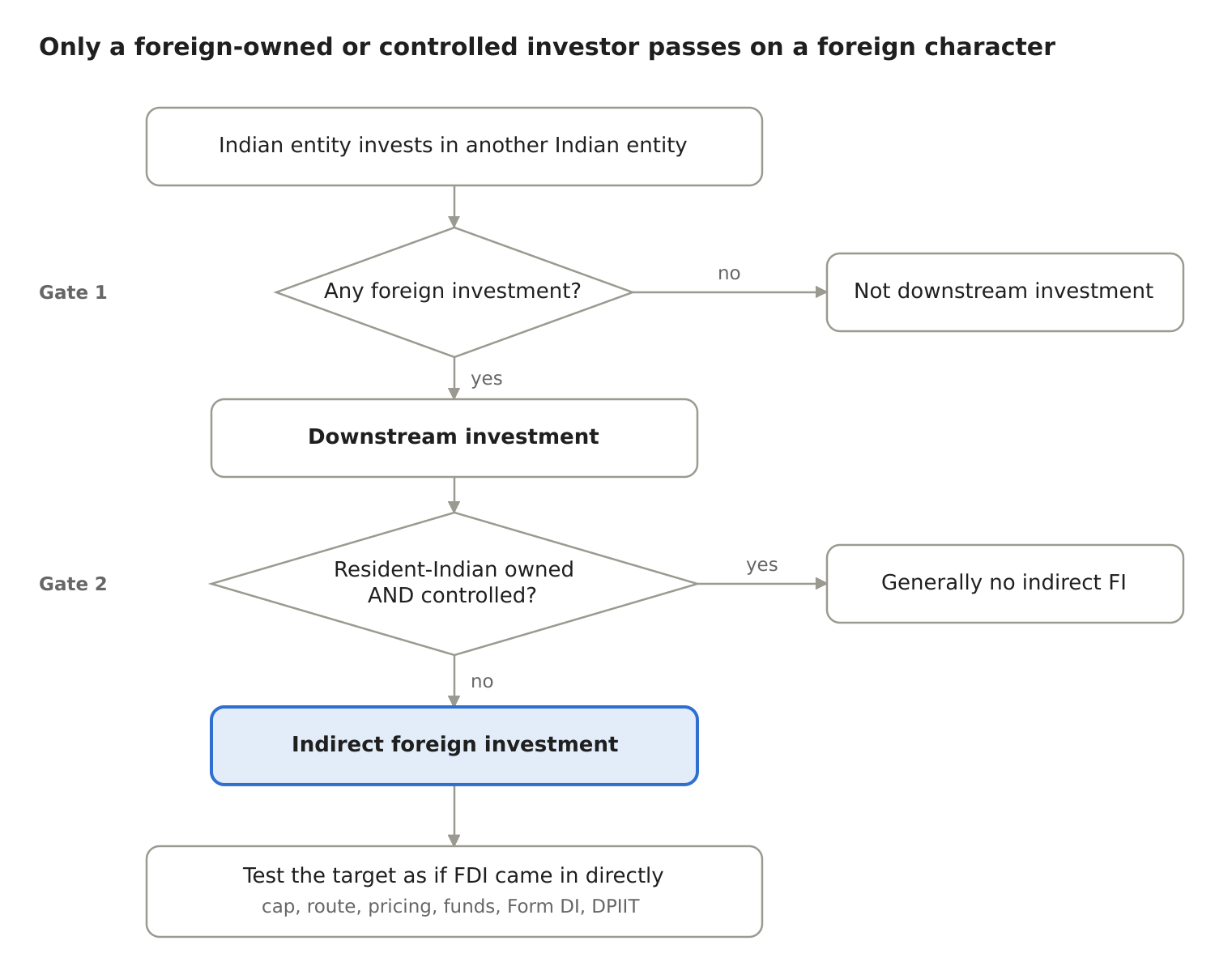
The two-gate test
Gate 1 decides whether it is downstream investment at all. Gate 2 decides whether Rule 23’s heavy compliance kicks in.
Quick example
A foreign investor owns 20% of India Company A. A invests in 30% of India Company B.
Gate 1: A has foreign investment. So A’s investment in B is a downstream investment.
Gate 2: Resident Indians own the other 80% and control A. So it is generally not indirect foreign investment in B.
Aha #1: “Downstream investment” is the big circle. “Indirect foreign investment” is the smaller circle inside it. Rule 23’s heavy compliance lives in the smaller circle.
Source: NDI Rules, Rule 23 and the RBI Master Direction.
Level 2: Owned vs controlled
Ownership is about the cap table. Control is about who calls the shots. FEMA checks both, separately.
The ownership test
Company: beneficial ownership of more than 50% of its equity instruments.
LLP: more than 50% of capital plus the majority profit share.
So 51% foreign = foreign-owned. 49% foreign = not foreign-owned. Easy so far.
The control test
Control means the right to appoint a majority of directors, or to control management or policy decisions. It can come from shares, a shareholders’ agreement (SHA), voting agreements, or anything else.
Trap 1: the 49% shareholder who runs the show
| Foreign investor | Indian founder | |
| Shares | 49% | 51% |
| Board seats (of 5) | 3 | 2 |
Ownership looks Indian. Control is foreign. The company can still land on the foreign side.
The same can happen with just 35%, if the SHA lets the investor drive management or policy decisions.
Aha #2: Never stop at the cap table. Read the Articles, the SHA, board appointment rights and reserved matters.
One fairness check: not every minority protection is “control”. A veto to protect your investment differs from a right to run the business. The answer depends on the documents.
Trap 2: the 50:50 company
The ownership test says more than 50%. So exactly 50% foreign is not foreign-owned on that test alone.
But 50:50 is not a safe harbour. Look at casting votes, board make-up, reserved matters, management powers and contractual control. Ask: can either side actually direct policy?
Level 3: The math that breaks intuition
FEMA does not multiply percentages down a chain. It labels the investing company first, then counts that company’s full stake. One exception: wholly owned subsidiaries.
Rule A: the full stake counts
Singapore Co owns 75% of India A. India A owns 40% of India B.
Your brain says: 75% x 40% = 30%.
FEMA says: India A is foreign-owned, so B has 40% indirect foreign investment.
Why it matters: say B’s sector caps foreign investment at 49%. A 40% stake fits. A 60% stake does not, even though 75% x 60% = 45% looks fine on paper.
Rule B: the wholly owned subsidiary (WOS) exception
Now India A owns 100% of India B.
| Step | Number |
| A’s stake in B | 100% |
| Total foreign investment in A | 75% |
| Indirect foreign investment in B | 75% (not 100%) |
For a WOS, indirect foreign investment is capped at the total foreign investment in the parent.
Aha #3: “Never multiply” is not the full rule either. The real rule: label the investor, take its stake, then check whether the WOS exception changes the answer.
Rule C: repeat at every layer
Three or four layers deep? Run the same five checks at each level:
What is this entity’s total foreign investment?
Who owns it?
Who controls it?
What investment is it making now?
What character does that investment carry to the next level?
This bites large groups hardest. Foreign capital that came in years ago at the top can quietly change the character of every investment below.
Level 4: The time bomb in old investments
A foreign funding round at the holding company can turn its old, purely Indian investments into downstream investment overnight. Nobody touches the target. The target still changes character.
| Year | Who owns India A | A’s 30% in India B is… |
| 2019 | Indian founders, 100% | Domestic. Nothing foreign. |
| 2026 | Foreign investor, 70% | Now potentially indirect foreign investment |
No new B shares were bought. No money moved into B. B’s cap table did not change.
The RBI covers this directly. When an investor later becomes foreign-owned or controlled, its existing investment is reclassified as downstream investment from that date. Then:
B must fit the sector’s entry route and cap.
Form DI is due within 30 days of reclassification.
Aha #4: In every foreign round, ask one extra question: “What does this company already own?”
Source: RBI Master Direction, Foreign Investment in India.
Level 5: Pretend the foreigner invested directly
Once an investment is indirect foreign investment, test the target as if the foreign shareholder had invested in it directly. That is the anti-shortcut rule doing its job.
Run the target through this checklist:
☐ What business does the target actually do?
☐ Which FDI sector does that fall in?
☐ What is the sectoral cap?
☐ Automatic route or Government route?
☐ Any FDI-linked performance conditions?
☐ Is the instrument permitted?
☐ Does the price comply?
☐ Any sector-regulator approvals?
The RBI requires the target to meet the entry route, sectoral cap, pricing guidelines and FDI-linked performance conditions. Check the sector against the Consolidated FDI Policy (see the official FDI Policy FAQs).
No back door into prohibited sectors
Foreign investment is prohibited in areas such as lottery, gambling and betting, chit funds, Nidhi companies, trading in transferable development rights, specified real estate and farm-house activity, specified tobacco manufacturing, and sectors closed to private investment (for example, specified atomic energy and railway operations).
“But we invested through an Indian company” does not work. That is exactly the move these rules block.
Special rule 1: LLPs are stricter
A foreign-side LLP can make downstream investment into a company only where the sector allows 100% FDI under the automatic route with no FDI-linked performance conditions. The same test applies to indirect foreign investment into an LLP.
Aha #5: When someone says “let’s just put an LLP in the middle”, reply: “Check Rule 23 first.”
Special rule 2: NRI/OCI money can count as Indian
Investment by NRIs or OCIs on a non-repatriation basis is treated as deemed domestic investment. Entities owned and controlled by NRIs/OCIs on that basis get matching treatment.
So an NRI-owned Indian company is not automatically foreign. The character of the upstream money matters.
Level 6: Follow the money
Where the cash comes from is a legal question, not an accounting one. A foreign-side Indian company cannot fund downstream investment with domestic borrowing.
The three pots
| Pot | Source of funds | Allowed? |
| A | Foreign parent sends equity funding | Yes, subject to the other conditions |
| B | Internal accruals: post-tax profits moved to reserves | Yes |
| C | Loan from an Indian bank | No. Domestic borrowing or leverage is restricted |
One useful carve-out: NCDs subscribed by non-residents are not treated as domestic borrowing for this purpose. The debt itself must still comply with FEMA.
Aha #6: Every checklist needs one simple line: “Please show us the source of funds.”
Which instruments count
For companies, the rules centre on equity instruments: equity shares, fully and mandatorily convertible preference shares and debentures (CCPS, CCDs), and share warrants.
A CCD sits in a different FEMA bucket from a non-convertible or optionally convertible debenture. Do not treat every “debenture” alike. For LLPs, the question is capital contribution.
Pricing still applies between two Indian companies
Odd but true. Because the investment counts as foreign, FEMA pricing rules apply.
Unlisted companies: arm’s length value under an internationally accepted method.
Who can certify: a chartered accountant, SEBI-registered merchant banker or practising cost accountant.
Freshness: RBI guidance says the valuation should generally be no more than 90 days old on the investment date.
Direction matters for secondary transfers.
Ask “what is the FEMA pricing rule for this exact deal?”, not just “what price did we agree?”. Get the valuation before signing.
Swaps and deferred payment now work downstream too
In January 2025 the RBI clarified that direct-investment tools also work for downstream deals, if Rule 23 is not circumvented. (summary)
Share swaps are available.
Rule 9(6) deferred consideration: up to 25% of the price can be deferred, escrowed or covered by indemnity for up to 18 months.
So a downstream acquisition need not be plain cash-for-shares.
Level 7: Approvals and filings
FEMA asks for a Board resolution and two separate 30-day filings. The Companies Act may add more. Keep the two laws in separate boxes.
Approvals: what each law actually asks
There is no universal “downstream investment shareholders’ resolution”.
FEMA: approval by the investing company’s Board of Directors.
Companies Act, s.179(3)(e): the Board must approve investing company funds at a Board meeting.
Companies Act, s.186: a special resolution of shareholders is needed if the investment crosses the higher of (a) 60% of paid-up capital + free reserves + securities premium, or (b) 100% of free reserves + securities premium, unless an exemption applies. Investments in a wholly owned subsidiary get special treatment.
| Action | Investor company | Target company |
| Approve the downstream investment | Board resolution (FEMA) | — |
| Approve investing company funds | Board resolution (s.179) | — |
| Section 186 | Board; special resolution if limits crossed | — |
| Fresh issue of shares | — | Board approval |
| Preferential / private placement | — | Shareholder approval and issue mechanics |
| Share transfer | Approvals per Articles / SHA | Register the transfer |
| Sector-regulator approval | Depends on sector | Depends on sector |
Aha #7: FEMA needing a Board resolution does not mean FEMA needs a shareholders’ special resolution. That usually comes from the Companies Act, the Articles, the SHA or sector rules.
MGT-14 filing depends on the exact resolution and available exemptions. Do not assume “downstream investment = MGT-14”.
Fresh issue vs buying existing shares
Fresh issue: the target issues new shares via rights, preferential allotment or private placement. Expect board and shareholder approvals, offer documents and PAS-3.
Secondary purchase: nothing is issued. The paperwork is a transfer, not an allotment.
The FEMA character can be the same. The corporate documents are completely different.
The two filings you must not mix up
| Filing | Who files | Deadline | Note |
| DPIIT (SIA) intimation | Investing Indian entity | 30 days from the investment | Required even before shares are allotted |
| Form DI | Investing Indian entity, via its AD bank | 30 days from allotment | Filed on the RBI reporting platform |
A checklist that only says “Form DI, 30 days” is incomplete. Both come from the FEMA 395 Reporting Regulations.
The secondary-purchase grey zone
The Form DI rule speaks of “30 days from allotment”. A share purchase has no allotment.
Market and AD-bank practice treats secondary downstream acquisitions as reportable on Form DI, usually within 30 days of the acquisition. Talk to your AD bank before closing, not after the clock starts.
Form DI is not FC-GPR
Picture a US parent funding India HoldCo, which then invests in India Target.
| Leg | Who invests in whom | Which world |
| US Parent to India HoldCo | Non-resident into Indian company | Direct FDI: FC-GPR if shares are issued |
| India HoldCo to India Target | Indian company into Indian company | Downstream: Form DI + DPIIT intimation |
The second leg does not become an FC-GPR filing just because HoldCo is foreign-owned.
But FC-TRS can still show up
If a foreign-side Indian company buys target shares from a non-resident seller, that leg is also a resident/non-resident transfer. That can trigger FC-TRS too.
So the right question is not “is this a Form DI deal?”. It is: “Which forms does each leg of this deal trigger?”
Full filing matrix
| Event | Filing | Timeline |
| Qualifying downstream investment made | DPIIT / SIA intimation | 30 days of investment |
| Fresh allotment creating indirect FI | Form DI | 30 days of allotment |
| Old investment reclassified after foreign round | Form DI | 30 days of reclassification |
| Direct issue to a non-resident | FC-GPR | Direct-FDI timeline |
| Resident/non-resident share transfer | FC-TRS | FC-TRS timeline |
| Fresh allotment by target | PAS-3 and related filings | Depends on issue route |
| Special or other registrable resolution | MGT-14, where applicable | Companies Act timeline |
| Late FEMA reporting | Late submission fee may apply | Regularise promptly |
It does not end at closing
The first-level Indian company must ensure downstream compliance at every level below it.
It needs an annual statutory auditor certificate on downstream compliance.
The compliance status goes in the Directors’ Report.
If the auditor qualifies it, the issue must be reported to the relevant RBI office.
Tip: keep a downstream investment register. Track upstream foreign ownership, control, each Indian holding, indirect FI %, sector cap, Form DI and DPIIT status, and auditor certificates.
Bonus trap: the “investing company”
An Indian company whose business is investing in other Indian companies can face its own regime. It may need NBFC or core investment company treatment and Government or RBI approvals. Check the HoldCo itself, not just its portfolio.
Boss level: close a real deal
NorthStar Inc. (USA) owns 80% of Atlas India. Atlas puts INR 25 crore into Nova for 35%. Result: Nova has 35% indirect foreign investment, Atlas files Form DI, and Nova files no FC-GPR.
Assume Nova does software services, a sector with 100% FDI on the automatic route and no special conditions.
| Step | Question | Answer |
| A | Is Atlas an Indian entity? | Yes |
| B | Does Atlas have foreign investment? | Yes, NorthStar holds 80% |
| C | Is Atlas resident-Indian owned and controlled? | No. Over 50% is foreign-held |
| D | Is Atlas’s stake in Nova indirect foreign investment? | Yes: 35% (not 80% x 35% = 28%) |
| E | Can Nova take 35% foreign investment? | Yes, on our sector assumption |
| F | Is the price compliant? | Get a FEMA valuation; meet the pricing floor |
| G | Where does Atlas’s INR 25 crore come from? | Foreign funding or internal accruals, not a domestic loan |
| H | Corporate approvals? | Atlas: Board, s.179, s.186, Articles/SHA. Nova: issue approvals |
| I | Closing | Atlas pays; Nova allots shares |
| J | Filings | DPIIT intimation within 30 days of investment; Form DI within 30 days of allotment; Nova’s Companies Act allotment filings |
What Nova does not file because of this deal: FC-GPR. Atlas is an Indian resident investor.
Now flip just one fact
NorthStar owns only 30% of Atlas. Resident Indians own 70% and control the Board. NorthStar has ordinary minority protections only.
Atlas still has foreign investment, so its Nova stake is still a downstream investment.
But Atlas is resident-Indian owned and controlled.
So the stake is generally not indirect foreign investment.
Same investor. Same target. Same INR 25 crore. Completely different FEMA result.
“Atlas has FDI, so Form DI” is too simple. Ownership and control decide.
Test yourself: 11 myths, all false
Cover the right column and see how many you get. Every statement on the left is false.
| # | Myth | Reality |
| 1 | “The investor is Indian, so FEMA doesn’t apply.” | Its investment can still be indirect foreign investment. |
| 2 | “Multiply the percentages down the chain.” | Usually wrong. Count the full stake; the WOS rule is the special case. |
| 3 | “One foreign shareholder makes a company foreign-owned or controlled.” | No. Test ownership and control. |
| 4 | “Under 50% foreign means no DI issue.” | Control can change the answer. |
| 5 | “No foreign money reached the target, so it has no foreign investment.” | Indirect FI arises without any cross-border remittance into the target. |
| 6 | “An old investment can’t later become DI.” | A later foreign ownership/control change reclassifies it. |
| 7 | “Form DI is basically FC-GPR.” | They report different legal events. |
| 8 | “Form DI is the only filing.” | DPIIT intimation, Companies Act filings and sometimes FC-TRS apply too. |
| 9 | “If HoldCo can take FDI, it can invest anywhere.” | The target must pass its own sector rules. |
| 10 | “We can fund it with an Indian bank loan.” | Rule 23 restricts domestic leverage. |
| 11 | “Only the cap table matters.” | Governance rights can decide control. |
Score 9 or more? You understand downstream investment better than most deal checklists do.
Before you say “yes, this is DI”: the 20-question checklist
Tick these off on any live deal.
The investor
☐ 1. What is the investor’s legal form?
☐ 2. Does it have any foreign investment?
☐ 3. Who are its direct and ultimate shareholders?
☐ 4. How much of that investment is repatriable?
☐ 5. Are any NRI/OCI holdings on a non-repatriation basis?
☐ 6. Who beneficially owns more than 50%?
☐ 7. Who appoints the Board?
☐ 8. What do the SHA and Articles say about management and policy?
The deal
☐ 9. What is being acquired: fresh shares, existing shares, CCDs, CCPS or LLP capital?
☐ 10. What will the post-closing stake be?
☐ 11. Is the target a wholly owned subsidiary?
☐ 12. What exactly does the target do?
☐ 13. What are the FDI cap, route and sector conditions?
☐ 14. Is Government or sector-regulator approval needed?
☐ 15. What is the source of funds?
☐ 16. Is it primary, secondary, swap or deferred consideration?
☐ 17. What FEMA valuation is needed?
Approvals and filings
☐ 18. Which Board and shareholder approvals apply (Companies Act, Articles, SHA)?
☐ 19. Which FEMA forms does each leg trigger?
☐ 20. Does the deal change the investor’s own ownership/control, reclassifying its existing holdings?
How other countries solve the same problem
Every regulator must decide how far to look through middle companies to find the real foreign owner. India, Australia, the UK and China answer differently.
| Country | Core question | How it looks through | Main trade-off |
| India | Does foreign ownership or control flow through this Indian investor? | Labels the investor, then tests the target as if foreign money arrived directly | Strong protection of sector caps; heavy compliance even for routine deals |
| Australia | Whose interest is really being acquired, and does it need screening? | Statutory tracing rules: a 20% “substantial interest” (40% in aggregate for multiple foreign persons) is traced down the chain | Focuses on screening specific acquisitions, not on giving every later investment a foreign label |
| United Kingdom | Does this acquisition of control raise a national-security risk? | Mandatory notice in listed sensitive sectors when crossing more than 25%, more than 50%, or 75%+, or gaining power to pass or block resolutions; wider call-in for material influence | Ordinary-sector businesses avoid India-style reporting; less structural protection of ownership caps |
| China | Is the investment foreign, directly or indirectly? | Article 2 of the Foreign Investment Law covers investment made directly or indirectly by foreign investors | Same instinct as India, with less detailed downstream machinery |
Australia in one example
The tracing rule works like this: a foreign person holding 30% of Company 1, which holds 100% of Company 2, is treated as having a substantial interest in Company 2. (FIRB Guidance Note 2: Key concepts)
The UK sector list is changing
The UK’s mandatory regime covers 17 sensitive areas such as AI, data infrastructure and civil nuclear. In March 2026 the government announced it will move to 19, adding water and making semiconductors and critical minerals standalone sectors, through secondary legislation. (GOV.UK guidance on notifiable acquisitions; Paul, Weiss summary, March 2026)
China’s one-liner
China’s Foreign Investment Law (in force since 1 January 2020) writes “directly or indirectly” into the definition itself. The shared idea: a local company in the chain does not erase the foreign character.
So is India’s way the best?
For: without a look-through rule, this would defeat a 49% cap easily:
Foreign investor → 100% → Indian shell company → 100% → Sector X company
Against: a plain Indian-to-Indian deal can require analysis of ownership, control, multi-level math, sector policy, valuation, funding source, Board approval, DPIIT intimation, Form DI and annual auditor certification. Not one rupee may cross the border.
A modern regime could keep the anti-shortcut core and still:
Make the ownership/control tracing method intuitive.
Treat primary and secondary deals the same in reporting, instead of tying Form DI to “allotment”.
Separate truly sensitive downstream deals from routine ones in 100%-automatic sectors with no conditions.
Plot twist: India is rewriting the rulebook
On 21 July 2026 the RBI released draft Foreign Exchange Management (Foreign Investment) Rules, 2026, to replace the NDI Rules. Comments closed 31 August 2026. As of mid-October 2026 they are still a draft, not law. (RBI press release; RBI consultation page)
What the draft proposes
| Today (NDI Rules) | Proposed (Draft FI Rules) |
| Foreign-owned or controlled company (FOCC) | Foreign controlled entity (FCE): a resident company, LLP or investment vehicle owned or controlled by a non-resident |
| Ownership/control defined in the FEMA rules | Ownership and control to be prescribed by the sectoral regulator with the Central Government; otherwise under applicable law |
| Indirect investment handled in a separate Rule 23 chapter | Indirect investment through FCEs captured inside the main definition of foreign investment |
| 33 rules, 9 chapters, 10 schedules | 9 rules, 4 short chapters, 3 annexures |
| Sector caps and routes in Schedule I of the Rules | Moved out to the separately amendable FDI Policy |
| Unlisted: any foreign stake is FDI | Uniform 10% line: 10%+ is FDI, below 10% is FPI |
| “Equity instruments” | A single, broader concept of “equity” |
Under the draft, an FCE’s investment must meet sectoral conditions where the FDI Policy specifically prescribes them.
Sources: Cyril Amarchand Mangaldas blog, Corporate Professionals, KPMG flash note, Business Standard.
The irony: after years of lawyers explaining that downstream investment, indirect foreign investment, foreign investment and FDI are four different things, the regulator itself is asking whether the architecture can be simpler.
Until the new rules are notified in the Gazette, keep using the NDI Rules, Rule 23, FEMA 395 and the current RBI Master Direction.
The whole subject in one sentence
When an Indian entity with foreign ownership or control invests in another Indian entity, FEMA can carry the foreign character through, and the target must then be tested as if it had received foreign investment directly.
The money may be Indian. The investor may be Indian. Both bank accounts may be Indian. FEMA still asks: who really owns or controls the investor, and what could they have done if they had invested in the target directly?
Follow the ownership. Follow the control. Follow the money. Check the target’s sector. Then follow the forms.
Glossary: decode the jargon
| Term | Plain meaning |
| AD bank | Authorised Dealer bank; the bank that files FEMA forms with the RBI for you |
| CCD / CCPS | Compulsorily convertible debentures / preference shares; count as equity instruments |
| DI | Downstream investment: an Indian entity with foreign investment investing in another Indian entity |
| DPIIT / SIA | Department for Promotion of Industry and Internal Trade / its Secretariat for Industrial Assistance; gets the 30-day intimation |
| FCE | Foreign controlled entity; the draft 2026 rules’ replacement for FOCC |
| FC-GPR | Form for reporting a fresh issue of shares to a non-resident (direct FDI) |
| FC-TRS | Form for reporting a share transfer between a resident and a non-resident |
| FEMA | Foreign Exchange Management Act, 1999; the parent law |
| FOCC | Foreign-owned or controlled company; an Indian company on the foreign side of the test |
| Form DI | Form reporting a downstream investment that counts as indirect foreign investment |
| IFI | Indirect foreign investment: DI by a foreign-owned or controlled investor |
| Internal accruals | Post-tax profits transferred to reserves; an allowed funding source |
| NDI Rules | Foreign Exchange Management (Non-Debt Instruments) Rules, 2019; Rule 23 covers DI |
| Non-repatriation basis | NRI/OCI money that cannot be taken out of India; treated as domestic |
| WOS | Wholly owned subsidiary; triggers the special IFI cap |
Reference library
Indian law and regulation
Foreign Exchange Management Act, 1999 (India Code)
FEM (Non-Debt Instruments) Rules, 2019 (RBI)
Master Direction: Foreign Investment in India, updated up to 15 June 2026 (RBI)
FAQs on FDI Policy, including indirect foreign investment (Foreign Investment Facilitation Portal)
Companies Act, 2013, Section 186 (Income Tax Department)
The 2026 draft rules
RBI press release, 21 July 2026
RBI Connect 2 Regulate consultation page
Cyril Amarchand Mangaldas: hits and misses
Corporate Professionals: decoding the draft
Practice updates
TTA: January 2025 Master Direction update on swaps and deferred payment
Other countries
Australia: FIRB Guidance Note 2, Key concepts and tracing
UK: NSI Act guidance on notifiable acquisitions; Paul, Weiss on the 2026 sector changes
China: Foreign Investment Law, English translation
This guide reflects the position as of mid-October 2026 and is for general understanding, not legal advice. Downstream investment analysis is fact-specific, especially for control rights, regulated sectors, secondary deals and multi-layer structures. The draft 2026 rules are proposals until notified in the Gazette.