
Why this guide exists
A carbon-capture hardware company in India answers to more regulators than most software startups ever meet: pollution control boards, biosafety committees, biodiversity boards, EPR portals, standards bodies, labour inspectors and, increasingly, consumer regulators policing green claims. Most of the gaps that surface in investor due diligence are not dramatic violations; they are registrations nobody realised applied.
This guide is written for founders, in-house counsel and investors in companies that:
- build photobioreactor or microalgae-based carbon capture and air purification systems;
- assemble connected hardware with pumps, LEDs, sensors and IoT telemetry;
- grow, modify or patent microbial strains;
- turn captured carbon into biomass products such as feed, protein, bioplastics or biochar; or
- sell carbon credits or climate claims alongside their hardware.
How to read each section
Each section follows the pattern a diligence report uses:
- The law in plain words, with the operative section.
- A compliance table: provision, what it requires, and when it applies.
- Where companies slip: the gaps that most often come up in diligence.
- What to do: the fix, in the order you would do it.
Note: General information only, not legal advice. State rules vary; examples use common state laws for illustration. The position is stated as of the date above.
At a glance: the nine compliance zones
The obligations group into nine zones: three about where you work, three about what you work with, three about what you sell, all sitting on foreign-exchange, trade and contract rules.
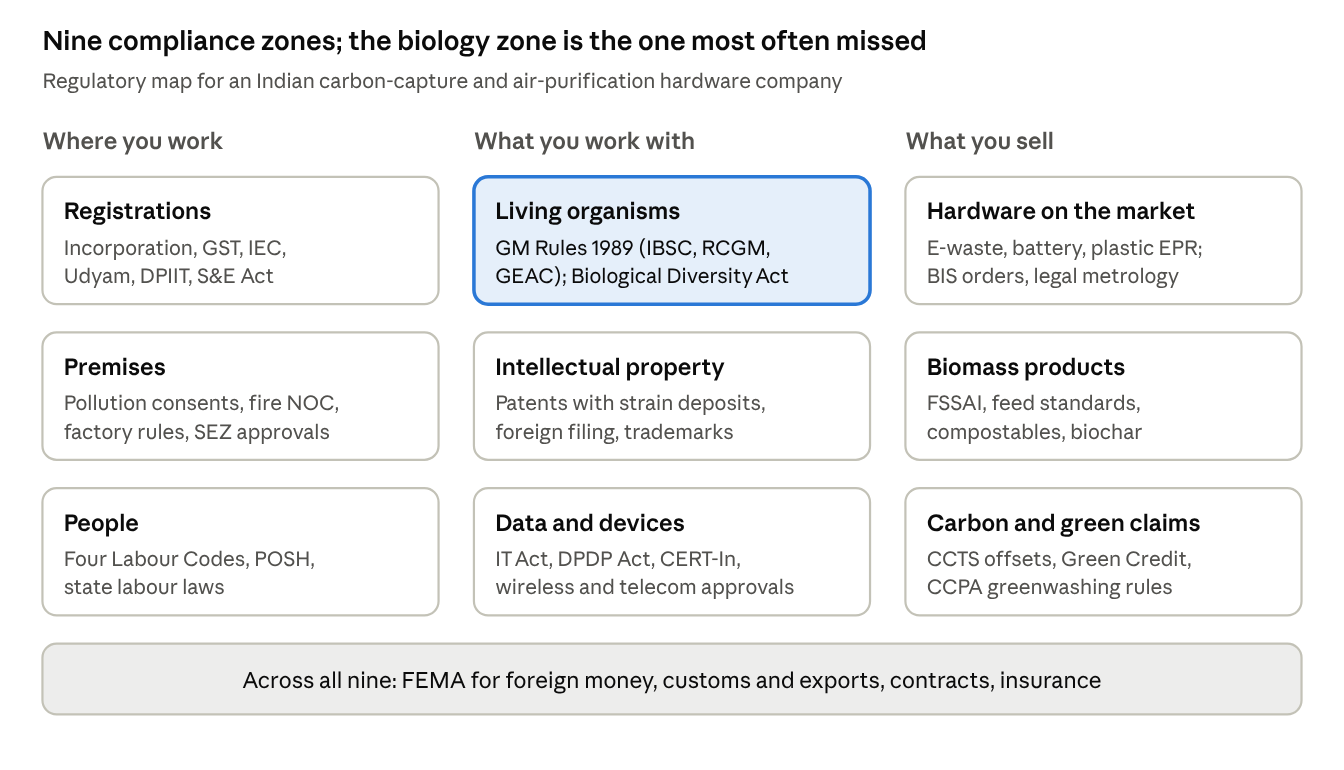
Regulatory map · Indian carbon-capture hardware company, November 2026
The highlighted zone, living organisms, is where a carbon-capture company differs most from an ordinary hardware maker, and where generalist checklists most often stop short.
1. Business registrations: the foundation layer
Every premises, every state and every activity can trigger its own registration; the commonest diligence finding is not a missing licence but one registration that no longer matches what the business actually does.
Registration | Law | What it requires | When it applies |
|---|---|---|---|
Certificate of incorporation, PAN, TAN | Companies Act, 2013; Income-tax law | Keep originals; objects clause should cover all current activities | Always |
GST registration | CGST Act, 2017 | One registration per state where you supply from; add each place of business | Turnover above threshold, or any inter-state supply |
Importer-Exporter Code (IEC) | Foreign Trade (D&R) Act, 1992 | Update annually on the DGFT portal | Any import of components or export of systems |
Udyam registration | MSMED Act, 2006 | One registration per PAN; add every unit; describe activity accurately | To claim MSME status and exemptions |
DPIIT startup recognition | Startup India scheme | Apply online with incorporation and innovation details | To claim startup patent-fee concessions, tax benefits, procurement relaxations |
Shops and establishments registration | State S&E Act (e.g. Tamil Nadu Shops and Establishments Act, 1947) | Register each office, lab or workshop | Each establishment, subject to state thresholds |
Trade licence | Municipal law of the area | Local body licence for the premises use | Most cities, for commercial or industrial use |
Where companies slip
- Two Udyam numbers for one company. Udyam allows only one registration per PAN; a second unit is added to the first, not registered separately.
- Wrong activity on record. A Udyam or GST record showing "manufacturing" from the first day, when the company has only done R&D and assembly, undermines later positions on pollution category and factory status.
- No DPIIT certificate, but startup patent fees paid. Startup fee concessions under the Patents Rules need proof of recognition; without it, the fee shortfall must be made good.
- GST registered only at the registered office. The workshop in another state, where goods are dispatched from, needs its own registration.
What to do
- List every premises and what happens there today.
- Map each to GST, S&E, trade licence and Udyam.
- Merge duplicate Udyam records and correct activity descriptions.
- Keep a one-page registration register with numbers, dates and renewal triggers.
MSME status matters more than it looks. From 1 April 2025, a micro enterprise is one with investment up to ₹2.5 crore and turnover up to ₹10 crore. Several EPR regimes exempt micro (and some small) enterprises, so your Udyam classification can switch obligations on or off.
2. Environmental approvals: consents, colours and clearances
Two separate systems decide whether a facility needs environmental permission, and companies often confuse them: environmental clearance under the EIA Notification depends on whether the activity is listed in its Schedule; consent to establish and operate under the Water and Air Acts depends on the CPCB colour category.
System 1: Environmental clearance (EIA Notification, 2006)
Projects listed in the Schedule need prior environmental clearance before any construction or land preparation. The Schedule works by sector and scale (mining, thermal power, chemicals, and building projects of 20,000 sq m built-up area and above, for example). It does not use Red, Orange, Green or White colours.
System 2: Consent to establish and operate (Water Act s.25; Air Act s.21)
The State Pollution Control Board grants a consent to establish (CTE) before you set up and a consent to operate (CTO) before you start. The CPCB groups industrial sectors into five colours by pollution potential:
Category | What it means | Consent position |
|---|---|---|
Red | Highest pollution potential | CTE and CTO; CTO valid up to 5 years |
Orange | Moderate | CTE and CTO; CTO valid up to 10 years |
Green | Low | CTE and CTO; CTO valid up to 15 years |
White | Practically non-polluting | No CTE or CTO since the MoEFCC notifications of 12 November 2024; intimation to the SPCB instead |
Blue | Essential environmental services (e.g. waste processing) | As notified |
The White list has been revised several times since November 2024, most recently in 2026, so always check the current version (Corpseed summary). Most White entries carry conditions, such as "completely dry process" or "no heat treatment, surface finishing or painting".
Mapping a carbon-capture business
Activity | Likely position | Watch for |
|---|---|---|
Dry assembly of pumps, LEDs, sensors and controllers | White: electrical and electronic assembly (dry process) | Any soldering bath, washing or coating step can take you out of White |
Light fabrication without heat treatment or painting | White: engineering and fabrication (dry) | Laser welding, powder coating or painting in-house may change the category |
Microalgae culture lab, strain testing, photobioreactor trials | Not specifically listed | Ask the SPCB for a category determination in writing |
Pilot pyrolysis or biochar unit | Often Orange or Red, depending on feedstock and scale | Needs CTE before you build |
Diesel generator set | Counted in the premises' consent; must meet CPCB emission and noise norms | Often forgotten in a White-category intimation |
Hazardous waste
Used oil from pumps and generators, empty chemical containers and lab reagents can be hazardous waste under the Hazardous and Other Wastes Rules, 2016. White-category units are spared the separate authorisation but must still hand such waste only to authorised recyclers or disposers, and keep the records.
Where companies slip
- Calling themselves "Green category" without any SPCB classification, then discovering the correct answer is White (needing intimation) or Orange (needing consent).
- Assuming the lab is covered because the assembly area is White.
- Signing a lease and fitting out a new production unit before obtaining CTE. "Establish" includes taking steps to establish.
- Relying on the colour category to rule out environmental clearance, which is a different test.
What to do
- Write down every process at each site, including the lab, generators and any heating, washing or coating step.
- Match each to the current CPCB list; where nothing fits, ask the SPCB for a written determination.
- File the White-category intimation, or apply for CTE before fitting out and CTO before starting.
- For a new plant, check the EIA Schedule separately, including the built-up area of the building.
Penalties: After the Jan Vishwas amendments, most Water, Air and EP Act breaches attract monetary penalties of up to ₹15 lakh imposed by an adjudicating officer, and the CPCB or NGT can add environmental compensation. Operating without consent can also lead to closure directions.
3. Working with living organisms: biosafety and biodiversity
If your carbon-capture system runs on microalgae or bacteria, two questions decide a whole layer of regulation: how was the strain made, and where did it come from. Investors increasingly ask both, because a "mutated" or "engineered" strain in a patent title is a flag in itself.
Question 1: How was the strain made? (GM Rules, 1989)
The Rules for the Manufacture, Use, Import, Export and Storage of Hazardous Micro-organisms, Genetically Engineered Organisms or Cells, 1989, made under the Environment (Protection) Act, apply to genetically engineered organisms. "Genetic engineering" under Rule 3(iv) covers inserting heritable material made outside the cell, and modifying an organism by deleting or removing parts of its heritable material.
Body | Where it sits | Role |
|---|---|---|
Institutional Biosafety Committee (IBSC) | Inside your organisation or host institute | First-level review of any GE research; registered on the DBT's biosafety portal |
Review Committee on Genetic Manipulation (RCGM) | Department of Biotechnology | Approves risk-category research, imports and exports of GE material for research |
Genetic Engineering Appraisal Committee (GEAC) | MoEFCC | Approves large-scale use, release, manufacture and sale of GE organisms and products (Rule 7) |
How the strain was developed | Likely position |
|---|---|
Wild-type, isolated from nature | Outside the GM Rules (but see Question 2) |
Classical random mutagenesis (UV, chemical) or adaptive evolution | Generally treated as outside, but keep lab records proving the method |
Genome editing (e.g. CRISPR) | Treat as inside; India's 2022 exemption for SDN-1 and SDN-2 edits was written for plants, so confirm the position for microbes with the RCGM |
Inserted foreign genes (transgenic) | Inside: IBSC and RCGM for research; GEAC before any commercial use or open deployment |
Example: A startup's patent claims a fast-growing Nannochloropsis strain with "enhanced CO2 uptake". If the improvement came from UV exposure and selection in the lab, the GM Rules are unlikely to bite, but the company must prove it with dated lab notebooks. If the same improvement came from an inserted carbon-fixation gene, deploying those bioreactors on customer rooftops without GEAC approval would be a serious breach.
Question 2: Where did the strain come from? (Biological Diversity Act, 2002)
Micro-organisms are "biological resources" under the BD Act. After the 2023 amendment (in force 1 April 2024) and the Access and Benefit Sharing Regulations notified on 30 April 2025:
Situation | Requirement | Section |
|---|---|---|
Indian company (not foreign-controlled) obtains an Indian resource for commercial use | Prior intimation to the State Biodiversity Board; deemed approved if no reply in 15 days | s.7 |
Foreign-controlled company obtains an Indian resource | Prior approval of the National Biodiversity Authority | s.3 |
Patent based on research on an Indian resource | NBA clearance before the patent is granted | s.6 |
Benefit sharing | As fixed by the authority; applicants with turnover up to ₹5 crore are exempt | ABS Regulations 2025 |
Breach | Penalty of ₹1 lakh to ₹50 lakh | s.55 (as amended) |
A strain bought from a foreign culture collection is not an Indian biological resource, but the collection's material transfer agreement may restrict commercial use, which matters just as much to an investor.
Watch the FDI trigger. Taking foreign investment can turn an Indian company into a "foreign-controlled company" under the BD Act, moving it from an SBB intimation to NBA approval for the same strain.
Where companies slip
- No written record of how a patented strain was developed.
- Strains obtained informally from a university lab with no transfer agreement.
- No SBB intimation before the first commercial sale of a system using an Indian isolate.
- A patent application filed on an Indian strain without planning for NBA clearance before grant.
What to do
- Build a strain register: name, source, date, method of development, transfer terms, products using it.
- Get a biosafety expert's written view on whether any strain is genetically engineered; if so, set up or join an IBSC immediately.
- File SBB intimations for Indian-origin strains used commercially; plan NBA clearance for patents.
- Recheck the BD Act route before any foreign investment closes.
4. Hardware on the market: EPR, standards and certifications
The moment a bioreactor, purification tower or sensor unit is sold under your brand, you can become a "producer" under three EPR regimes and a regulated seller under product-standards law, even if every component was made by someone else.
Extended producer responsibility (EPR)
Regime | Who is a producer | Core duties | Current carve-out |
|---|---|---|---|
E-Waste (Management) Rules, 2022 | Anyone selling electrical and electronic equipment under its own brand, including equipment assembled by others; importers | Register on the CPCB portal; meet EPR targets; file returns; comply with hazardous-substance limits (Rule 16) | Rule 2(c) excludes micro enterprises under the MSMED Act |
Battery Waste Management Rules, 2022 | Anyone selling batteries, including inside equipment, under its own brand; importers of batteries or battery-containing equipment | Register in Form 1(A); collection and recycling targets; annual return by 30 June | No micro-enterprise carve-out |
Plastic Waste Management Rules, 2016 (Schedule II) | Producers, importers and brand owners of plastic packaging | Register on the CPCB portal; EPR targets; annual returns | Brand owners that are micro or small enterprises are excluded; importers are not |
Example: A company ships a rooftop purification tower with a third-party lithium battery pack for solar backup. The battery maker has its own EPR registration, but the tower is sold under the company's brand, so the company should check whether it is the producer for that battery under the Battery Rules. If it imports the pack, it almost certainly is.
Product standards and radio approvals
Requirement | Law | Typical trigger in this business |
|---|---|---|
BIS licence or registration | BIS Act, 2016; Quality Control Orders; Electronics and IT Goods (Requirements for Compulsory Registration) Order, 2021 | LED luminaires and drivers, power adapters, displays and other notified items sold or imported under your brand |
Equipment Type Approval (WPC) | Indian Telegraph and Wireless Telegraphy law; Telecommunications Act, 2023 | Wi-Fi, Bluetooth or other radio modules in telemetry units |
MTCTE certification | Telecom equipment testing regime run by the TEC | Equipment in notified categories, such as some cellular customer-premises gear; check whether your 4G gateway falls in a notified category |
Legal metrology | Legal Metrology (Packaged Commodities) Rules, 2011 | Retail packages; sales to institutional or industrial buyers are largely exempt |
We are not aware of a Quality Control Order covering air purifiers as a category at the date of this guide, but components inside them may be covered, and the BIS list changes often, so check it before each new product. Selling a notified product without the BIS mark is an offence, and imports are held at customs.
Product liability
Chapter VI of the Consumer Protection Act, 2019 makes a manufacturer liable for harm caused by a defect in design, manufacture or warnings. Business buyers acting for commercial purposes are often not "consumers" under the Act, but contract claims and tort still apply. A pump failure that floods a client's lobby is a contract and insurance problem whatever the label.
Where companies slip
- "We outsource manufacturing, so EPR isn't ours." Brand ownership, not factory ownership, decides it.
- Relying on the micro-enterprise exemption without tracking when turnover or investment will cross the limit.
- Importing LED panels or adapters without checking BIS registration.
- Adding a cellular telemetry module without checking WPC and MTCTE.
What to do
- Build a bill of materials for each product and flag every battery, radio module and notified electronic item.
- Decide, product by product, whether you are the producer under each EPR regime, and register before sale where you are.
- Diary the date your MSME classification is likely to change.
- Buy notified components only from BIS-registered suppliers, and keep the certificates.
5. Turning captured carbon into products
Captured CO2 becomes biomass, and biomass becomes something you sell: each end product brings in its own regulator, and none of them cares that the input was climate-positive.
Product | Main law | What it requires | Watch-out |
|---|---|---|---|
Algae protein or ingredient for human food | Food Safety and Standards Act, 2006; FSSAI licence; Approval of Non-Specified Food and Food Ingredients Regulations, 2017 | FSSAI licence for manufacture; product approval if the species or ingredient is not already standardised or permitted | Some algae (e.g. spirulina) are already used in permitted categories; a new strain or novel processing may need fresh approval |
Algae biomass for animal or fish feed | BIS feed standards; state and sector rules (e.g. coastal aquaculture input rules) | Meet the applicable standard; register inputs where a sector regulator requires it | Feed claims ("boosts immunity") can be treated as drug claims |
Bioplastics (compostable or biodegradable) | Plastic Waste Management (Amendment) Rules, 2024 | CPCB certificate before marketing compostable or biodegradable items; labels such as "compostable only under industrial composting" and conformity to IS/ISO 17088:2021 (MBG summary) | "Biodegradable" must state the days and environment in which it degrades |
Biochar sold as a soil input | Fertiliser (Control) Order, 1985 (made under the Essential Commodities Act) | If it is sold as a fertiliser, soil conditioner or biostimulant, check whether it must meet a notified specification or registration | Selling an unregistered fertiliser can be an offence |
Pyrolysis units for biochar | Water and Air Acts; CPCB category | CTE and CTO; usually not White | Supplying a pyrolysis kit to a customer's site makes the customer the occupier, but your contract should allocate who gets the consent |
Where companies slip
- Pitching "edible protein from captured carbon" to investors before any FSSAI pathway is mapped.
- Labelling a bio-based product "biodegradable" without the 2024 certification and labelling.
- Selling biochar to farmers with agronomic claims and no regulatory check.
What to do
- For each end product, name the regulator and the approval before you sign an offtake deal.
- Budget time: food and feed approvals can take many months.
- Put regulatory responsibility for customer-site units (consents, operation, waste) in the supply contract.
6. Carbon markets and green claims
For a carbon-capture company, the claim is part of the product. "Captures 2 tonnes of CO2 a year" or "equal to 100 trees" is now a regulated statement, and selling carbon credits is a regulated activity with its own registry.
The Indian carbon market
Element | What it is | Relevance |
|---|---|---|
Carbon Credit Trading Scheme, 2023 | Notified under the Energy Conservation Act, 2001; administered by the Bureau of Energy Efficiency (BEE) | Creates Carbon Credit Certificates (CCCs) traded on power exchanges |
Compliance mechanism | Emission-intensity targets for obligated industrial sectors | Your heavy-industry customers may need reductions or credits |
Offset mechanism | Non-obligated entities register projects, get validated by accredited verification agencies and earn CCCs (K&S summary) | Your route to Indian credits, but only under an approved methodology |
Approved methodologies | The first set approved in 2025 covered renewable energy, green hydrogen, industrial energy efficiency, landfill methane and mangroves (Energetica India) | Check whether a methodology exists for your technology before promising credits |
Green Credit Programme | Green Credit Rules, 2023 under the EP Act | Early activities focus on plantation and water, not industrial capture |
Voluntary and international markets (international registries, biochar-specific standards) remain open to Indian projects, but credits transferred abroad for another country's targets need Indian government authorisation under Article 6 of the Paris Agreement.
The CCPA greenwashing guidelines
The Central Consumer Protection Authority's Guidelines for Prevention and Regulation of Greenwashing or Misleading Environmental Claims, 2024 require environmental claims to be clear, specific and backed by verifiable evidence:
Claim | Risky version | Safer version |
|---|---|---|
Capture | "Removes carbon from the air" | "Captured 1.8 t CO2 in 12 months at site X, measured by method Y, verified by Z" |
Tree equivalence | "Equal to 100 trees" | State the tree species, age and assumption behind the comparison, with a link to the calculation |
Air quality | "Removes 99% of pollution" | "Reduced PM2.5 by N% in a test chamber of V m³ under conditions C (NABL-accredited lab report)" |
Offsets | "Carbon-neutral installation" | Disclose what is reduced on site and what is offset, and which credits were retired |
Future targets | "Net zero by 2030" | Publish the plan, milestones and interim progress |
Breaches are misleading advertisements under the Consumer Protection Act, 2019; the CCPA can order corrective advertising and impose penalties (up to ₹10 lakh, and up to ₹50 lakh for repeat breaches, under s.21).
Where companies slip
- Website and pitch-deck capture numbers taken from lab conditions, not field data.
- Promising customers "carbon credits" without an approved methodology or registry.
- Selling the same tonne twice: once as a customer's ESG claim and again as a credit.
What to do
- Keep a claims register: every public number, its source, test method and date.
- Get capture and air-quality numbers tested by an accredited lab or verifier.
- In customer contracts, say who owns the carbon attributes of each installation.
7. Premises: factory status, fire, buildings and SEZs
The move from a lab-and-assembly unit to a production facility is when premises law starts to bite, and many of the approvals must be in hand before the first machine is installed.
Requirement | Law | When it applies |
|---|---|---|
Factory registration and licence | Occupational Safety, Health and Working Conditions Code, 2020 (in force 21 November 2025); state rules | 20+ workers with power, or 40+ without, in a manufacturing process (up from 10 and 20 under the Factories Act, 1948), unless an older state threshold still applies (Taxmann) |
Establishment registration | OSH Code | 10+ workers |
Fire NOC or licence | State fire service law (e.g. Tamil Nadu Fire Service Act, 1985, s.13) | Depends on building height and area, and on materials stored |
Gas cylinder storage licence | Gas Cylinders Rules, 2016 (Explosives Act) | Storing compressed CO2 or other gas cylinders above the exemption limits; growth systems often use CO2 |
Building plan approval and completion or occupancy certificate | State town-planning law and building rules | Any construction or change of use; land zoned for the activity |
SEZ Letter of Approval | SEZ Act, 2005 and SEZ Rules, 2006 | Any unit inside an SEZ; the approved activity must match what you do |
Lease registration and stamp duty | Registration Act, 1908; state stamp law | Leases longer than 11 months; landlord consent for industrial use |
SEZ trap: Many SEZs in Indian cities are IT or ITES zones. A hardware-assembly or production line in an IT SEZ may fall outside what the zone and your Letter of Approval permit. Check the zone's notified sector and get the Development Commissioner's approval for manufacturing before you sign a long lease.
What to do
- Count workers (including contract workers) at each site against the factory and establishment thresholds.
- For a new facility, sequence approvals: land use and building plan, fire NOC, pollution CTE, then factory licence, then CTO.
- Keep the building's occupancy certificate and the landlord's consent for industrial use on file.
8. People: the Labour Codes era
Since 21 November 2025, the four Labour Codes — Code on Wages, Industrial Relations Code, Code on Social Security and OSH Code — have replaced 29 older laws, and diligence now tests compliance under both regimes either side of that date.
Obligation | Law | Threshold or trigger |
|---|---|---|
Provident fund registration and contributions | Code on Social Security, 2020 | 20+ employees |
ESI registration and contributions | Code on Social Security | 10+ employees; covers employees up to the wage ceiling |
Gratuity | Code on Social Security | After 5 years' service; after 1 year for fixed-term employees |
Maternity benefit, crèche | Code on Social Security | 26 weeks' leave; crèche at 50+ employees |
Appointment letters, health and safety duties | OSH Code | All workers in covered establishments |
Contract-labour licence | OSH Code | Contractors engaging 50+ contract workers |
Wage definition (50% rule), timely payment | Code on Wages, 2019 | All employees |
Internal Committee and annual report | POSH Act, 2013 | 10+ employees |
Shops and establishments, professional tax, labour welfare fund | State laws | Varies by state |
Field installation crews
A large share of carbon-capture installation happens on customer rooftops and campuses. Those crews:
- are your employees or your contractor's, and the customer may be the "principal employer" for contract labour;
- work at height and with electrical systems, so safety training and insurance (employees' compensation, public liability) matter;
- may fall within building and other construction work if installations involve structural work, which brings in registration and cess under the Codes.
Where companies slip
- 30+ people on payroll but no PF registration because "most are interns or consultants".
- No Internal Committee under POSH, or one without an external member.
- Salary structures where allowances exceed 50% of pay, shrinking contributions under the new wage definition.
What to do
- Reconcile the payroll headcount (including interns, consultants and contract staff) against each threshold.
- Register under PF and ESI where due and pay arrears with interest before investors ask.
- Constitute or refresh the POSH Internal Committee and file the annual report.
- Re-cut salary structures for the 50% wage rule.
9. Intellectual property: the asset investors are really buying
In deep-tech climate companies the patents, strains and software are often most of the value, so IP diligence asks two questions: does the company actually own it, and was it filed in a way that will survive?
Patents involving biological material
Requirement | Patents Act, 1970 | What it means for you |
|---|---|---|
Micro-organisms can be patented | s.3(j) excludes plants and animals but not micro-organisms | A novel, inventive strain or process can be protected |
Disclose source and origin | s.10(4)(d)(ii) | State where the biological material came from |
Deposit the strain | s.10(4)(d)(ii) | Deposit with an International Depositary Authority (in India, e.g. the Microbial Type Culture Collection, Chandigarh) if the material is not publicly available |
NBA clearance | BD Act s.6 | Needed before grant if the strain came from India |
Foreign filing permission | s.39 | An Indian resident must get permission (Form 25), or file in India and wait six weeks, before filing abroad; breach can mean abandonment of the Indian application and criminal penalties |
Startup fee concessions and expedited examination | Patents Rules, 2003 | Need DPIIT recognition (Form 28) |
Ownership: the quiet killer
- Founders and employees. Applications filed in a founder's name, or inventions made before incorporation, must be assigned to the company in writing and recorded with the Patent Office.
- Incubators and universities. Incubation and research agreements often give the institute a share of IP, a licence or a right to publish. Read them before claiming sole ownership.
- Contract manufacturers and designers. Designs, moulds and firmware made by vendors need written assignment.
- Grants. Government research grants can carry conditions on IP ownership and licensing.
Trademarks, software and domains
- Use ® only once a mark is registered; falsely representing a mark as registered is an offence under s.107 of the Trade Marks Act, 1999.
- File in every class you trade in (devices, software, services).
- Keep source code in company-controlled repositories, check open-source licences in firmware, and register domains in the company's name.
10. Data and connected devices
A connected purification tower that streams air-quality data to a cloud dashboard is an IT system, a wireless device and, once it touches people's data, a data-processing operation.
Obligation | Law | Status and trigger |
|---|---|---|
Privacy policy, grievance officer, reasonable security | IT Act, 2000 s.43A; SPDI Rules, 2011 | Now, for any sensitive personal data collected |
Notice, consent, purpose limits, security, breach reporting, data-principal rights | Digital Personal Data Protection Act, 2023 and DPDP Rules, 2025 (notified 13 November 2025) | Most substantive duties apply from May 2027; consent-manager rules from November 2026 (AZB) |
Report cyber incidents within 6 hours; keep logs for 180 days in India | CERT-In Directions, 28 April 2022 | Now, for service providers and body corporates |
Platform duties (terms, takedown, grievance) | Intermediary Guidelines, 2021 | Only if you host user content, e.g. a public dashboard or community app |
SIMs in devices | Telecom rules on M2M connectivity | Use licensed M2M SIMs; keep device KYC records |
Is air-quality data personal data? Usually not on its own. It becomes personal data when linked to an identifiable person: the app user's login, a camera on a public display, a building occupant's location. Design dashboards so the two can be separated.
What to do
- Map what each device and app collects; separate environmental data from personal data.
- Update the privacy policy, appoint a grievance officer, and set a DPDP readiness plan for May 2027.
- Write a 6-hour incident-reporting runbook.
11. Money and trade
Foreign investment, imported components and export orders each bring their own paperwork, and some of it reaches back into the biology and IP rules above.
Area | Law | Key requirements |
|---|---|---|
Foreign investment | FEMA (Non-Debt Instruments) Rules, 2019 | Most manufacturing is on the automatic route; issue at not less than fair value; report allotment in Form FC-GPR within 30 days |
Investors from land-border countries | Press Note 3 (2020) | Government approval before investment, including indirect investment |
After foreign investment | BD Act s.3; downstream investment rules | May become a foreign-controlled company needing NBA approval for Indian biological resources |
Overseas subsidiaries or offices | FEMA (Overseas Investment) Rules, 2022 | Report the investment through the AD bank |
Imports | Customs Act, 1962; BIS orders | Notified electronics need BIS registration even when imported |
Exports | Foreign trade policy; FEMA export rules | IEC; realise export proceeds within the RBI-prescribed period; GST letter of undertaking for zero-rated exports |
Government and PSU buyers | GeM; Public Procurement (Make in India) Order, 2017 | Local-content declarations; DPIIT startups often get relaxed turnover and experience criteria |
R&D contracts with public-sector buyers often say who owns the IP in a proof-of-concept unit. Read those clauses before reusing the design for other customers.
12. The toolkit: penalties, red flags, checklist and FAQs
Penalty snapshot
Law | Exposure |
|---|---|
Water Act, Air Act, EP Act (after Jan Vishwas amendments) | Penalties up to ₹15 lakh; environmental compensation; closure directions |
Biological Diversity Act, s.55 | ₹1 lakh to ₹50 lakh, plus continuing penalties |
E-Waste, Battery and Plastic EPR rules | Environmental compensation set by the CPCB |
BIS Act, 2016 | Fines from ₹2 lakh up to ten times the value of goods, and possible imprisonment, for selling notified goods without the mark |
Patents Act, s.39 breach | Indian application treated as abandoned; criminal penalty under s.118 |
Consumer Protection Act, s.21 (misleading claims) | Up to ₹10 lakh; up to ₹50 lakh for repeat breaches |
DPDP Act, 2023 | Up to ₹250 crore for failing to protect personal data |
Code on Social Security | Arrears with interest and damages; prosecution for persistent default |
Ten red flags investors look for
- Pollution category self-assessed, with no SPCB intimation or consent on file.
- A lab culturing organisms with no category determination.
- "Mutated" or "engineered" strains with no development records.
- Indian-origin strains used commercially with no SBB intimation.
- Branded hardware sold with no EPR analysis.
- Notified electronics or radio modules without BIS, WPC or MTCTE checks.
- Capture or air-quality claims with no test report.
- Patents filed in founders' names, or abroad without s.39 permission.
- Headcount above PF, ESI or POSH thresholds without registrations.
- A new production site leased or fitted out before CTE and building approvals.
Compliance checklist
- ☐ Registration register: GST per state, one Udyam with all units, DPIIT, S&E, trade licences
- ☐ CPCB category confirmed for every site and process, including the lab and DG sets
- ☐ White intimation filed, or CTE and CTO obtained; EIA Schedule checked for new sites
- ☐ Hazardous waste handed only to authorised recyclers, with records
- ☐ Strain register with source, method and transfer terms; biosafety opinion obtained
- ☐ SBB intimation or NBA approval as applicable; NBA clearance planned for patents
- ☐ EPR producer analysis for e-waste, batteries and packaging; MSME status tracked
- ☐ BIS, WPC and MTCTE checks for each product's bill of materials
- ☐ Food, feed, bioplastic or fertiliser approvals mapped for every biomass product
- ☐ Claims register with test reports; carbon-attribute ownership set out in contracts
- ☐ Factory, fire, building, gas cylinder and SEZ approvals sequenced for each site
- ☐ Labour Code registrations, wage structures and POSH Internal Committee current
- ☐ IP assigned to the company; s.39 permissions; strain deposits; trademark use correct
- ☐ Privacy policy, grievance officer, CERT-In runbook, DPDP plan for May 2027
- ☐ FEMA filings complete; BD Act status rechecked before any foreign investment
FAQs
We only do R&D and assembly. Do we need pollution consent? Possibly not, if every activity is on the White list; you then file an intimation instead. But a microalgae lab is not listed, so get a written determination.
We outsource manufacturing. Are we a producer for EPR? Usually yes: selling under your own brand makes you the producer, subject to the micro-enterprise carve-outs where they exist.
Is a mutated strain a GMO? Not automatically. Classical mutagenesis is generally outside the GM Rules; genetic engineering, including inserted genes, is inside. Keep the records that prove which.
Can we sell Indian carbon credits from our installations? Only through the offset mechanism, under an approved methodology, after validation and registration. Check the BEE's current list before you promise credits.
We have 15 people at our workshop. Is it a factory? Under the OSH Code a factory using power needs 20 or more workers, unless an older state threshold still applies. You will still be an establishment at 10+ workers.
References and further reading
Environment and biology
- MoEFCC revises White category list (Corpseed)
- Reviewing the Access and Benefit Sharing Regulations, 2025 (LiveLaw)
- Plastic Waste Management (Amendment) Rules, 2024 (MBG Corp)
Carbon and claims
- Offset mechanism under the Carbon Credit Trading Scheme (K&S Partners)
- Government approves offset methodologies (Energetica India)
- CCPA greenwashing guidelines, 2024 (Mondaq)
Labour, data and devices
- OSH Code applicability and factory thresholds (Taxmann)
- Labour Codes notified with effect from 21 November 2025 (Mondaq)
- DPDP Act phased rollout (AZB & Partners)
- DoT enforces MTCTE certification from August 2025 (Aleph India)
All examples are hypothetical and do not describe any particular company.