
The 30-second version
A private limited company in India can buy back its own shares, but only through one door: Section 68 of the Companies Act, 2013, read with Rule 17 of the Share Capital and Debentures Rules, 2014. Walk through that door correctly and the company returns cash, cleans up its cap table and gives shareholders an exit, all without going to the NCLT. Miss one step and the buyback is open to challenge, with fines on the company and every officer in default.
And since 1 April 2026, the tax rules flipped again: buyback money is once more taxed as capital gains in the shareholder's hands, with an extra levy on promoters. More on that plot twist in the tax section.
Picture it like this
Imagine a cricket club owned by 10 friends who each chipped in. Five years later, the club has more cash than it needs, and two friends want to move on. Instead of finding outsiders to buy their stake, the club itself pays them out and tears up their membership cards. The remaining eight now own a bigger slice of the same club.
That is a buyback. The club (company) pays from its savings (free reserves), the cards are destroyed (shares extinguished), and the remaining owners' percentage goes up.
Why private companies actually do it
- Founder or investor exit. An early angel wants out and there is no IPO in sight.
- ESOP liquidity. Employees with vested shares want cash; buybacks are one of the routes Indian startups use.
- Returning surplus cash. A profitable family company with idle reserves gives money back to members.
- Consolidating control. Buying out a dissenting minority so the remaining shareholders hold more.
- Cap-table clean-up before a fund-raise. Fewer, cleaner holders make a new investor's diligence easier.
What you'll walk away with
- The exact legal tests (sources, limits, cooling periods) with a worked example for each.
- A step-by-step calendar from board meeting to final ROC filing, with every form named.
- The accounting entries, including the Capital Redemption Reserve.
- The 2026 tax regime with numbers, for ordinary shareholders and for promoters.
- FEMA rules if any shareholder lives abroad.
- A checklist, myths vs facts, and FAQs you can hand to your CS.
Note: This guide is general information, not legal or tax advice. Rules are as of the date above; confirm the current position with a company secretary, chartered accountant or lawyer before acting.
The legal map: which rules apply
Four bodies of law touch a private company buyback; the Companies Act sets the gate, and tax and FEMA decide what it costs and how money moves.
Law | What it governs | Key provisions |
|---|---|---|
Power to buy back, sources of funds, limits, modes, solvency, extinguishment, register, return | s.68(1)–(11) | |
Transfer to Capital Redemption Reserve | s.69(1)–(2) | |
When a buyback is banned | s.70(1)–(2) | |
Procedure for private and unlisted public companies: disclosures, SH-8, SH-9, offer period, payment, SH-10, SH-11 | Rule 17(1)–(14) | |
Income-tax Act, 2025 (as amended by Finance Act, 2026) | Tax on the shareholder; promoter additional tax | s.69 |
FEMA (Non-Debt Instruments) Rules, 2019 | Pricing and reporting when a shareholder is non-resident | Rules 9, 21; Form FC-TRS |
Three ideas that unlock everything else
1. Section 68 is a deliberate exception. Section 67 generally bars a company from buying its own shares. Section 68 opens with "notwithstanding anything contained in this Act", which is why a buyback reduces capital without the NCLT confirmation that a capital reduction under s.66 needs. Section 66(6) says so expressly.
2. SEBI's buyback regulations do not apply. The SEBI (Buy-back of Securities) Regulations, 2018 govern listed shares only, through s.68(2)(f). A private company follows s.68(2)(g) and Rule 17 instead.
3. Rule 17 is the playbook. Rule 17 opens by saying its norms apply to private companies and unlisted public companies. Almost every date in your timeline comes from it.
Key definitions you'll keep bumping into
- Buy-back: the company purchasing its own shares or other specified securities under s.68(1).
- Specified securities: includes employees' stock options, per Explanation I to s.68.
- Free reserves: reserves available for dividend per the latest audited balance sheet, excluding unrealised or notional gains and revaluation reserves (s.2(43)). For s.68 only, it includes securities premium (Explanation II).
- Paid-up capital: the capital actually paid on issued shares.
Quick check: Is "Section 66 capital reduction" the same as a buyback? No. Section 66 needs a special resolution plus NCLT confirmation and can be done even without free reserves. Section 68 is faster, but you must pass every s.68 test. The comparison section lays them side by side.
Where the money can come from (s.68(1))
A buyback may be funded from only three pockets: free reserves, the securities premium account, or the proceeds of a fresh issue of a different kind of security. Borrowed money from banks or financial institutions is off-limits under Rule 17(10)(e).
Pocket 1: Free reserves
Retained profits and general reserves that could legally be paid as dividend, per the latest audited balance sheet.
Not free reserves, so not usable:
- Revaluation reserve (a property re-valued from ₹5 crore to ₹9 crore does not create ₹4 crore of spendable reserve).
- Unrealised fair-value gains sitting in equity.
- Capital Redemption Reserve and other reserves the law ties to a specific purpose.
Example 1 — The revaluation trap. Sunrise Foods Pvt Ltd shows ₹6 crore of "reserves": ₹2.5 crore retained earnings and ₹3.5 crore revaluation reserve on its factory land. Its free reserves for buyback purposes are ₹2.5 crore, not ₹6 crore.
Pocket 2: Securities premium
The extra amount investors paid above face value. If a Series A investor paid ₹510 for a ₹10 share, ₹500 per share sits in securities premium, and it can fund a buyback.
Example 2 — Startup with no profits. BrightLoop Tech Pvt Ltd has accumulated losses but ₹40 crore of securities premium from past rounds. It can still fund an ESOP buyback from the premium account, provided it clears every other s.68 test, including the solvency declaration.
Pocket 3: Proceeds of a fresh issue, but never the same kind
The proviso to s.68(1), repeated in Rule 17(10)(f), forbids using money from an earlier issue of the same kind of shares or securities.
Example 3 — Same kind vs different kind. Kavya Logistics Pvt Ltd raised ₹8 crore by issuing preference shares in April. In September it wants to buy back equity shares.
- Using the preference-share money to buy back equity: allowed (different kind).
- Using the preference-share money to buy back preference shares: not allowed (same kind).
What's banned outright
- Bank or FI loans (Rule 17(10)(e)). A term loan drawn to pay shareholders is a clear breach.
- Paying in anything other than cash (Rule 17(10)(c)). No property, no set-off of loans, no share swaps.
Spot the problem: A promoter-director "pays himself" for his tendered shares by writing off ₹50 lakh he owes the company. Why is that a breach? Because the consideration was not paid in cash into and out of the separate buyback bank account. The fix: the company pays cash; the director repays the loan separately.
The eight tests every buyback must pass (s.68(2) and Rule 17)
Think of these as eight locks on the same door; the buyback is valid only if every one opens.
# | Test | Rule | Source |
|---|---|---|---|
1 | Articles of Association authorise buyback | Must be in the AoA; if not, amend the AoA first by special resolution | s.68(2)(a) |
2 | Right approval for the size | Board resolution if ≤ 10% of paid-up equity capital + free reserves; special resolution if above, up to 25% | s.68(2)(b) |
3 | Overall size cap | ≤ 25% of paid-up capital + free reserves | s.68(2)(c) |
4 | Equity count cap | Equity bought back in a financial year ≤ 25% of total paid-up equity capital | Proviso to s.68(2)(c) |
5 | Debt–equity after buyback | Secured + unsecured debt ≤ 2 × (paid-up capital + free reserves) | s.68(2)(d) |
6 | Fully paid shares only | Partly paid shares cannot be bought back | s.68(2)(e) |
7 | Cooling-off | No new offer within 1 year of closure of the previous offer | Proviso to s.68(2) |
8 | Finish in time | Complete within 1 year of the resolution | s.68(4) |
The running example: Saffron Software Pvt Ltd
We'll use one company for every test.
Item (latest audited balance sheet) | Amount |
|---|---|
Paid-up equity capital (20,00,000 shares × ₹10) | ₹2.00 crore |
Securities premium | ₹3.00 crore |
Retained earnings (free) | ₹5.00 crore |
Paid-up capital + free reserves | ₹10.00 crore |
Total borrowings | ₹13.00 crore |
Fair value per share (registered valuer) | ₹50 |
Test 2 — Which approval? Board route ceiling = 10% × ₹10 crore = ₹1 crore. Anything above needs a special resolution (75% of votes cast at a general meeting).
Test 3 — Overall cap. 25% × ₹10 crore = ₹2.5 crore is the absolute maximum in this round.
Test 4 — Equity count cap. 25% of paid-up equity capital = 25% × ₹2 crore = ₹50 lakh of face value = 5,00,000 shares this financial year. At ₹50 a share that is exactly ₹2.5 crore, so both caps bind together here. If the price were ₹80, the ₹2.5 crore cap would allow only 3,12,500 shares.
Test 5 — Debt–equity (the one that trips people). Suppose Saffron buys back 5,00,000 shares at ₹50 = ₹2.5 crore.
- Paid-up capital falls by ₹50 lakh to ₹1.5 crore.
- ₹2.0 crore premium paid above face value comes out of reserves, and ₹50 lakh of free reserves moves to the Capital Redemption Reserve (s.69).
- Free reserves left: ₹8 crore − ₹2 crore − ₹0.5 crore = ₹5.5 crore.
- Post-buyback paid-up capital + free reserves = ₹1.5 + ₹5.5 = ₹7 crore. Debt allowed = 2 × ₹7 crore = ₹14 crore.
- Saffron's ₹13 crore debt passes. If it had ₹15 crore of debt, the full buyback would fail, and it would need to shrink the offer or repay debt first.
Pro tip: Practitioners usually leave CRR out of "free reserves" in this calculation, since it cannot be distributed. That is the conservative way; ask your auditor which basis they will certify.
Test 7 — Cooling-off. If Saffron's last buyback offer closed on 15 March 2026, the next offer cannot be made before 15 March 2027.
Test 8 — Deadline. A special resolution passed on 10 November 2026 means the buyback must be complete by 9 November 2027.
Five more rules that run alongside
- No fresh shares during the offer. From the special resolution to offer closure, no new shares, not even bonus shares, except from existing convertibles (Rule 17(10)(b)).
- Six-month freeze after. No further issue of the same kind of shares for six months after completion, except bonus issues and subsisting obligations like ESOPs, warrants or conversions (s.68(8)).
- No U-turns. Once announced to shareholders, the offer cannot be withdrawn (Rule 17(10)(d)).
- Fresh numbers. Calculations must use audited accounts not more than six months old, or limited-reviewed unaudited accounts (Rule 17(1)(n)).
- Demat first. Private companies that are not small companies must hold securities in demat under Rule 9B; the one-time deadline was 30 June 2025, and promoter, director and KMP holdings must be in demat before a buyback.
Spot the problem: Saffron's board approves a ₹1.8 crore buyback by board resolution alone. What went wrong? ₹1.8 crore is above the ₹1 crore board-route ceiling, so a special resolution was required.
Red cards: when a buyback is banned (s.70)
Section 70 shuts the door completely in four situations, however healthy the company otherwise looks.
1. No buying through a subsidiary (s.70(1)(a))
A company cannot buy its own shares indirectly through any subsidiary.
Example: Orbit Holdings Pvt Ltd asks its 100% subsidiary, Orbit Retail Pvt Ltd, to purchase Orbit Holdings' shares from a departing founder. That is an indirect buyback through a subsidiary and is prohibited. If Orbit Holdings wants the shares gone, it must run its own s.68 buyback.
2. No buying through investment companies (s.70(1)(b))
The same applies to an investment company or a group of investment companies. Routing the purchase through a family investment vehicle that the company funds is the classic example.
3. Not while in default (s.70(1)(c))
No buyback while the company is in default on any of these:
- repayment of deposits or interest on them;
- redemption of debentures or preference shares, or interest on them;
- payment of dividend to any shareholder;
- repayment of a term loan or interest to a bank or financial institution.
The three-year rule. Once the default is cured, the company must still wait three years from the date the default ceased.
Example: Meridian Agro Pvt Ltd missed term-loan EMIs from January to June 2025 and cleared all arrears on 30 June 2025. Its earliest buyback is after 30 June 2028, even if it is cash-rich by 2026.
4. Not if basic filings are broken (s.70(2))
No buyback if the company has not complied with:
Section | What it requires |
|---|---|
s.92 | Filing the annual return (MGT-7 / MGT-7A) |
s.123 | Declaring and paying dividends correctly |
s.127 | Paying declared dividends within 30 days |
s.129 | Preparing financial statements that give a true and fair view |
Example: Lotus Interiors Pvt Ltd never filed its annual return for FY 2023-24. Until that non-compliance is made good, a buyback is barred. File the overdue return with additional fees first, then plan the buyback.
Quick win: Before the board meeting, ask your CS for a one-page "s.70 clean bill": no defaults in the last three years, all MGT-7 and AOC-4 filings up to date, and dividends (if any) paid on time. It costs a day and saves the whole transaction.
Step by step: from board meeting to the last ROC filing
Once the offer goes out, Rule 17 puts the company on a fixed clock: offer open 15 to 30 days, verification within 15 days, payment within 7 days after that, so shareholders usually see cash about 5 to 8 weeks after dispatch.
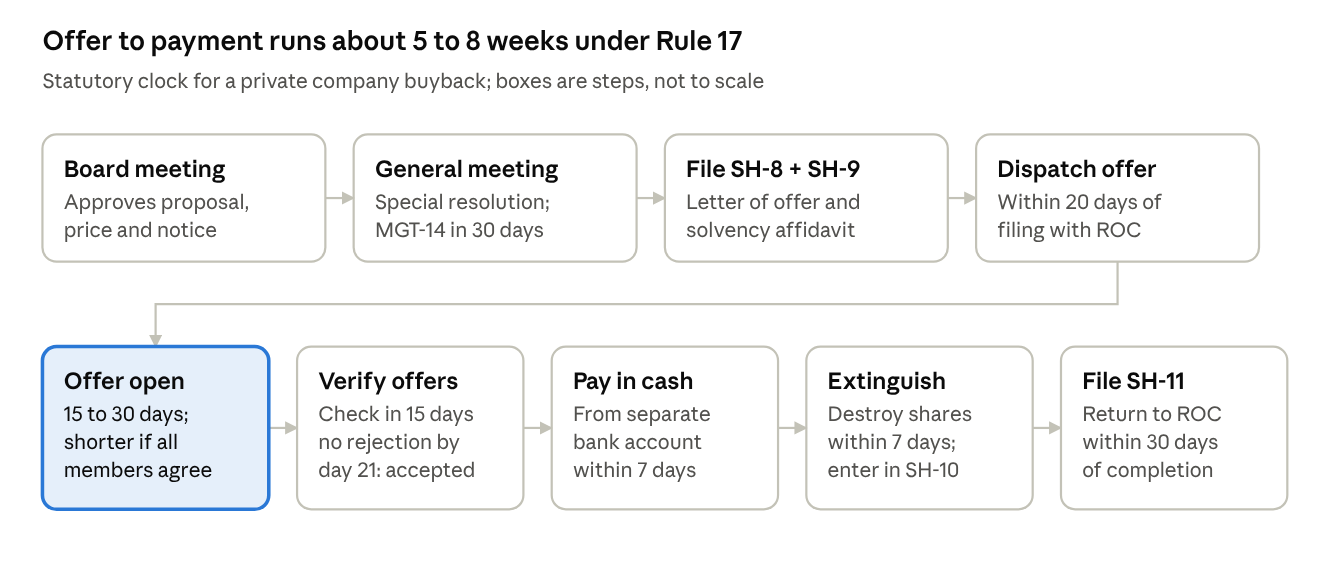
Buyback clock · s.68 and Rule 17, Companies Act 2013
The accent marks the offer window, the only stretch where shareholders act; every other box is a company deadline.
The full playbook
- Pre-flight check (week 0). Confirm the AoA allows buyback, get the s.70 clean bill, confirm demat status under Rule 9B, and make sure audited accounts are not more than six months old. Commission a valuation report to support the price.
- Board meeting. Approve the size, price, source of funds and method (proportionate offer to all holders, or purchase of ESOP/sweat-equity shares). Directors form the solvency opinion and receive the auditors' report required by Rule 17(1)(m)–(n). On the board route (≤ 10%), this resolution itself authorises the buyback. On the special-resolution route, the board approves the notice of general meeting.
- General meeting (special-resolution route only). The notice carries an explanatory statement with every item in s.68(3) and Rule 17(1)(a)–(n): objective, number of shares, price and its basis, maximum amount, source of funds, timeline, and promoter/director holdings and dealings for the past 12 months.
- MGT-14 within 30 days of the special resolution (s.117). Private companies are generally exempt from filing MGT-14 for board resolutions, so board-route buybacks usually skip this.
- File SH-8 and SH-9 with the ROC. SH-8 is the letter of offer; SH-9 is the declaration of solvency, verified by affidavit. Both are signed by at least two directors, one being the MD if there is one. Rule 17(2) ties SH-8 to the special-resolution route, but practitioners commonly file it on the board route too, because the SH-11 return expects it (TaxGuru).
- Dispatch the letter of offer to shareholders immediately, and no later than 20 days after filing (Rule 17(4)).
- Offer window: 15 to 30 days from dispatch (Rule 17(5)). If every member agrees, it can be shorter. If more shares are tendered than the company will buy, acceptance is proportionate (Rule 17(6)).
- Open the separate bank account right after the offer closes and deposit the full consideration (Rule 17(8)).
- Verify within 15 days of closure. Tendered shares are deemed accepted unless rejection is communicated within 21 days (Rule 17(7)).
- Pay within 7 days in cash (bank transfer), and return certificates for rejected or partly accepted shares (Rule 17(9)).
- Extinguish and destroy the shares within 7 days of completion (s.68(7)); for demat shares this happens through the depository. Record everything in the SH-10 register (s.68(9), Rule 17(12)).
- File SH-11 within 30 days of completion (s.68(10), Rule 17(13)). Since the 2023 amendment, the separate SH-15 compliance certificate is gone; a declaration by two directors (including the MD, if any) now sits inside SH-11.
- Housekeeping. Transfer the face value to the Capital Redemption Reserve (next section), update the register of members, and file FC-TRS if any seller is non-resident.
The forms at a glance
Form | What it is | When |
|---|---|---|
MGT-14 | Filing of special resolution | Within 30 days of the resolution |
SH-8 | Letter of offer | Before the buyback opens |
SH-9 | Declaration of solvency + affidavit | With SH-8 |
SH-10 | Register of securities bought back | Maintained at the registered office |
SH-11 | Return of buyback, with directors' declaration | Within 30 days of completion |
FC-TRS | FEMA reporting of transfer by a non-resident | Within 60 days |
Pro tip: Ask every shareholder in advance whether they will consent to a shorter offer period. In a closely held company with five shareholders, unanimous consent can compress the 15-day minimum to a few days.
The Capital Redemption Reserve and the journal entries (s.69)
When a buyback is paid from free reserves or securities premium, s.69(1) requires a sum equal to the face value of the shares bought back to be moved into a Capital Redemption Reserve (CRR), and the balance sheet must disclose it.
Why the law insists on CRR
Creditors lend partly against the company's capital cushion. A buyback shrinks paid-up capital, so CRR locks an equal amount back into the balance sheet. That money can no longer be paid out as dividend.
Under s.69(2), CRR is treated like paid-up share capital for capital-reduction purposes. Its one free use: issuing fully paid bonus shares.
Saffron's entries (5,00,000 shares at ₹50; face value ₹10)
# | Entry | Debit | Credit |
|---|---|---|---|
1 | Transfer cash to the separate buyback bank account | Buyback bank a/c ₹2.50 cr | Bank a/c ₹2.50 cr |
2 | Record shares bought back | Equity share capital ₹0.50 cr; Securities premium ₹2.00 cr | Shareholders' buyback payable ₹2.50 cr |
3 | Pay shareholders | Shareholders' buyback payable ₹2.50 cr | Buyback bank a/c ₹2.50 cr |
4 | Create CRR for face value | Retained earnings ₹0.50 cr | Capital Redemption Reserve ₹0.50 cr |
The ₹40 per share paid above face value is charged to securities premium, which s.52(2) allows to be used for buying back the company's own shares under s.68. The CRR in entry 4 is made from retained earnings, the conservative and widely used approach.
Before and after
Equity line | Before | After |
|---|---|---|
Equity share capital | ₹2.00 cr | ₹1.50 cr |
Securities premium | ₹3.00 cr | ₹1.00 cr |
Retained earnings | ₹5.00 cr | ₹4.50 cr |
Capital Redemption Reserve | — | ₹0.50 cr |
Net worth | ₹10.00 cr | ₹7.50 cr |
Net worth fell by exactly the ₹2.5 crore paid out, and paid-up capital + CRR is still ₹2 crore. That is the creditor-protection idea in one line.
Note on costs: Legal, valuation and filing costs of a buyback are an equity transaction cost. Under Ind AS 32 they are usually deducted from equity; under Indian GAAP (AS) practice varies. Agree the treatment with your auditor before closing the books.
Case study: Indigo Craft Pvt Ltd, start to finish
Indigo Craft buys back 1,25,000 shares at ₹240 for ₹3 crore, passes every test, and its founder crosses 50% ownership without buying a single share. Here is how the numbers flow.
The set-up (balance sheet at 30 September 2026, limited-reviewed by the auditors)
Item | Amount |
|---|---|
Equity shares (10,00,000 × ₹10) | ₹1.00 crore |
Securities premium | ₹4.00 crore |
Retained earnings | ₹8.00 crore |
Paid-up capital + free reserves | ₹13.00 crore |
Borrowings | ₹5.00 crore |
Fair value per share (registered valuer, September 2026) | ₹240 |
Shareholder | Shares | Holding |
|---|---|---|
Anjali (founder) | 4,50,000 | 45% |
Bharat (co-founder) | 2,50,000 | 25% |
Chirag (angel investor, bought at ₹50 in 2019) | 1,50,000 | 15% |
Employees (exercised ESOPs) | 1,00,000 | 10% |
Deepa (early friend-and-family investor) | 50,000 | 5% |
The goal: give Chirag and the employees an exit, and return idle cash.
Step 1: Run the tests
Test | Calculation | Result |
|---|---|---|
Approval route | ₹3 cr vs 10% × ₹13 cr = ₹1.3 cr | Above 10%, so special resolution |
Overall cap | ₹3 cr vs 25% × ₹13 cr = ₹3.25 cr | Pass |
Equity count cap | 1,25,000 vs 25% × 10,00,000 = 2,50,000 | Pass |
Debt–equity after | ₹5 cr vs 2 × ₹9.875 cr = ₹19.75 cr | Pass |
Fully paid, AoA, s.70 clean, demat | Confirmed by CS | Pass |
Step 2: The offer is oversubscribed
Anjali, Bharat and Deepa decline to tender. Chirag tenders all 1,50,000 shares; employees tender 50,000. That is 2,00,000 shares for 1,25,000 slots, so Rule 17(6) applies and acceptance is proportionate: 1,25,000 ÷ 2,00,000 = 62.5%.
Seller | Tendered | Accepted (62.5%) | Cash received |
|---|---|---|---|
Chirag | 1,50,000 | 93,750 | ₹2,25,00,000 |
Employees | 50,000 | 31,250 | ₹75,00,000 |
Total | 2,00,000 | 1,25,000 | ₹3,00,00,000 |
Priya, one of the employees, tendered 5,000 shares; 3,125 were accepted (₹7,50,000) and 1,875 were returned to her demat account.
Step 3: The books
- Share capital falls by 1,25,000 × ₹10 = ₹12.5 lakh, to ₹87.5 lakh.
- The ₹230 premium per share (₹2.875 crore) is charged to securities premium, leaving ₹1.125 crore.
- ₹12.5 lakh moves from retained earnings to the Capital Redemption Reserve, leaving ₹7.875 crore.
- Post-buyback paid-up capital + free reserves = ₹0.875 + ₹1.125 + ₹7.875 = ₹9.875 crore, which is the figure the debt–equity test used.
Step 4: Who owns what now
Shareholder | Before | After |
|---|---|---|
Anjali | 45.00% | 51.43% |
Bharat | 25.00% | 28.57% |
Employees | 10.00% | 7.86% |
Chirag | 15.00% | 6.43% |
Deepa | 5.00% | 5.71% |
Anjali now holds an outright majority and can pass ordinary resolutions on her own. Shareholders who stayed out (Bharat, Deepa) also gained percentage. That is why a buyback can quietly shift control, and why the shareholders' agreement should be checked for consent rights and anti-dilution clauses before the board meets.
Step 5: The calendar
Date (2026) | Action |
|---|---|
5 Oct | Board approves proposal and EGM notice |
30 Oct | EGM passes special resolution |
3 Nov | SH-8 and SH-9 filed; MGT-14 filed |
4 Nov | Letter of offer dispatched |
4 Nov – 19 Nov | Offer open (15 days) |
20 Nov | Separate bank account opened and funded with ₹3 crore |
by 4 Dec | Verification done; rejections (if any) by 10 Dec |
by 17 Dec | Payment made; excess shares returned |
by 24 Dec | Shares extinguished; SH-10 written up |
by 16 Jan 2027 | SH-11 filed |
The tax bill for Chirag and Priya is worked out in the next section.
Taxation: the plot twist of 2026
For any buyback on or after 1 April 2026, the shareholder pays capital gains tax on the actual gain (price minus cost), the company pays nothing, and "promoters" pay an extra layer on top. This is the third regime in three years.
Three regimes in three years
Buyback date | Who pays | Tax base | Law |
|---|---|---|---|
Up to 30 Sep 2024 | Company: buyback tax at 23.296% effective | Consideration minus amount received on issue | s.115QA, Income-tax Act 1961; shareholder exempt under s.10(34A) |
1 Oct 2024 – 31 Mar 2026 | Shareholder, as dividend at slab rates | Entire consideration; cost becomes a separate capital loss | s.2(22)(f) and s.46A, 1961 Act (Finance (No. 2) Act, 2024) |
From 1 Apr 2026 | Shareholder, as capital gains; promoters pay extra | Consideration minus cost of acquisition | s.69, Income-tax Act 2025, as amended by Finance Act 2026 |
The Budget Speech of 1 February 2026 said the 2024 change hurt minority shareholders and that the promoter layer was there to stop promoters using buybacks as a cheap payout route (TaxGuru).
The current rules for a private company buyback
- Holding period. Unlisted shares held for more than 24 months are long-term.
- Long-term gains: 12.5%, without indexation.
- Short-term gains on unlisted shares: normal slab rates for individuals.
- No ₹1.25 lakh exemption. That exemption is for listed equity on which STT was paid; it does not cover unlisted private company shares.
- Nothing at company level. The old s.115QA company tax has not come back.
Who is a "promoter" for the extra tax
For an unlisted company, s.69 of the 2025 Act treats as promoter:
- a promoter as defined in s.2(69) of the Companies Act, or
- anyone holding, directly or indirectly, more than 10% of the shares.
That second limb surprises people. An angel investor with 12%, who has never run the company, is a "promoter" for this purpose.
The promoter add-on
Type of gain | Promoter is a domestic company | Any other promoter (individual, HUF, firm, foreign company) |
|---|---|---|
Short-term (s.196, listed) | +2% | +10% |
Long-term (s.197 / s.198) | +9.5% | +17.5% |
A flat 12% surcharge applies to this additional tax, whatever the shareholder's income (TaxGuru, Finance Act 2026 analysis). The extra tax applies only where the buyback is done under s.68 of the Companies Act; capital reductions and other routes pay ordinary capital gains tax. How the add-on works for short-term gains on unlisted shares, which are taxed at slab rates rather than under s.196, is worth confirming with your CA.
Example A: Chirag, the angel who is a "promoter"
Chirag held 15% of Indigo Craft, so he crosses the 10% line. 93,750 shares accepted at ₹240; cost ₹50; held since 2019.
Line | Amount |
|---|---|
Long-term gain (93,750 × ₹190) | ₹1,78,12,500 |
Capital gains tax at 12.5% | ₹22,26,563 |
Promoter add-on at 17.5% | ₹31,17,188 |
12% surcharge on the add-on | ₹3,74,063 |
Total, before cess and income-based surcharge | ₹57,17,813 (32.1% of the gain) |
Example B: Priya, the employee
Priya's 3,125 accepted shares came from ESOPs exercised more than 24 months ago, when fair value was ₹120. That ₹120 was already taxed as a salary perquisite, so it is her cost.
Line | Amount |
|---|---|
Long-term gain (3,125 × ₹120) | ₹3,75,000 |
Tax at 12.5% | ₹46,875 |
With 4% cess | ₹48,750 |
She holds under 10% and is not a promoter, so no add-on.
Example C: a corporate promoter
A domestic holding company sells shares with a ₹1 crore long-term gain: 12.5% + 9.5% + (12% of 9.5%) = 23.14%, or ₹23.14 lakh before cess.
Same deal, three regimes: Chirag's bill
If the buyback happened… | Tax on Chirag | Tax on Indigo Craft |
|---|---|---|
Before 1 Oct 2024 | Nil (exempt) | ₹41.50 lakh (23.296% of ₹1.78 crore) |
1 Oct 2024 – 31 Mar 2026 | ₹67.50 lakh (30% slab on the full ₹2.25 crore), plus a ₹46.88 lakh capital loss usable only against capital gains | Nil |
From 1 Apr 2026 | ₹57.18 lakh | Nil |
Figures exclude cess and income-based surcharge.
Planning thought: A shareholder sitting at, say, 10.5% could fall below the 10% line through a secondary sale before the buyback. Anti-avoidance rules and the "directly or indirectly" wording apply, so take advice before restructuring holdings around the threshold.
What it costs to get it wrong
A defective buyback can be challenged by shareholders or creditors, and it exposes the company and every officer in default to fines.
Provision | Who | Consequence |
|---|---|---|
Company | Fine of ₹1 lakh to ₹3 lakh | |
s.68(11) | Every officer in default | Fine of ₹1 lakh to ₹3 lakh (imprisonment was removed by the Companies (Amendment) Act, 2020) |
s.450 (general penalty where no specific one applies, e.g. a Rule 17 lapse) | Company and officers | Up to ₹10,000, plus ₹1,000 a day for a continuing default, capped at ₹2 lakh (company) and ₹50,000 (officer) |
Late filing of SH-8, SH-9, SH-11, MGT-14 | Company | Additional fees that rise with the delay |
s.448 / s.447 | Signatories | A false statement in the solvency affidavit or letter of offer can be treated as fraud |
FEMA | Company / non-resident | Late submission fee or compounding for FC-TRS lapses |
Five ways buybacks go wrong (illustrative)
- The stale balance sheet. A buyback in November priced on March accounts, with no limited review. Rule 17(1)(n) requires figures not more than six months old.
- The board-route overreach. A 14% buyback passed by board resolution alone. Anything above 10% needs a special resolution.
- The sneaky allotment. A rights issue squeezed in during the offer period, breaching Rule 17(10)(b).
- The loan-funded payout. A working-capital loan used to pay tendering shareholders, breaching Rule 17(10)(e).
- The forgotten return. SH-11 filed four months late, and the six-month freeze on issuing fresh shares misread as starting from that filing.
Any of these can be regularised through ROC adjudication under s.454; a company can also apply suo motu, which usually helps when the penalty is set.
Real-world India: the ESOP liquidity wave
Indian startups have turned employee buybacks into a recurring event, and early 2026 alone outpaced the whole of 2025.
Period / company | What was reported | Source |
|---|---|---|
Calendar 2025 | 12 startups; about 9,265 employees; about ₹1,409 crore | |
Q1 2026 | About $220 million of ESOP buybacks, above full-year 2024 and 2025 | |
CoinDCX (Feb 2026) | ₹111 crore for 500+ current and former employees | |
Unacademy (Feb 2026) | ₹50 crore; 8 employees above ₹1 crore each | |
Atlys (Apr 2026) | ₹4 crore; up to a quarter of vested options |
What the headlines don't tell you
- Not every "ESOP buyback" is a s.68 buyback. Many are funded by investors through secondary purchases, or run by a foreign parent company. Only when the Indian company itself pays and cancels the shares do s.68 and Rule 17 apply.
- Options are not shares. s.68(5)(c) lets a company buy back securities issued under an ESOP scheme. Unexercised options are usually settled by cancelling them for cash, which is taxed as salary, not as a buyback.
- The 10% trap for founders. If a founder holding more than 10% participates in a post-April 2026 buyback, the promoter add-on applies. Many companies now limit tenders to employees and small holders.
Your buyback checklist, myths and FAQs
Pre-flight checklist
- ☐ Articles of Association permit buyback (amend first if not)
- ☐ Audited or limited-reviewed accounts not more than six months old
- ☐ Size within 10% (board route) or 25% (special resolution) of paid-up capital + free reserves
- ☐ Equity bought back this financial year ≤ 25% of paid-up equity capital
- ☐ Post-buyback debt ≤ 2 × (paid-up capital + free reserves)
- ☐ All shares fully paid; holdings in demat where Rule 9B applies
- ☐ More than one year since the last buyback offer closed
- ☐ No s.70 defaults in the last three years; MGT-7, AOC-4 and dividends up to date
- ☐ Funding from free reserves, premium or a different-kind issue; no bank or FI loans
- ☐ Registered valuer's report; FEMA valuation if any seller is non-resident
- ☐ Shareholders over 10% identified for the promoter add-on
- ☐ Shareholders' agreement checked for consent rights and change-of-control triggers
Myths vs facts
Myth | Fact |
|---|---|
"A private company needs NCLT approval to buy back." | No. s.68 overrides s.66, so no NCLT confirmation is needed. |
"We can borrow to fund it if we repay quickly." | No. Rule 17(10)(e) bars money borrowed from banks or financial institutions. |
"Only listed companies can buy back." | No. Rule 17 is written for private and unlisted public companies. |
"Under 10%, no paperwork." | The board route skips the general meeting, not SH-9, SH-10, SH-11 or the other s.68 conditions. |
"Buyback money is a dividend." | Only for buybacks between 1 Oct 2024 and 31 Mar 2026. From 1 Apr 2026 it is capital gains. |
"Only founders are promoters for tax." | Anyone holding more than 10% counts. |
FAQs
Can we buy back from just one shareholder? Not under s.68(5)(a), which requires a proportionate offer to existing holders. The exception is buying back ESOP or sweat-equity shares under s.68(5)(c). To pay out one holder only, consider a secondary sale or a s.66 capital reduction.
Can the company buy back preference shares? Yes, if they are fully paid and the same-kind rule on funding is respected. Redemption under the terms of issue (s.55) is a separate route.
Can we pay in instalments? No. Payment must be in cash within seven days of the Rule 17(7) deadline, from a separately funded account.
Can we issue new shares straight after? Not of the same kind for six months, except bonus shares and existing obligations like ESOP exercises and conversions (s.68(8)).
Do small companies need demat for a buyback? Rule 9B exempts small companies, so physical certificates can still be cancelled and destroyed under s.68(7).
Does the company withhold tax for resident sellers? The dividend TDS that applied from October 2024 fell away with the move back to capital gains. Confirm the current withholding position with your CA; non-resident payments always need withholding review.
References and further reading
Statute and rules
- Section 68, Companies Act, 2013 — Power of company to purchase its own securities (CAIRR)
- Section 69 — Capital Redemption Reserve (CAIRR)
- Section 70 — Prohibition for buy-back in certain circumstances (CAIRR)
- Rule 17, Companies (Share Capital and Debentures) Rules, 2014 (CAIRR)
- MCA notification of 21 January 2023 amending Rule 17 and the SH forms (CAIRR)
- Companies (Amendment) Act, 2020 (CAIRR)
- Rule 9B dematerialisation deadline (MBG Corp)
Tax
- Budget 2026 buyback taxation: capital gains and promoter add-on (TaxGuru)
- Buyback taxation under Finance Act 2026, with the 12% surcharge (TaxGuru)
- Share buybacks to be taxed as capital gains (Business Standard)
Procedure and FEMA
Market data
- ESOP buybacks in 2025 (Inc42)
- CoinDCX ₹111 crore ESOP buyback (Angel One)
- Unacademy ₹50 crore ESOP buyback (Indian Startup News)
All company examples other than those in the market-data table (Saffron, Indigo Craft, Sunrise, BrightLoop, Kavya, Orbit, Meridian, Lotus) are fictional illustrations.