
Plain-English legal analysis, practical examples and supporting references.
Source article updated in November 2026. This publication is general information; check later legislative changes and professional guidance before relying on a position.
1. The 60-second version
Mini glossary (steal these)
| Term | Plain-English meaning |
|---|---|
| SAR | Stock Appreciation Right. A right to the growth in share value between a start date and a later date. |
| Base price (SAR price) | The share value fixed on the grant date. In SEBI’s wording, the “SAR price”. |
| Appreciation (the spread) | Share value on the vesting or exercise date, minus the base price. This is what the SAR pays. |
| Vesting | The date you become entitled to the benefit. Until then you can lose it, for example by resigning. |
| Settlement | How you get paid: cash (cash-settled), shares (equity-settled) or a mix. |
| Phantom stock | A cousin of the SAR that pays the full value of notional shares, not just the growth. |
| ESOP | Employee Stock Option Plan. A right to buy real shares at a fixed price. |
| Perquisite | In Indian tax law, a benefit from your employer that is taxed as part of salary. |
| TDS | Tax Deducted at Source. The employer withholds tax before paying you. |
| Ind AS 102 | The Indian accounting standard for share-based payments. It is aligned with IFRS 2. |
2. What a SAR actually is
Start with a story.
That is the whole idea. A SAR is a bet on growth that the company underwrites.
Anaya shares the upside of the company without owning part of it.
Two ways to get paid
| Cash-settled | Equity-settled | |
|---|---|---|
| What the company hands over | Cash equal to the appreciation | Shares worth the appreciation |
| Does the employee become a shareholder? | No | Yes, once shares are allotted |
| Dilution for existing owners | None | Yes (new shares are issued) |
| Cash leaving the company | Yes, on settlement | No (apart from fractions, which listed companies settle in cash) |
| Can it be mixed? | Yes. A plan may split settlement between cash and shares | Yes (same plan, both forms) |
SAR vs ESOP vs phantom stock vs RSU
People mix these up all the time. Here is the cheat table.
| SAR | ESOP | Phantom stock | RSU | |
|---|---|---|---|---|
| What you get | The growth in value above a base price | The right to buy shares at a fixed price | The full value of notional shares | Real shares, free, on vesting |
| Do you pay? | No | Yes, the exercise price | No | No |
| Paid in | Cash, shares or both | Shares | Cash | Shares |
| If the price falls below base | Worth nothing | Worth nothing | Still worth something | Still worth something |
| Indian tax on the employee | Salary perquisite when paid or settled | Perquisite at exercise, then capital gains on sale | Salary income when paid | Perquisite at allotment, then capital gains |
3. Why companies (and employees) like them, and don’t
A SAR is a trade-off. It solves some problems and creates others.
| For the company | For the employee |
|---|---|
Likes: no shares issued if cash-settled, so no dilution and no cap-table clutter. Likes: a private company can reward people without giving them ownership or voting rights. Likes: flexible design, since the plan is mostly a contract. |
Likes: nothing to pay upfront, unlike an ESOP exercise price. Likes: a cash-settled SAR has value when it pays, even if there is no market to sell shares. Likes: you share the upside as the company grows. |
Dislikes: a real cash liability that can be large in a good year. Dislikes: under Ind AS 102 the cost swings with the share price, so profit is volatile. Dislikes: unlisted companies need a fair valuation, which invites disputes. |
Dislikes: a cash payout is taxed as salary at slab rates. No lower capital-gains rate. Dislikes: you never own anything, so no voting rights or dividends. Dislikes: if the share value doesn’t rise above the base price, you get nothing. |
4. India: two worlds, listed and unlisted
Indian SAR law depends on one question: is the company listed? The answer decides how much of the rulebook applies.
| Listed company | Unlisted / private company | |
|---|---|---|
| Main rulebook | SEBI (Share Based Employee Benefits and Sweat Equity) Regulations, 2021 (“SBEB Regulations”), plus the Companies Act, 2013 | No SAR-specific rule in the Companies Act, 2013. A contract plus general law |
| Is a SAR defined? | Yes. Regulation 2(1)(qq) defines it as a right to receive appreciation on a specified number of shares, settled in cash or shares | No statutory definition |
| Approval | Shareholders’ special resolution (Reg. 6(1)) | No prescribed procedure. Good practice is board and shareholder approval |
| Vesting | Minimum one year (Reg. 24), except on death or permanent incapacity | No mandatory minimum. Many follow the ESOP one-year rule to be safe |
| Disclosure | Disclosure document to each grantee, annual disclosures and a secretarial auditor’s certificate | None prescribed |
5. India: the rules for listed companies
If you are listed, SARs are a regulated product. The consolidated SBEB Regulations (amended up to 4 December 2025) give you this checklist.
| Rule | What it says |
|---|---|
| Definition (Reg. 2(1)(qq)) | A right to receive the appreciation on a specified number of shares. Settlement may be cash or shares. Equity-settled SARs are the ones that involve issuing or delivering shares. |
| Shareholder approval (Reg. 6(1)) | No scheme may be offered unless shareholders approve it by special resolution. Separate approvals are needed for grants to subsidiary or holding-company employees, and for grants to an identified employee of 1% or more of capital in a year (Reg. 6(3)). |
| Cash or equity (Reg. 23) | The company may run cash-settled or equity-settled SARs. Fractions of a share are settled in cash. Disclosures in Schedule I apply before grant. |
| Minimum vesting (Reg. 24) | At least one year. On death or permanent incapacity the minimum does not apply. |
| No shareholder rights (Reg. 25) | SAR holders have no dividend or voting rights. |
| Non-transferable (Reg. 9) | SARs cannot be transferred or pledged. Unvested SARs lapse on resignation or termination, subject to scheme terms for vested ones. |
| Changing terms (Reg. 7) | Variations need a special resolution. If the share price falls and the scheme becomes unattractive, repricing is allowed with a special resolution (Reg. 7(5)). |
| Trust route (Reg. 3) | A company may run the scheme directly or through an irrevocable trust. A trust buying shares from the market faces limits: 2% of paid-up capital per year (Reg. 3(10)) and holding ceilings of up to 5% (Reg. 3(11); check the table there for the exact limit for your scheme type). |
| Audit (Reg. 13) | A secretarial auditor’s certificate is placed before the AGM. |
6. India: the grey zone for private companies
For a private company, there is no SAR chapter anywhere. What you do is mostly contract and good practice. That is flexible, but it leaves gaps.
What the law doesn’t say
The Companies Act, 2013 does not recognise SARs. ESOP rules (special resolution, one-year vesting, Form SH-6 register) apply to ESOPs, not SARs.
The Company Law Committee (March 2022) recommended recognising SARs and RSUs in the Act. I could not confirm that this has been enacted.
A genuinely cash-only plan generally doesn’t involve issuing shares, so Section 62 (further issue of shares) and PAS-3 filings generally don’t apply.
What careful companies do anyway
Board approval of the plan and of each grant (date, number, base price, vesting).
Shareholder approval of the scheme, as good practice. It becomes essential if any settlement could involve issuing shares.
A one-year minimum vesting, copied from the ESOP rules, to stay on the safe side.
An objective valuation method: an independent valuer, a formula, or both, fixed in advance.
A signed plan document that deals with leavers, exits, disputes and tax withholding.
7. India: tax, for the employee and the employer
The employee: salary, at slab rates
| Type | Treatment |
|---|---|
| Cash-settled SAR | The payout is salary income (a perquisite under Section 17(2)), taxed at your slab rate in the year you are paid. The employer deducts TDS under Section 192. There is no capital-gains stage because you never own shares. |
| Equity-settled SAR | The value of shares allotted is a perquisite taxed on settlement. If you sell the shares later, the gain or loss is capital gains, with the holding period running from allotment. |
| At grant or vesting? | Tax follows the settlement event, not the grant. Read your plan to see when the payout actually happens. |
The employer: deduction and withholding
The cash payout is generally a deductible business expense (under Section 37) in the year it is paid.
The employer must withhold TDS on the perquisite and report it in Form 16, like other salary.
The case law curveball
In ACIT v. Bharat V. Patel (2018), the Supreme Court looked at a SAR redemption from before 1 April 2000. It held the amount was not taxable as a perquisite or as business income for that period, because the law then had no specific provision for it.
Summaries differ on whether it was left outside tax or treated as capital gains. Either way, the ruling is limited to pre-amendment years. Since the 1999 amendment, which took effect from 1 April 2000, share-based rewards fall within the perquisite rules.
An earlier ITAT Special Bench case, Sumit Bhattacharya v. ACIT (2008), treated the redemption of employment-linked SARs as an employment-related monetary benefit.
8. India: accounting and cross-border (Ind AS 102, FEMA)
Ind AS 102: a liability that moves
Equity-settled awards are valued once, at grant. Cash-settled SARs are different: the company owes cash, so it records a liability.
That liability is re-measured at fair value on every reporting date until it is paid. The change goes straight to profit or loss.
The expense is spread over the vesting period, but the amount keeps moving with the share price.
FEMA and cross-border plans
The FEMA (Non-Debt Instruments) Rules were amended on 12 April 2022 to define “share based employee benefits”, which now cover SARs.
A purely domestic, cash-only plan generally doesn’t involve issuing shares to non-residents, so FEMA pricing and reporting rules are generally not triggered.
A plan funded by a foreign parent, or paid to non-residents, needs a proper review: fund flows, reporting and transfer pricing can all matter.
9. India: the life of one SAR (a story)
Follow Anaya’s 1,000 SARs from grant to the last rupee. The plan is cash-settled, and it pays out on each vesting date.
1 April 2026. The grant. Zephyr Foods’ board approves the plan. Anaya gets a letter: 1,000 SARs, base price ₹100, vesting 25% a year. No tax is due. The company starts recognising the liability under Ind AS 102.
1 April 2027. Year 1. 250 SARs vest. The share is valued at ₹140. The spread is ₹40, so the payout is 250 × ₹40 = ₹10,000. It arrives in the April payroll, and TDS under Section 192 is withheld.
1 April 2028. Year 2. Share at ₹180. 250 × ₹80 = ₹20,000.
1 April 2029. Year 3. Share at ₹260. 250 × ₹160 = ₹40,000.
1 April 2030. Year 4. Share at ₹340. 250 × ₹240 = ₹60,000. The plan is now fully settled. The SARs are retired.
The bottom line. Total paid: ₹1,30,000. Anaya never owned a share. The company never issued one.
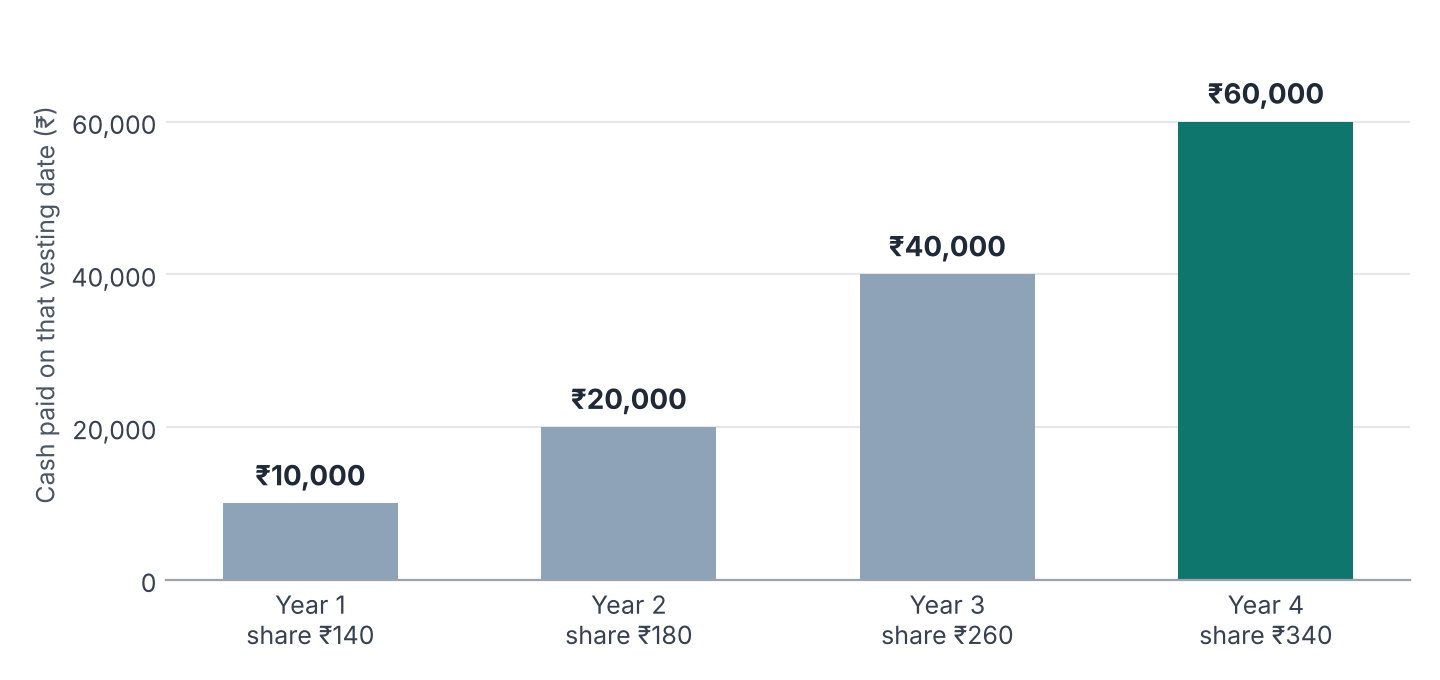
Payouts by vesting date. Each bar is 250 SARs × (share value minus ₹100).
10. Designing a SAR plan: the decisions that matter
If you are drafting a plan, these are the choices. The plan document should answer every one of them.
| Decision | Options | Why it bites |
|---|---|---|
| Base price | Market price on grant (listed), independent valuation or formula (unlisted) | Too low and the plan is costly. Too high and it motivates nobody. |
| Payout trigger | Each vesting date, a fixed date, or an exit or IPO | Exit-only plans leave employees waiting. Date-based plans create regular cash outflows. |
| Valuation method | Fixed formula, independent valuer, board decision | The #1 source of disputes in private companies. |
| Settlement form | Cash, shares, or a choice of both | Shares trigger company-law and SEBI/FEMA analysis. Cash triggers a liability. |
| Vesting | Cliff, or yearly instalments | Listed companies must vest for at least one year. |
| Leavers | Good leaver / bad leaver, lapse of unvested SARs | Spell out what happens on resignation, dismissal, retirement, death. |
| Change of control | Accelerate, continue, or cash-out | Decides whether an acquisition pays out the plan. |
| Cap or floor | Limit on appreciation or number of SARs | Controls the size of the cash liability. |
| Tax withholding | Employer withholds TDS from the payout | Must be built in, or the company carries the tax. |
11. The world tour
A SAR is a SAR everywhere: the growth in value, paid to an employee. What changes is when it is taxed, who regulates it, and what traps lurk.
United States: taxed at exercise, 409A is the trap
| Snapshot | Details |
|---|---|
| Example | 1,000 SARs granted at $10. Exercised when the share is $25. The spread is $15 per SAR, $15,000 in total, in cash or in shares. |
| Employee tax | Nothing at grant. At settlement, the spread is ordinary compensation income, with FICA (Social Security and Medicare) and withholding. |
| Employer | A deduction for the amount the employee includes in income, with timing depending on cash or share settlement. |
| Section 409A | SARs avoid the deferred-compensation rules if they meet an exemption: short-term deferral (paid within about 2.5 months after the year-end of vesting) or the stock right exception (base price generally at least the fair market value at grant). Private companies need a reasonable valuation (formula or third-party appraisal). |
| The penalty | If neither exemption applies and the plan doesn’t comply, the employee faces income inclusion at vesting plus a 20% penalty tax. |
United Kingdom: employment income, plus employer NIC
| Snapshot | Details |
|---|---|
| Employee tax | Phantom or cash-settled payments are employment income, not capital gains. Taxed at marginal rates (20%, 40% or 45%) plus employee NIC, through PAYE. |
| Employer cost | Employer NIC is payable on the full payment, a significant extra cost. Rates can change in each Budget. |
| Corporation tax | A deduction as a trading expense in the year paid, if wholly and exclusively for business purposes. |
| Traps | Part 7A (disguised remuneration) can bite if the employer pre-funds the promise through a trust or offshore vehicle. A purely cash-settled plan generally stays outside the employment-related securities reporting regime, but if shares could be delivered, check it. |
Singapore: employment income in the year of settlement
| Snapshot | Details |
|---|---|
| Employee tax | The cash or share value received on settlement is employment income, taxable in the year of exercise or settlement. |
| Bunching | A large payout in one year can push the employee into a higher bracket that year. |
| Reporting | The employer includes the value in annual employment-income reporting. |
| Private companies | Valuations are infrequent or company-controlled, which can make the appreciation contested. |
IRAS’s published equity guidance centres on stock options and share awards, so check it directly for a specific SAR design.
United Arab Emirates: no personal income tax
| Snapshot | Details |
|---|---|
| Employee tax | No personal income tax on grant, exercise or sale of employee equity or on SAR payouts. Employees who are tax residents elsewhere may owe tax at home. |
| Mainland LLCs | True ESOPs are awkward (partner caps, pre-emption rights, notarised transfers), so phantom shares and SARs are the common alternative. No share changes hands. |
| Free zones | DIFC and ADGM have more flexible company-law frameworks for real share plans. |
| Employer | UAE Corporate Tax is 9% on taxable income above AED 375,000. Accounting follows IFRS 2, so cash-settled plans are re-measured. |
| Labour law | Forfeiting SARs doesn’t affect statutory end-of-service gratuity. Plan terms that clash with mandatory labour protections may be unenforceable. |
Australia: Division 83A, and cash-settled rights as salary
| Snapshot | Details |
|---|---|
| Framework | Division 83A of the ITAA 1997 (employee share schemes), plus Fringe Benefits Tax rules. |
| Cash-settled | The ATO view (ATO ID 2010/142) is that where rights are settled in cash, the grant is viewed as a step in paying salary or wages, not a separate fringe benefit. |
| Share-settled | If settled in shares, the rights are treated as having always been ESS interests, and are excluded from fringe benefits. |
That ruling is from 2010. Check the current ATO position and any newer class rulings before designing a plan.
Canada: watch the salary deferral rules
| Snapshot | Details |
|---|---|
| Employee tax | SARs are generally treated as having no value at grant. Tax usually arises at vesting, when the payout becomes available. |
| Dividend-equivalents | If the plan gives dividend-equivalents before vesting, taxation can be accelerated to when the participant first becomes entitled. |
| The trap | If the Salary Deferral Arrangement rules are triggered, the appreciation must be reported annually as earned, not as one lump at vesting. |
| Certainty | A company can ask the CRA for an advance tax ruling. It may take 90 days or longer. |
12. Side-by-side comparison
Table A: tax and regulation at a glance
| Country | Main rulebook | When the employee is taxed | Biggest watch-out |
|---|---|---|---|
| India | SEBI SBEB Regulations, 2021 (listed). Contract and general law (private) | At payout or settlement, as salary perquisite. TDS under s.192 | Private-company grey zone. Slab-rate tax, no capital-gains rate on cash payout |
| United States | Internal Revenue Code (incl. s.409A) | At settlement, as ordinary income, plus FICA | 409A penalty: income inclusion plus 20% tax |
| United Kingdom | Employment income rules, PAYE and NIC | At payout, as employment income plus employee NIC | Employer NIC, and Part 7A if pre-funded |
| Singapore | Income Tax Act (IRAS) | In the year of exercise or settlement | Large payout pushes the employee into a higher bracket |
| UAE | Company law of mainland, DIFC or ADGM | Not taxed (no personal income tax) | Labour law and gratuity. Home-country tax of foreign residents |
| Australia | Division 83A, ITAA 1997 | Cash-settled treated as salary or wages | ATO view dates from 2010. Check current rulings |
| Canada | Income Tax Act (CRA) | Generally at vesting | Salary Deferral Arrangement rules; dividend-equivalents |
Five big differences worth remembering
India has a two-speed system. Listed companies follow a detailed SEBI rulebook. Private companies have almost none.
The US is the strictest on design. Section 409A can turn a badly drafted SAR into a penalty for the employee.
The UK’s sting is on the employer side. Employer NIC is a real extra cost on top of the payout.
The UAE is the outlier. No personal income tax, but real labour-law and company-law constraints.
Everywhere, cash-settled SARs are treated as salary-type income, not as a capital gain. That is the main reason employees often prefer real shares.
On accounting, India (Ind AS 102, aligned with IFRS 2) and the UAE (IFRS 2) both re-measure cash-settled plans every reporting date. US liability-classified awards are re-measured too.
13. Cheat sheet, myths and mistakes
Myths, busted
| Myth | Reality |
|---|---|
| “A SAR is the same as an ESOP.” | An ESOP lets you buy shares. A SAR pays you the growth and needs no purchase. |
| “SARs are completely unregulated in India.” | Listed companies are fully covered by the SEBI SBEB Regulations. Private companies are in a grey zone, not a free-for-all. |
| “A cash SAR payout gets the lower capital-gains rate.” | It is salary at slab rates, with TDS. |
| “No shares means no cost.” | A cash liability sits on the balance sheet and swings with the share price (Ind AS 102). |
| “If the share price falls, I still get something.” | A SAR is worth nothing if the price stays below the base. A full-value phantom plan or RSU is different. |
| “A foreign parent’s plan is outside Indian law.” | Don’t assume it. Check Indian tax, TDS and FEMA. |
| “The one-year minimum vesting applies to every SAR.” | It is a SEBI rule for listed companies. Private companies usually copy it for safety. |
| “The Supreme Court said SAR gains aren’t taxable.” | Only for pre-2000 redemptions. The law changed from 1 April 2000. |
Mistakes that cause real trouble
No valuation method. The most common cause of disputes.
A vague payout trigger. “On exit” means nothing until you define exit.
Forgetting TDS. The company then owes the tax.
Ignoring leavers and change of control. Both come up in every plan.
Ignoring 409A when the plan covers US employees.
Surprising the CFO. The Ind AS 102 liability moves with the share price.
Where to go next
The SBEB & SE Regulations, 2021 (SEBI’s website), for the listed-company rulebook
A chartered accountant for tax and Ind AS 102, and a lawyer for the plan document
The Income-tax Act, 2025 and its final Rules, for current section numbers
Sources
Pages consulted for this guide (as of 5 November 2026):
India: SEBI SBEB & SE Regulations, 2021 (consolidated to 4 Dec 2025): https://www.sebi.gov.in/sebi_data/attachdocs/aug-2026/1785911420093.pdf
India: Bar & Bench, SARs as an unregulated alternative to ESOPs: https://www.barandbench.com/view-point/stock-appreciation-rights-an-unregulat...
India: Treelife, SARs in India (meaning and working): https://treelife.in/legal/stock-appreciation-rights-in-india
India: Cyril Amarchand Mangaldas, SBEB framework for listed companies: https://corporate.cyrilamarchandblogs.com/2024/08/regulatory-framework-govern...
India: K&S Partners, is phantom stock legal in India: https://ksandk.com/labour-employment/is-phantom-stock-legal-in-india/
India: CalcGuru, phantom stock and SARs (tax and comparison): https://calcguru.in/?p=7278
India: ITAT digest, ACIT v. Bharat V. Patel (Supreme Court, 2018): https://itatonline.org/digest/acit-v-bharat-v-patel-sc-www-itatonline-org/
India: Conventus Law, SC on SAR income: https://conventuslaw.com/report/india-sc-holds-that-income-from-sars-is-taxed...
India: Patron Accounting, Ind AS 102 guide: https://www.patronaccounting.com/accounting-standards/ind-as-102-share-based-...
India: Income-tax Act 2025 and perquisites (TaxUpadesh): https://taxupadesh.blogspot.com/2026/02/perquisites-whats-changed-in-tax-law....
India: SEBI founder-ESOP amendments, September 2025 (Business Standard): https://www.business-standard.com/pti-stories/national/sebi-amends-esop-rules...
US: RSM, FAQs about stock appreciation rights: https://www.rsmus.com/insights/services/business-tax/frequently-asked-questio...
US: myStockOptions, what are SARs: https://www.mystockoptions.com/content/what-are-stock-appreciation-rights
UK: Global Investments, phantom share schemes guide: https://www.globalinvestments.net/financial-planning/guides/phantom-share-sch...
Singapore: Kopi Notes, SARs in Singapore: https://thekopinotes.com/glossary/stock-appreciation-rights-sars-singapore/
UAE: Kayrouz & Associates, employee incentives in the UAE: https://www.kayrouzandassociates.com/insights/uae-employee-incentives-stock-o...
Australia: Guerdon Associates on ATO ID 2010/142: https://www.guerdonassociates.com/articles/australian-tax-office-provides-cla...
Canada: BDO, SARs and dividend-equivalents (March 2022): https://www.bdo.global/en-gb/microsites/tax-newsletters/ges-news/march-2022-i...