
The 30-second version
A private company in the Dubai International Financial Centre (DIFC) can buy back its own shares under Article 53 of the DIFC Companies Law (DIFC Law No. 5 of 2018) with a special resolution, a written purchase contract, payment in full on completion, and a Registrar filing within 30 days. Compared with India's eight-lock regime, DIFC is refreshingly lean: no percentage caps, no debt–equity ratio, no cooling-off period.
Lean is not lawless. Directors still answer for solvency, the selling shareholder cannot vote, and an unlawful payout can be clawed back from a shareholder who knew. And outside the DIFC, an onshore UAE LLC has no comparable buyback route at all.
Picture it like this
Four friends own a Dubai café inside the DIFC. One wants to move to London. Instead of hunting for a new partner, the café pays her out of its profits and either shreds her share certificate or puts it in a drawer to give to the head barista later. The other three now own a bigger slice. That drawer is what the DIFC calls treasury shares, a tool India does not allow.
Why DIFC companies buy back
- Founder or partner exit without bringing in an outsider.
- Investor exit at the end of a fund's life.
- Employee equity: buy shares back from leavers and hold them in treasury for new hires.
- Returning surplus cash from a holding company to its owners.
- Tidying the cap table before a sale or new funding round.
What you'll walk away with
- The exact Article 53 conditions, with examples.
- The three routes — buyback, redemption and capital reduction — and when to use each.
- A step-by-step flow with every Registrar filing.
- A worked case study with voting maths.
- UAE corporate tax treatment for individuals and companies.
- How DIFC compares with ADGM, onshore UAE and India.
Note: General information only, not legal or tax advice. Based on the consolidated DIFC Companies Law (March 2022 version, as amended by DIFC Law No. 2 of 2022); check for later amendments and take advice from a DIFC-qualified adviser before acting.
The legal map: three systems inside one country
The UAE has three separate company-law systems, and the one your company is registered under decides whether and how it can buy back shares.
Jurisdiction | Governing law | Buyback by a private company? |
|---|---|---|
DIFC (Dubai common-law financial free zone) | DIFC Companies Law No. 5 of 2018, Chapter 6 (Arts 52–55), Chapter 7 (Arts 56–63), Chapter 8 (Arts 64–65) | Yes, under Art 53 |
ADGM (Abu Dhabi common-law financial free zone) | ADGM Companies Regulations 2020, Part 17 | Yes, UK-style; out of profits, fresh issue, limited cash, or capital with a directors' statement |
Onshore UAE and most other free zones | Federal Decree-Law No. 32 of 2021 (Commercial Companies Law), amended by Decree-Law No. 20 of 2025 | No general buyback route for LLCs; exits usually by share transfer or capital reduction |
This guide focuses on DIFC, then compares the others.
The DIFC toolkit
Article | What it does |
|---|---|
Art 52 | Redeemable shares: issued only if the Articles allow; directors' solvency certificate before redemption |
Art 53 | Purchase of own shares (the buyback) |
Art 54 | Treasury shares: hold, sell, use for employee schemes, or cancel |
Art 55 | Financial assistance: banned for public companies and their subsidiaries, with exceptions |
Arts 56–63 | Reduction of capital: private companies can use a special resolution plus solvency statement, no court needed |
Arts 64–65 | Distributions: only out of realised profits; shareholders who knew must repay unlawful ones |
Arts 68–77 | Directors' duties, including care, skill and diligence |
Key terms
- Private Company: a DIFC company that is not public. It has no minimum share capital (Art 35(2)).
- Off-market purchase: any purchase not made on a Regulated Market (Art 53(7)). Every private company buyback is off-market.
- Special Resolution: a resolution passed by at least 75% of votes cast.
- Treasury shares: bought-back shares the company keeps rather than cancels. They carry no votes and no dividends (Art 54(3)).
- Profits available for distribution: accumulated realised profits less accumulated realised losses (Art 64(1)).
Quick check: Is a DIFC buyback a "reduction of capital"? No. Art 56(5)(b) says a purchase under Chapter 6 is not a reduction of share capital, so the Chapter 7 notice-and-solvency-statement procedure does not apply to a straight buyback.
The Article 53 conditions
A DIFC private company buyback needs six things: permission in the Articles, a special resolution, a disclosed contract, fully paid shares, at least one other shareholder left standing, and payment in full on purchase.
# | Condition | Article |
|---|---|---|
1 | Articles of Association do not prohibit it | 53(1) |
2 | Special resolution for an off-market purchase (not needed by a wholly owned subsidiary) | 53(2)(a) |
3 | The selling shareholder's shares carry no vote on that resolution | 53(3) |
4 | Purchase contract sent to every shareholder with the resolution, or available at the registered office for at least 15 days before the meeting | 53(6) |
5 | Shares fully paid; at least one non-redeemable, non-treasury share left in issue | 53(4) |
6 | Paid for on purchase | 53(5) |
+ | Notify the Registrar and confirm share capital within 30 days | 53(8) |
Example 1: The lone shareholder
Palm Advisory Ltd has one shareholder. She cannot have the company buy back all her shares, because Art 53(4) forbids a purchase that leaves no shareholder holding non-redeemable, non-treasury shares. If she wants to exit entirely, she sells to a new owner or winds the company up.
Example 2: The partly paid share
Dune Robotics Ltd issued 10,000 shares at USD 5, with USD 2 paid so far. Those shares cannot be bought back until fully paid (Art 53(4)). The holder pays the USD 3 balance first.
Example 3: The vote that doesn't count
Oasis Logistics Ltd has three shareholders: Sara 40%, Karim 35%, Lina 25%. The company will buy back all of Lina's shares. Lina cannot vote (Art 53(3)), so the eligible votes are 75%. Sara alone casts 40 of 75 votes, which is 53%, short of 75%. Karim must vote yes too.
Where does the money come from?
Article 53 does not list funding sources the way Art 52(3) does for redemptions, or the way India's s.68 does. Practitioners usually take a cautious line:
- Pay from profits available for distribution (Art 64(1): realised profits less realised losses), so the payout cannot be attacked as an unlawful return of capital.
- Get a directors' solvency certificate modelled on Art 52(4): every director confirms the company can pay its debts as they fall due and keep trading for 12 months.
- If profits are not enough, use the capital-reduction route (Art 56: special resolution plus solvency statement) or a court-confirmed reduction.
Why bother if the law doesn't say so? Directors owe a duty of care, skill and diligence (Art 72). If a buyback leaves the company unable to pay creditors, those directors face scrutiny, and Art 65 lets the company recover distributions from shareholders who knew they were unlawful. A board minute plus a solvency certificate is cheap insurance.
What DIFC does not impose
No 10% or 25% caps, no 2:1 debt–equity ratio, no one-year cooling-off, no six-month freeze on new issues, no rule that the offer go to all shareholders pro rata. A DIFC private company can buy back from one shareholder alone.
Four tools, four jobs: buyback, treasury, redemption and reduction
Article 53 is the everyday tool, but three neighbours often do the job better.
Tool | When it fits | Approval | Key safeguard |
|---|---|---|---|
Buyback (Art 53) | One or more holders want out now | Special resolution, seller excluded | Contract disclosure; prudent solvency check |
Treasury shares (Art 54) | Keep bought-back shares for future hires or a later sale | Ordinary resolution; Articles must not prohibit | No votes or dividends on treasury shares |
Redemption (Art 52) | Exit terms agreed at issue, e.g. investor preference shares | Articles must authorise redeemable shares | All directors sign a 12-month solvency certificate |
Capital reduction (Arts 56–57) | Returning more than distributable profits | Special resolution + solvency statement (private), or court | Notice 15–30 days before effect; file within 30 days |
Treasury shares in action
Nomad Labs Ltd buys back 3,000 shares from a departing engineer and, by ordinary resolution, holds them in treasury. A year later it transfers them to two new hires under its employee share scheme (Art 54(2)). No new issue, no dilution of other shareholders. Selling treasury shares counts as an allotment for pre-emption purposes (Art 40(2)(b)), so check whether existing holders have first refusal.
Redemption in action
Cedar Health Ltd issued redeemable preference shares to an investor, redeemable at USD 1.2 million after five years. On that date, all directors sign the Art 52(4) certificate. The nominal value can come from paid-up capital, share premium or reserves; the premium from profits, share premium or reserves (Art 52(3)). The shares are cancelled and capital falls by their nominal value (Art 52(6)).
Financial assistance: mostly a public-company issue
Art 55 stops a public company or its subsidiary from funding someone else's purchase of its shares. A buyback or redemption under the Law is not "financial assistance" (Art 55(9)). A private company that is a subsidiary of a DIFC public company must still check Art 55 before, say, lending money to a manager to buy shares.
Step by step: the DIFC buyback flow
With no statutory offer period, a DIFC buyback can complete within days of the resolution; the hard deadline is the Registrar notice within 30 days of the purchase.
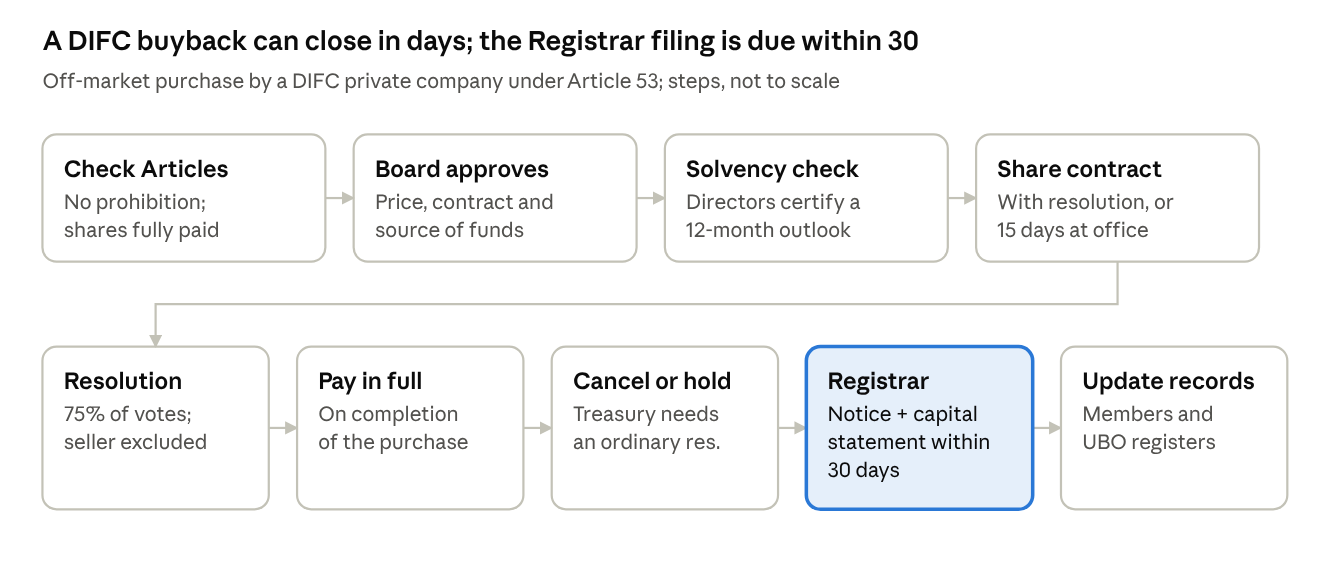
DIFC buyback flow · Articles 53–54, DIFC Companies Law No. 5 of 2018
The accent marks the one statutory deadline; every other step is a precondition.
The playbook
- Diligence. Read the Articles for any prohibition or pre-emption rights, and the shareholders' agreement for consent rights, drag/tag and exit pricing. Confirm the shares are fully paid.
- Value and fund. Agree the price (often fair value from a valuer, or a formula in the shareholders' agreement). Draw up accounts showing realised profits available for distribution.
- Board meeting. Approve the share purchase contract, the funding source and the recommendation to shareholders. Directors record their solvency view and, prudently, sign a certificate modelled on Art 52(4).
- Disclose the contract. Send a copy to every shareholder with a written resolution, or keep it at the registered office for at least 15 days before a general meeting (Art 53(6)).
- Special resolution. At least 75% of votes cast, without counting the selling shareholder's shares (Art 53(3)). A wholly owned subsidiary does not need this resolution.
- Complete and pay. Sign the contract and pay in full at completion (Art 53(5)). No instalments or deferred consideration.
- Cancel or hold in treasury. Cancel the shares, or pass an ordinary resolution to hold them as treasury shares if the Articles allow (Art 54(1)).
- Registrar filings within 30 days. Notify the Registrar of the purchase and confirm the share capital (Art 53(8)); file the special resolution (Art 19(3)). Filings go through the DIFC Registrar's online portal.
- Records. Update the register of shareholders, the beneficial-ownership register and the next Confirmation Statement, showing any treasury shares (Art 54(7)).
The documents at a glance
Document | Why | Timing |
|---|---|---|
Board minutes | Approve terms; record solvency view | Before the resolution |
Directors' solvency certificate | Prudent evidence of solvency | Before payment |
Share purchase contract | Required disclosure under Art 53(6) | Circulated with the resolution, or 15 days before the meeting |
Special resolution | Shareholder approval under Art 53(2) | Before completion; file within 30 days |
Ordinary resolution (if treasury) | Authorise holding as treasury | At or after completion |
Registrar notice and statement of capital | Art 53(8) | Within 30 days of purchase |
Case study: Falcon Analytics Ltd buys out a co-founder
Falcon buys back all 20,000 of Omar's shares for USD 3 million, keeps 5,000 in treasury for future hires, and finishes the legal work in about ten days.
The set-up
Item | Amount (USD) |
|---|---|
Share capital (100,000 shares × USD 1) | 100,000 |
Share premium | 2,900,000 |
Realised retained profits | 4,000,000 |
Cash | 5,000,000 |
Liabilities due within 12 months | 1,500,000 |
Agreed price per share (independent valuation) | 150 |
Shareholder | Shares | Holding |
|---|---|---|
Layla (founder) | 50,000 | 50% |
Omar (co-founder, leaving) | 20,000 | 20% |
Gulf Ventures LLC (UAE investor) | 20,000 | 20% |
Employees | 10,000 | 10% |
Step 1: The vote
Omar's 20,000 shares cannot vote (Art 53(3)), leaving 80,000 eligible votes. A special resolution needs 75%, i.e. 60,000.
- Layla alone: 50,000 of 80,000 = 62.5%. Not enough.
- Layla + Gulf Ventures: 70,000 of 80,000 = 87.5%. Passes.
Layla needs her investor on side, so the shareholders' agreement negotiation starts here, not at the board table.
Step 2: Money and solvency
- Price: 20,000 × USD 150 = USD 3,000,000, paid from the USD 4,000,000 of realised profits.
- After payment, cash is USD 2,000,000 against USD 1,500,000 of liabilities falling due within 12 months. Directors review a 12-month cash forecast and sign a solvency certificate.
Step 3: Cancel 15,000, keep 5,000
By ordinary resolution, 5,000 shares go into treasury for the next two senior hires (Art 54). The other 15,000 are cancelled, reducing share capital by USD 15,000.
Shareholder | Votes before | Votes after |
|---|---|---|
Layla | 50% | 62.5% |
Gulf Ventures | 20% | 25% |
Employees | 10% | 12.5% |
Omar | 20% | — |
Treasury (5,000) | — | No votes |
Layla goes from a 50% blocking stake to a clear majority, without investing anything.
Step 4: The books (IFRS)
Entry | Debit (USD) | Credit (USD) |
|---|---|---|
Cancel 15,000 shares at USD 150 | Share capital 15,000; Retained earnings 2,235,000 | Cash 2,250,000 |
Hold 5,000 in treasury at cost | Treasury shares (deducted from equity) 750,000 | Cash 750,000 |
Step 5: The calendar
Date | Action |
|---|---|
1 Dec 2026 | Board approves contract; directors sign solvency certificate |
2 Dec | Written special resolution and contract sent to all shareholders |
9 Dec | Resolution passes (Layla and Gulf Ventures sign) |
10 Dec | Completion; USD 3 million paid; ordinary resolution on treasury shares |
by 8 Jan 2027 | Registrar notified; statement of capital and special resolution filed |
Tax: mostly good news, with a home-country twist
For most sellers the UAE takes no tax on a DIFC buyback: individuals holding shares personally pay nothing, the company withholds nothing, and corporate sellers are often exempt. The real tax question is usually in the seller's home country.
UAE side
Who | UAE tax on buyback proceeds | Why |
|---|---|---|
Company buying back | None; payment is not a deductible expense | It is a return to shareholders, not a cost |
Individual holding shares personally | None | No personal income tax; corporate tax does not reach personal investments held outside a licensed business |
UAE company holding ≥ 5% (or cost ≥ AED 4 million) for 12+ months | Usually exempt | Participation exemption, Art 23 Corporate Tax Law (Kayrouz & Associates) |
UAE company not meeting those tests | Possibly 9% on the gain above AED 375,000 of taxable income | Ordinary corporate tax; domestic dividends are exempt under Art 22, so how the payment is characterised matters |
Non-resident shareholder | No UAE withholding (rate is 0%) | Taxed, if at all, at home |
VAT: the transfer of shares is generally an exempt financial service.
Grey area: UAE corporate tax law has no buyback-specific rule saying whether proceeds are a dividend or a disposal gain. For a UAE corporate seller that misses the participation tests, that difference decides whether tax is due. Get written advice before signing.
Home-country examples
Omar is a UAE tax resident. No UAE tax, and no home-country tax if he is not tax resident elsewhere. He keeps the full USD 3 million.
If Omar were tax resident in India. India taxes residents on worldwide income. A gain on unlisted foreign shares held over 24 months is long-term capital gain at 12.5% (plus surcharge and cess), subject to relief under the India–UAE tax treaty. As an Indian resident disposing of an overseas investment, he would also have reporting duties under India's Overseas Investment rules.
If Gulf Ventures had sold. It held 20% for over 12 months in a UAE company subject to corporate tax, so the participation exemption should apply and the gain would be exempt.
Special situations and the wider UAE picture
DFSA-regulated firms
If the company is authorised by the Dubai Financial Services Authority, a buyback reduces the capital that counts towards its prudential requirements. Check the DFSA's prudential rules and notification duties before agreeing any price; in practice the regulator should hear about a capital reduction before it happens, not after.
Holding companies and Prescribed Companies
Many DIFC companies are holding vehicles or Prescribed Companies used for structuring. The same Article 53 rules apply. Two practical points:
- A wholly owned subsidiary does not need a special resolution (Art 53(2)(a)), but it still cannot buy back shares leaving no other holder (Art 53(4)).
- If a holding company's only assets are shares in subsidiaries, it may need a dividend from them first to have realised profits and cash.
How DIFC compares
DIFC | ADGM | Onshore UAE LLC | India private company | |
|---|---|---|---|---|
Buyback route | Art 53 | Part 17, Companies Regulations 2020 | None general; transfer or capital reduction | s.68 |
Approval | Special resolution, seller excluded | Contract approved by special resolution | General assembly for capital reduction | Board (≤10%) or special resolution (≤25%) |
Size cap | None | Limited by profits, or capital with directors' statement | Not applicable | 25% of paid-up capital + free reserves |
Funding rules | Not stated; profits is safest | Distributable profits, fresh issue, small cash amount, or capital | Not applicable | Free reserves, premium, different-kind issue |
Selective (one shareholder) | Yes | Yes | Not applicable | No, proportionate offer |
Treasury shares | Yes | Yes | No | No, must cancel |
Registrar filing | 30 days | 1 month | Per authority | SH-11 within 30 days |
Shareholder tax | Usually none in UAE | Usually none in UAE | Usually none in UAE | Capital gains; extra for promoters |
ADGM details: purchase out of capital needs a directors' statement after full inquiry, a special resolution within a week of it, public notice, and payment no more than six weeks after the resolution; members or creditors have five weeks to apply to court to cancel it (ADGM Part 17 text).
Onshore: Federal Decree-Law No. 20 of 2025, in force from 15 October 2025, lets LLCs issue share classes that may carry redemption rights, with details left to implementing regulations (Cleary Gottlieb). Until those arrive, an onshore partner exit is usually a share transfer to the remaining partners, subject to pre-emption.
What can go wrong
The DIFC's light rules put the risk on people rather than paperwork: directors who certify solvency without grounds, and shareholders who take money they knew was unlawful.
Provision | Who is exposed | Consequence |
|---|---|---|
Art 53(9)–(10) | Company and employees in default | Fines under Schedule 2 for breaching the approval, voting, fully-paid or disclosure rules, or the Registrar notice |
Art 52(5), applied by Art 53(11) | Directors | Fine for signing a solvency certificate without reasonable grounds |
Art 57(4) | Directors | Fine for a capital-reduction solvency statement without reasonable grounds |
Art 64(8) | Company | Fine for an unlawful distribution |
Art 65 | Shareholders | Must repay a distribution they knew, or should have known, was unlawful |
Arts 72, 76, 84 | Directors | Breach of the duty of care, skill and diligence is a contravention and can support disqualification |
Four illustrative mistakes
- Counting the seller's vote. The resolution passes 80% to 20% only because the seller voted. Without his votes it fails, and the purchase was never validly approved.
- Deferred payment. The founder is paid half now and half in a year. Art 53(5) requires payment on purchase; restructure as a full payment funded properly, or use a different exit route.
- Paying from unrealised gains. A revaluation surplus on property funds the buyback. It is not a realised profit, so the payout is exposed under Art 64.
- Forgetting the Registrar. The 30-day notice slips. The company now carries a contravention and its public record shows the wrong share capital.
Safe harbour that isn't: Art 68(5) lets shareholders authorise or ratify a director's breach, but only if the company stays able to pay its debts as they fall due. Unanimity does not cure insolvency.
Your DIFC buyback checklist, myths and FAQs
Checklist
- ☐ Articles do not prohibit buybacks (and allow treasury shares, if you want them)
- ☐ Shareholders' agreement checked: consents, pre-emption, valuation formula, drag/tag
- ☐ Shares fully paid; at least one other shareholder will remain
- ☐ Accounts show enough realised profits; no reliance on revaluation surpluses
- ☐ Directors' solvency certificate covering the next 12 months
- ☐ Share purchase contract circulated with the resolution, or available 15 days before the meeting
- ☐ Special resolution passed without the seller's votes
- ☐ Full payment at completion
- ☐ Ordinary resolution if holding shares in treasury
- ☐ Registrar notice, statement of capital and special resolution filed within 30 days
- ☐ Registers of shareholders and beneficial owners updated
- ☐ DFSA consulted if the company is regulated
- ☐ Seller's home-country tax and reporting checked
Myths vs facts
Myth | Fact |
|---|---|
"DIFC buybacks need court approval." | No. Only a court-route capital reduction does. |
"Every shareholder must be offered the same deal." | No. A DIFC private company can buy from one shareholder. |
"The seller can vote like everyone else." | No. The seller's shares are excluded (Art 53(3)). |
"Bought-back shares must be destroyed." | No. They can be held in treasury with an ordinary resolution (Art 54). |
"The UAE taxes buyback gains at 9%." | Individuals holding personally pay nothing; many corporate holders are exempt. |
"Onshore LLCs can do the same." | Not yet. There is no general LLC buyback mechanism onshore. |
FAQs
Can we pay in instalments? Not under Art 53(5): payment is due on purchase. Some deals use a capital reduction or a third-party buyer instead.
Can the company borrow to fund it? The DIFC law does not ban it outright, unlike India. Directors must still be satisfied about solvency, and lenders' covenants often restrict distributions.
Can we buy back preference shares? Yes, if fully paid. If they were issued as redeemable, Art 52 redemption is usually cleaner.
What about a buyback from an employee leaving under a share scheme? Art 53 applies. Holding the shares in treasury lets you re-grant them to the next hire without a new issue.
Is there a minimum capital we must keep? Not for a private company (Art 35(2)), unless the company is DFSA-regulated or its licence sets one.
References and further reading
DIFC
- DIFC Companies Law, DIFC Law No. 5 of 2018 (consolidated, March 2022) — official PDF
- DIFC Companies Law 5/2018 — searchable text (Shushin)
- DIFC Laws Amendment Law No. 2 of 2022
- Key changes introduced by the new DIFC Companies Law regime (White & Case)
- DIFC Law Amendment Law No. 1 of 2024 overview (Mondaq)
ADGM and onshore UAE
- ADGM Companies Regulations 2020, Part 17 (Shushin)
- UAE Companies Law Update 2025 — Decree-Law No. 20 of 2025 (Cleary Gottlieb)
Tax
- UAE corporate tax participation exemption: dividends and capital gains (Kayrouz & Associates)
- Dividends under UAE corporate tax law (Mondaq)
All companies in the examples (Falcon Analytics, Palm Advisory, Dune Robotics, Oasis Logistics, Nomad Labs, Cedar Health) are fictional.