
Deep research, clear legal explanations, practical examples and references.
Research material current to November 2026. General information only; confirm current law, facts and professional guidance before relying on it.
Singapore has no single rulebook for "SARs". The label does not decide the treatment; the plumbing does. So rather than asking "what are the rules for SARs?", ask these four questions about any particular award:
1 What exactly was promised? |
2 Who owes the promise? |
3 How can it be settled? |
4 What event turns it into value? |
The answers to those four questions settle most of what follows.
What this guide covers
The guide is current to 17 November 2026. It looks at SARs granted by a Singapore-incorporated entity to employees, directors and consultants; at private, start-up and SGX-listed issuers; at cash and share settlement; at parent-company awards to subsidiary staff; and, as an illustration, at a Singapore–India mobility scenario. Singapore statutes and the guidance of ACRA, IRAS, the CPF Board, MAS, SGX, the PDPC and the accounting-standard setters come first; Indian primary sources are used only for the India example. [1]
One clarification: SAR here means Stock Appreciation Right. It has nothing to do with Suspicious Activity Reports, Special Administrative Regions, radar, or any other use of the acronym.
How to read it
| Part | What you will get | Read it if you are… |
|---|---|---|
| 1 The mental model | The SAR formula, the settlement types and five tempting myths | New to SARs |
| 2 How SARs work | Lifecycle, valuation, dilution, leavers, exits | Designing a plan |
| 3 Corporate and securities law | Approvals, directors, SFA, SGX | Counsel, company secretary |
| 4 Tax, CPF and more | Income tax, CPF, deductions, TP, GST, stamp duty | HR, payroll, tax |
| 5 Accounting | Worked journal entries for cash and equity SARs | Finance team |
| 6 Cross-border and risk | Mobility, India case, data, insolvency, disputes | Group and mobility teams |
| 7 Playbook | Steps, term sheet, checklists, mistakes, questions for advisers | Everyone, before launch |
| FAQ & Glossary | Quick answers and plain-English definitions | Anyone who skipped ahead |
PART 1
The mental model
One formula, four settlement styles, five myths to drop
The payoff in one line
Take a holder with 10,000 SARs, a base price of S$5, and a reference share worth S$13 on exercise. The gain per SAR is S$8, so:
S$8 gain per SAR |
× 10,000 vested SARs |
S$80,000 SAR value |
How that S$80,000 reaches the holder is a design choice. It could be:
paid entirely in cash;
delivered as roughly 6,154 shares (S$80,000 ÷ S$13);
split between shares and cash, for example to cover tax or round off fractions; or
reshaped by caps, hurdles, exit multiples, performance conditions or valuation adjustments written into the plan.
Four ways to settle, four different consequences
Almost every downstream question starts from how the SAR is settled:
| Type | Holder receives | Typical corporate effect | Accounting starting point |
|---|---|---|---|
| Cash-settled | Cash equal to the appreciation | No shares needed; creates a cash obligation | A liability, remeasured through profit or loss |
| Equity-settled | Shares worth the appreciation | Share issue or transfer, dilution and approvals all matter | An equity award, if the IFRS 2 conditions are met |
| Issuer-choice | Whatever the company elects: cash or shares | Turns on whether the company in substance has a present cash obligation | Fact-specific under IFRS 2 |
| Holder-choice | Whatever the holder elects | Often the most complex of the four | Possible compound instrument or liability consequences |
IFRS 2 itself uses cash SARs as its textbook example of a cash-settled award, one where the employee earns a future cash payment tied to the rise in the entity's share price. Such awards are carried at fair value and remeasured at every reporting date and on settlement, with each change going through profit or loss. [2]
Five tempting shortcuts that are wrong
Each of these sounds sensible. Each can lead to a bad plan.
| The shortcut | Why it fails |
|---|---|
| "SARs are always securities." | A contractual cash bonus linked to share value and a genuinely transferable capital-markets instrument are not necessarily regulated alike. The SFA analysis follows the legal instrument and the rights actually created. [3] |
| "SARs are taxed when granted." | Singapore's employee-share regime normally looks to exercise, vesting or the lifting of restrictions. And IRAS says pure cash phantom-share plans sit outside its ESOW definition altogether, so they need a general remuneration analysis instead. [4] |
| "A cash SAR is just an option without shares." | Similar economics in places, but different in law and in the books. A cash SAR is a money liability; an employee option is generally a right to acquire shares. [2] |
| "No shares, so no regulation." | A cash instrument whose value moves with securities may still touch the SFA's derivatives concepts, depending on its terms. [3] |
| "Share settlement means dilution." | Shares can be newly issued, taken from treasury or sourced from existing holders. Only a fresh issue mechanically grows issued share capital. |
| "If accounting says equity-settled, tax must too." | Company law, securities law, tax, CPF and accounting each apply their own tests. An IFRS 2 label does not decide IRAS or CPF treatment. [5] |
PART 2
How SARs actually work
Lifecycle, valuation, dilution, and the design choices that decide disputes
The five-stage lifecycle
Every SAR passes through five stages. A surprising number of drafting and administration errors come from documents that blur them together.
Grant Award created or communicated |
Vesting Conditions satisfied |
Exercise Holder crystallises (or auto-trigger) |
Valuation Reference price fixed |
Settlement Cash or shares delivered |
| Stage | What it means | Why people trip on it |
|---|---|---|
| Grant | The award is created or communicated. | Vital for accounting (grant-date fair value under IFRS 2), yet it does not usually trigger Singapore income tax, which tends to come later. [2] |
| Vesting | The holder has met the conditions to keep or exercise the award: service, individual targets, EBITDA, revenue, ARR, TSR, an exit valuation, an IPO, a regulatory milestone, or a mix. | Vesting and exercise are often mixed up. |
| Exercise | The holder elects to crystallise a vested SAR. | Not mandatory: an exit-only SAR can settle automatically on a sale or IPO. |
| Valuation | Fixing the reference price used in the payoff. | Easy for listed shares. For private shares the plan needs a defensible method, because accounting, tax, expectations and disputes all hinge on the number. |
| Settlement | The holder actually receives cash or shares and the company's obligation ends. | The point at which payroll, CPF, ACRA and bank mechanics all collide. |
On valuation specifically: IRAS employee-share reporting refers to open-market value, and where an unlisted share's arm's-length value cannot readily be determined, net asset value (NAV) may be relevant. Which method is right depends on the tax provision and the facts. [6]
SAR versus phantom shares, options, RSUs and real shares
Start-up paperwork uses these words loosely. "Phantom shares" can mean anything from a cash bonus equal to the whole share value to a cash SAR that tracks only the appreciation.
| Instrument | Starting point | Holder pays an exercise price? | Upside captured | Owns shares before settlement? | Employer cash burden |
|---|---|---|---|---|---|
| SAR | Base / strike price | Usually no | Appreciation above base | Usually no | High if cash-settled |
| Phantom (full value) | Zero | No | The entire share value | No | High if cash-settled |
| Option / ESOP | Exercise price | Yes | Appreciation above exercise price | No, not until exercise | Usually low |
| RSU | Full-value unit | No | Full value once vested | No, not until delivery | Low if share-settled |
| Restricted share | Actual share | Sometimes | Entire value | Yes, subject to restrictions | Low |
| Cash bonus indexed to valuation | Per formula | No | As the formula says | No | High |
Why SARs can be less dilutive than options
Compare two awards over 1,000 shares with a S$10 price, when the shares are worth S$18:
The option holder pays 1,000 × S$10 = S$10,000 and receives 1,000 shares worth S$18,000.
The net-share SAR holder pays nothing and receives only the S$8,000 gain, which is S$8,000 ÷ S$18 ≈ 444.44 shares, or 444 if the plan rounds down.
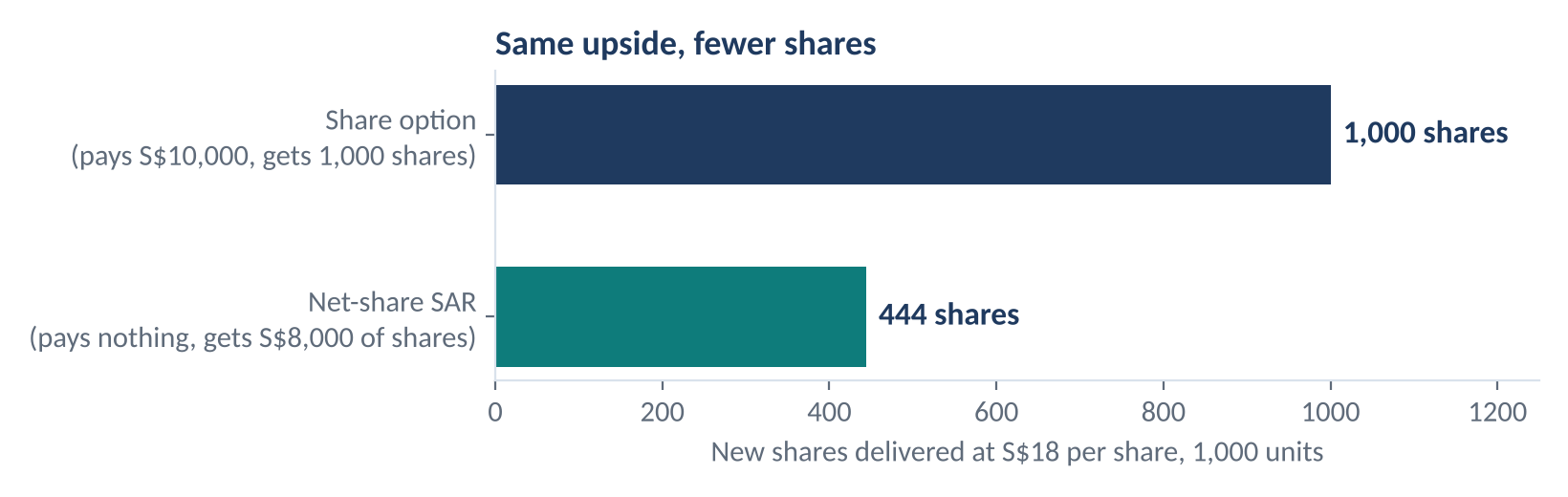
That can mean much less issuance than a conventional option. The real dilution picture still depends on how the company sources shares, the valuation, rounding, tax settlement and the size of the plan pool.
Value is not the same as dilution
A SAR can hand an employee a large benefit without ever creating a new shareholder. A S$3 million cash-settled SAR liability causes zero legal dilution but consumes S$3 million of cash. An equity-settled SAR does the opposite: it conserves cash and dilutes shareholders. So the cash-or-equity choice is really a balance-sheet decision:
| Protects | Exposes | |
|---|---|---|
| Cash SAR | The cap table | Cash and profit or loss |
| Equity SAR | Cash | The cap table and governance |
The books reinforce the contrast. Cash-settled liabilities are remeasured until settlement; employee equity-settled awards are generally fixed at grant-date fair value and not remeasured merely because the share price moves. [2]
Designing the base price
Common approaches are:
fair market value at grant, or the last financing price;
a board-approved or independently valued figure;
a NAV-based proxy, where appropriate;
the listed closing or volume-weighted price;
a deliberately discounted base;
an investor-preference-adjusted common-share value; or
an exit hurdle, such as "only value above S$100 million of equity value".
Whatever the approach, the clause must say which security is being valued. In a venture-backed company, "share price" misleads if investors hold preference shares with liquidation preferences while employees notionally track ordinary shares. A S$100 million headline valuation does not mean S$100 million ÷ fully diluted shares is the right ordinary-share value.
A robust private-company valuation looks at the capital structure, liquidation preferences, convertibles and SAFEs, the option pool, minority status, marketability, recent arm's-length deals, forecast uncertainty and the plan's exact definition of "Equity Value". Accounting may also demand an option-pricing or simulation model rather than simple intrinsic value, because IFRS 2 separates fair value from intrinsic value and holds cash SARs at fair value while outstanding. [2]
Performance hurdles
Vesting might be 25% a year for four years; half on service and half on ARR; only if EBITDA tops S$5 million; only if equity value exceeds S$150 million; on an exit above an investor-return threshold; or by relative TSR. The drafting must separate two different ideas:
| Concept | What happens if it is missed |
|---|---|
| Vesting threshold | The award never vests. |
| Payoff hurdle / base | The award vests, but may have no intrinsic value unless the reference price clears the hurdle. |
They differ economically and in the accounts. IFRS 2 distinguishes service conditions, non-market performance conditions, market conditions and non-vesting conditions, and each is treated differently if it fails. Market and some non-vesting conditions are built into fair value rather than handled by adjusting how many awards are expected to vest. [5]
Leavers: say more than "unvested SARs lapse"
A good plan answers these before anyone resigns:
|
|
Singapore's employment legislation defines salary broadly as pay for work under a contract of service, while contractual bonuses and other variable pay depend heavily on the agreed terms. Whether a forfeiture clause bites therefore turns on the instrument, the employment contract and the circumstances, not on a universal "leaver rule". [7]
Exit design
A private-company SAR is often most useful when tied to a liquidity event, so define "Exit" precisely: a sale of more than X% of voting power, a sale of substantially all assets, a merger, a scheme of arrangement, an IPO, a liquidation or another defined change of control. Then settle these points:
|
|
Without this machinery, the simplest promise to an employee can become the hardest claim to price on deal day.
PART 3
Corporate, securities, employment and governance law
The analysis splits sharply: a pure cash SAR on one side, a right that can end in shares on the other
Authority to grant a cash SAR
A cash-only SAR usually starts as a contractual pay obligation, not a share allotment. The board still needs authority under the constitution, the Companies Act and internal delegations. Directors must act honestly and with reasonable diligence under section 157, and board powers are subject to anything the Act or the constitution reserves to members. [8]
For a large pool, minute the commercial reasons: retention, recruitment, alignment, affordability, performance metrics, peer benchmarks, conflicts, the valuation method and the expected effect on the financial statements. That is good practice; the Companies Act does not prescribe a special SAR-minutes checklist.
Authority to grant a share-settled SAR
If settlement might require new shares, section 161 of the Companies Act is the centre of gravity. Directors generally cannot exercise the company's power to issue shares without prior approval in general meeting. That approval can be general or specific and normally lapses at the next AGM deadline, although shares can still be issued afterwards under an offer, agreement or option made while it was in force, if the approval says so. An issue made in breach can be void. [1]
ACRA adds that shareholder approval is needed before an allotment even if the constitution lets directors decide allotments. In a private company the allotment takes effect when ACRA's electronic register of members is updated after filing; public-company return-of-allotment rules differ and carry filing deadlines. [9]
So map the whole chain for an equity SAR:
1 Plan approval |
2 Valid s 161 authority |
3 Grant, then vest or exercise |
4 Board allotment resolution |
5 ACRA filing and register update |
6 Certificate or depository steps |
Also check the constitution for:
|
|
ACRA describes the constitution as the company's internal rulebook, which can be tailored within the law; there is also statutory protection for variations of class rights. [10]
When the participant is a director
A director's SAR adds conflict and approval issues. Section 169 restricts giving or improving a director's emoluments for the office without separate member approval, and "emoluments" reaches well beyond cash. Whether a particular SAR is granted for the directorship, for an executive employment role or in some other capacity depends on the facts, so don't guess it from the job title. [11]
The board minutes should also deal with the interested director's disclosure and participation, any constitutional requirements, and related-party rules.
Is a SAR a "security"?
The safe answer: sometimes the point is significant enough that counsel should classify the actual instrument and not trust its label.
The Securities and Futures Act defines "securities" and separately defines a derivatives contract by reference to obligations whose value changes with an underlying. A securities-based derivatives contract is one whose underlying is a security or a securities index. [3]
MAS has itself illustrated that something tied economically to share prices can be a securities-based derivatives contract even without ordinary share ownership. That does not make every employee cash SAR a regulated derivative. It shows why "no shares, therefore no SFA issue" is unsafe. [12]
Where the arrangement is an offer of securities or securities-based derivatives, Part XIII of the SFA and the prospectus exemptions come into play. Singapore has exemptions for offers connected with employees and qualifying persons, but the current conditions of section 273 and the eligible persons should be checked against the instrument and participant group before launch. [13]
A practical route through it:
| Ask | If yes | If no |
|---|---|---|
| Does the SAR only promise cash from the employer? | Analyse as a contract and remuneration matter, but check whether its share-linked formula could still fall within an SFA derivatives concept. | Go to the next question. |
| Can the participant receive or subscribe for shares or another capital-markets product? | Classify the instrument under the SFA; do the prospectus and offer-restriction analysis; test the employee, qualifying-person, private-placement or other exemptions; apply transfer, disclosure and marketing restrictions. | Revisit the first answer. |
SGX-listed issuers
SGX Mainboard rules contain a dedicated regime for employee share-option and share schemes. As at 17 November 2026 they provide, among other things, that subsidiaries can be brought within a scheme, that shareholder approval is required in specified cases, that participation is principally for directors and employees (with some extensions) and that scheme limits must be stated. [14]
Rule 845 sets the main numbers for Mainboard issuers: [15]
15% of issued shares (excl. treasury and subsidiary holdings) across all schemes |
25% / 10% of a scheme to controlling shareholders and associates / each such person |
20% of a scheme to parent-company directors and employees |
20% maximum discount, with separate shareholder approval |
These limits matter directly to a share-settled SAR that falls within a share scheme. A pure cash SAR may need different treatment because no share may ever be issued, so a listed issuer should take Singapore listing-rule advice rather than mechanically applying or ignoring Part VIII.
Listed issuers must also weigh market disclosure, dealing restrictions, inside information, controlling-shareholder participation and remuneration governance. Where SGX rules require grant announcements, they specify items such as the grant date, exercise price, quantity, market price and grants to directors or controlling shareholders. [14]
Employees, consultants and directors are not interchangeable
| Participant | Where they fit | Watch for |
|---|---|---|
| Employee | Remuneration, payroll, CPF and employment-law frameworks. | Leaver terms and CPF classification. |
| Director | Companies Act emolument approvals plus separate Singapore tax and withholding rules, especially if non-resident. | A 24% withholding regime applies to specified non-resident director remuneration; ESOP/ESOW gains in a non-resident director capacity go through the Form IR21A framework instead. [16] |
| Consultant | Service-income and withholding questions. | Payments to a non-resident professional for services performed in Singapore can attract withholding; services wholly performed abroad are treated differently. [17] |
A single generic plan document for all three groups invites avoidable problems.
PART 4
Tax, CPF, reporting, deductions, GST, stamp duty and transfer pricing
This is where "actual shares" and "pure cash SAR" part ways most sharply
Employee income tax
Don't automatically apply the ESOP rules to a cash SAR
IRAS guidance says that gains from employee share options and other employee share-ownership plans, granted while the person is exercising employment in Singapore, are generally Singapore employment income. Option gains are normally taxed at exercise; other share-ownership awards generally at vesting; and selling restrictions can defer the tax point until they end. [4]
But IRAS also says expressly that its ESOW concept excludes a phantom-share plan under which the employee receives only cash, determined by reference to the company's share price, with no possibility of acquiring shares. [4]
That sentence matters a great deal for SAR design. A pure cash SAR that fits it should not simply be pushed through the ESOW machinery. The better starting point is that the payout is employment remuneration under ordinary income principles, with the taxable moment set by the employee's entitlement and the plan's payment terms. IRAS treats salary, bonuses and other employment pay as taxable and has rules on when bonuses become taxable. [18]
Share-settled SARs
If the SAR can really settle in shares, the ESOP/ESOW regime may apply, depending on how the right is legally built. Under the section 10(6) principles in IRAS's 30 January 2026 e-Tax Guide, the full gain from an ESOP/ESOW granted for Singapore employment is Singapore employment income; grants relating to overseas employment are treated differently. [6]
The taxable gain generally compares the share's open-market value at the taxable event with what the participant paid, with special valuation rules where market value is not directly visible. IRAS reporting materials use market prices for listed shares and contemplate NAV in specified unlisted-share situations where arm's-length value cannot be determined. [6]
Employer reporting
Employers must prepare the prescribed employment-income returns, including Form IR8A and Appendix 8B where ESOP/ESOW benefits are involved, generally by 1 March of the following year. The Auto-Inclusion Scheme has been compulsory from YA 2022 for employers above the applicable employee threshold, and those employers transmit the data electronically. [19]
A pure cash SAR outside ESOW may instead run through ordinary employment-remuneration reporting. Payroll set-up should follow the tax classification, not the marketing name of the plan.
Foreign employees who leave Singapore
Tax clearance can accelerate matters. Employers generally must withhold monies from an employee who is leaving Singapore or ceasing employment where the clearance rules apply, and IRAS has deemed-exercise treatment for certain unexercised or unvested ESOP/ESOW awards of foreign employees. [20]
Whether a pure cash SAR is caught by those deemed-exercise rules should not be assumed just because it is called a SAR, given IRAS's phantom-cash exclusion from ESOW. The ordinary clearance duty and the power to withhold settlement monies still need attention.
CPF: cash and shares can diverge sharply
The CPF Board says wages generally include pay in money, including bonuses and cash incentives, subject to the Ordinary Wage and Additional Wage structure and ceilings. [21] Separately, it says that shares provided in kind, even at a discount, do not attract CPF contributions, whereas cash given to an employee to buy or subsidise shares does. [22]
That gives a working model for a Singapore citizen or PR employee:
| Settlement | CPF starting point |
|---|---|
| S$100,000 cash SAR payout | Likely cash remuneration (wages), subject to CPF classification and ceilings |
| S$100,000 of shares delivered in kind | The share benefit itself is generally outside CPF |
| Employer pays S$100,000 cash earmarked for the employee's share purchase | CPF Board guidance: a cash subsidy or payment is contributable |
| Payment made after employment ends | Can still attract CPF if it is cash remuneration in respect of the employment [23] |
Corporate income-tax deduction
Singapore's general deduction rules need the expense to be incurred in producing income, to be revenue in nature, to be a legal liability and not to be specifically prohibited. Employee pay ordinarily fits where those conditions are met. [24] A cash SAR payout that is an employee remuneration expense therefore has a more intuitive route to a deduction than a direct issue of the company's own new shares. Timing and deductibility remain fact-specific.
Share-based pay has special rules. IRAS's current guidance on employee equity-based remuneration (EEBR) recognises deductions in specified situations involving treasury shares and shares acquired for employee plans. From YA 2026, deductibility was widened to specified payments made to a holding company or special-purpose vehicle for new holding-company shares issued under an EEBR scheme. The deduction is based on the lower of the qualifying payment and the relevant share value, less employee contributions. [25]
Transfer pricing: parent SARs for subsidiary staff
Suppose Singapore Parent grants SARs to employees of India Sub, or a foreign Parent grants awards to Singapore Sub's employees. Three questions follow:
| # | Question |
|---|---|
| 1 | Who economically employs, and benefits from the work of, the individual? |
| 2 | Is there an intercompany recharge? |
| 3 | How does the share-based cost enter the transfer-pricing cost base? |
IRAS's Transfer Pricing Guidelines (9th edition, 4 June 2026) cover share-based compensation. For relevant cost-based service arrangements, IRAS expects the share-based pay costs of the employees performing the services to be considered in the cost base, even where the expense is not recharged in the simplest way. [26]
Section 34F documentation applies where statutory thresholds are met; IRAS refers to the S$10 million gross-revenue condition alongside transaction-category thresholds and exemptions. Records generally must be kept for five years and, once formally requested, supplied within 30 days, with penalties for non-compliance. [26] A group SAR is therefore not just an HR item: it can move the cost base and operating margin of a routine service company.
Permanent establishment
A SAR grant does not, on its own, create a permanent establishment. PE risk comes from the employee's activities, authority and physical presence, and from the treaty or domestic rules. IRAS's transfer-pricing guidance recognises that a Singapore taxpayer's activities can create a PE for a related foreign enterprise, and it addresses how arm's-length pay for the Singapore enterprise interacts with further PE profit attribution. [27]
The SAR's relevance is evidential. A parent-issued incentive document calling someone "responsible for Asia sales for Parent" can become part of the factual record of whose business the person is running. Keep the incentive wording consistent with the real operating model.
GST
Salary paid to employees is not consideration for a taxable supply in the ordinary GST sense. [28] Dealings in shares and many derivatives fall under Singapore's exempt financial-services rules. [29] So a SAR benefit itself generally does not create a straightforward GST charge between employee and employer.
But intercompany administration or recharge services, broker services and cross-border plan-management fees can raise their own GST or reverse-charge questions. Each should be analysed as its own supply, not waved through on the basis that "the award is compensation, so everything around it is outside GST".
Stamp duty
Share-transfer duty is generally 0.2% of the higher of consideration or value on a dutiable transfer of shares. [30] That matters when settlement involves transferring existing shares. A straightforward new allotment is a different transaction, although special regimes (including Additional Conveyance Duties for property-holding entities) can apply in other ways and reach transactions the ordinary share-transfer analysis would miss. [31]
So the implementation question is not just "cash or shares?" It is also where the shares come from:
New shares Issued by the company |
Treasury shares Held by the company |
Transferred shares From a shareholder |
Trust-held shares Via a trust |
Market purchase Bought on market |
Each route has its own tax and corporate mechanics.
PART 5
Accounting under SFRS(I), FRS 102 and IFRS 2
Worked journal entries for cash-settled and equity-settled SARs
Which standard?
Singapore companies report under the framework that applies to them. ACRA's accounting-standards guide, last updated 24 September 2026, identifies the SFRS(I) framework and the Singapore FRS framework as effective for annual periods beginning 1 January 2026. [32]
| Name | What it is |
|---|---|
| IFRS 2 | The international share-based payment standard (the source). |
| SFRS(I) 2 | Singapore's IFRS-aligned version. |
| FRS 102 | The share-based payment standard under the legacy Singapore FRS framework. Don't confuse it with unrelated standards just because "102" appears in the name. |
IFRS 2 covers share-based payments settled in cash, other assets or equity instruments, and requires their effects to be recognised in the financial statements. [5]
Cash-settled SAR: a worked example
IFRS 2 (paragraph 30) requires a cash-settled share-based payment liability to be measured at fair value and remeasured at every reporting date and on settlement, with changes recognised in profit or loss. It names employee SARs paid in cash as an example. [2] So the cost can swing sharply even after most of the service is done.
End of Year 1
| Year 1 entry | Dr (S$) | Cr (S$) |
|---|---|---|
| Employee compensation expense | 9,000 | |
| SAR liability | 9,000 |
End of Year 2
Year 2 expense = 30,666.67 − 9,000 = S$21,666.67.
| Year 2 entry | Dr (S$) | Cr (S$) |
|---|---|---|
| Employee compensation expense | 21,666.67 | |
| SAR liability | 21,666.67 |
Year 3: catch-up and settlement
| Year 3 catch-up | Dr (S$) | Cr (S$) |
|---|---|---|
| Employee compensation expense | 33,733.33 | |
| SAR liability | 33,733.33 |
| Settlement | Dr (S$) | Cr (S$) |
|---|---|---|
| SAR liability | 64,400 | |
| Cash | 64,400 |
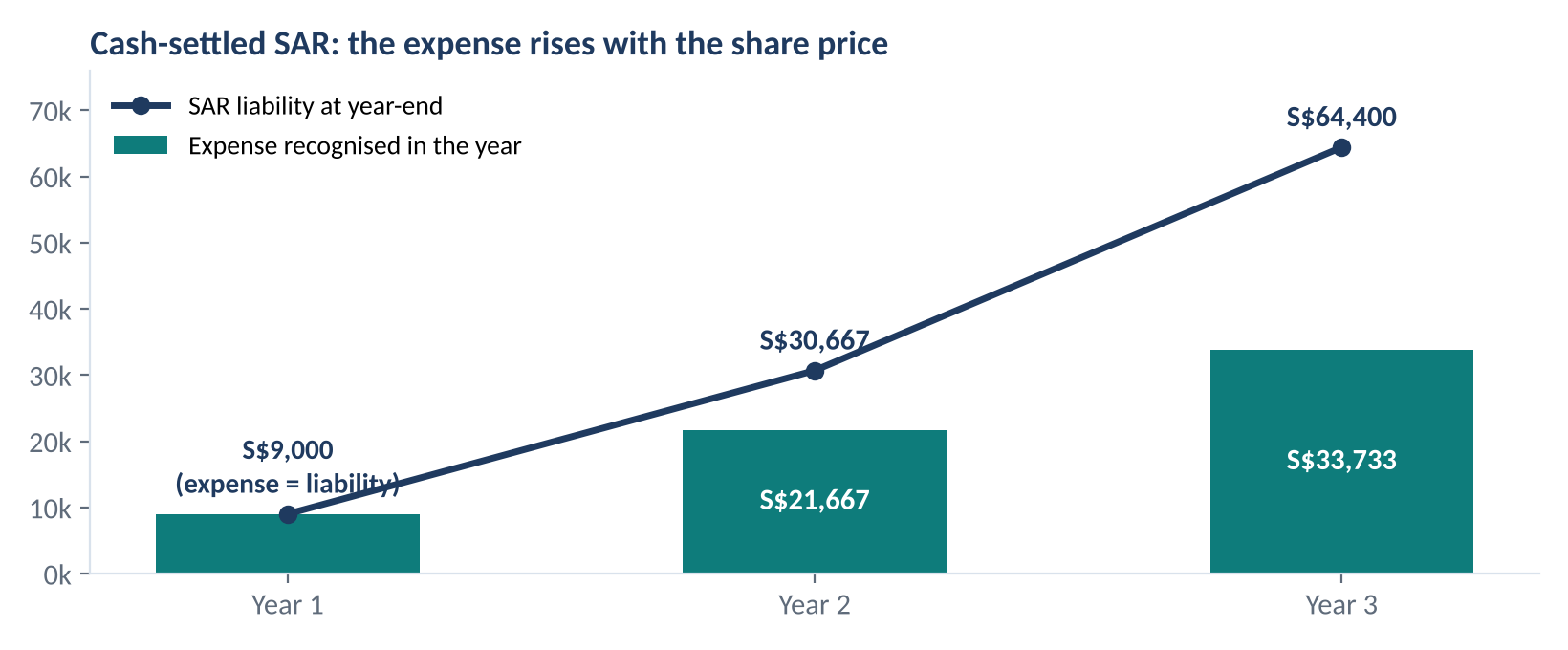
That volatility is not an accounting quirk. It is built into a cash SAR, because the company has promised a value that moves with its share price. IFRS Foundation implementation material shows the same effect, and notes that an unexercised SAR's fair value can exceed its intrinsic value because it still carries future upside. [33]
Equity-settled SAR: the same award, steadier numbers
For an employee equity-settled award, the service received is generally measured by the grant-date fair value of the equity instruments, subject to IFRS 2's rules on vesting and performance conditions. That value is not remeasured every period because the share price has moved. [2]
Classification still needs checking where settlement involves a variable number of shares, a cash choice for either side, group-company shares or tax-net-settlement features. IFRS 2 has specific rules on cash alternatives and modifications. [5]
| Cash-settled | Equity-settled | |
|---|---|---|
| Measured at | Fair value, re-done every reporting date | Grant-date fair value, fixed |
| Credit side | Liability | Equity reserve |
| Total cost in the examples above | S$64,400 (follows the share price) | S$22,080 (fixed at grant; only the service outcome changes it) |
| Volatility in profit or loss | High | Low |
Market conditions versus performance conditions
A target of "EBITDA ≥ S$10 million" is not accounted for like "share price ≥ S$20". IFRS 2 separates market conditions from other vesting conditions. A market condition can be built into grant-date fair value, so an equity-settled expense may not be reversed just because the market hurdle later fails, provided the service and non-market conditions are met. Cash awards, by contrast, keep being remeasured. [2]
Valuation methods
A vested SAR with no optionality left may sit near intrinsic value, max(0, S − K). An outstanding SAR that can be exercised for years has time value, so valuation may draw on:
|
|
The IFRS Foundation's SAR example shows fair value exceeding intrinsic value because the holder can wait and share in later appreciation. [33] For a start-up, "last funding price minus strike" is therefore not automatically an IFRS 2 fair value.
Deferred tax
Do not simply multiply the IFRS 2 expense by Singapore's corporate tax rate and call that deferred tax. IAS 12 deals specifically with share-based payments. Where a future deduction is expected, the deductible temporary difference rests on the amount the tax authority is expected to allow; if that depends on a future share price, estimate it from information at the reporting date. If the estimated deduction exceeds the cumulative accounting expense, the excess tax effect may belong in equity rather than profit or loss. [34]
So settle Singapore deductibility first. Direct new-share issues, treasury-share arrangements, holding-company recharges and cash SARs do not necessarily give identical deductions. [25]
Group arrangements: parent issuer, subsidiary employer
Two common patterns:
Foreign Parent grants Parent SARs or shares → employee works for Singapore Sub.
Singapore Parent grants awards → employee works for India Sub.
IFRS 2's group rules look at which entity receives the employee's services, which entity bears the settlement obligation and whether the award is settled in cash or equity. The subsidiary's own accounts can therefore classify the award differently from the consolidated accounts. [5]
The accounting must then be reconciled with the intercompany recharge and Singapore transfer-pricing treatment. Don't assume the consolidated IFRS 2 expense is the amount the local company can deduct. [26]
Disclosures and the working-paper file
IFRS 2 requires disclosures that let users understand the nature and extent of the arrangements, how fair value was determined and the effect on profit or loss and financial position. [5] For a material plan, keep on file:
|
|
That file is not bureaucratic decoration. It is the bridge between HR's award spreadsheet and the audited financial statements.
PART 6
Cross-border SARs, data, insolvency and disputes
Analyse by workday and legal capacity, not by where the issuer happens to be incorporated
The cross-border matrix
| Question | The Singapore answer may depend on | The foreign answer may depend on |
|---|---|---|
| Employment tax | Where the services behind the award were performed | Residence, work location, treaty |
| Payroll withholding | Employer or payor, and tax-clearance status | The local withholding employer |
| Social security | CPF: citizenship or PR status and wage classification | The local social-security regime |
| Securities | The instrument and the offer | Local securities exemptions |
| Exchange control | Settlement and remittance route | The resident's ability to acquire and remit |
| Corporate tax | Employer cost and deduction | Recharge and deduction |
| Transfer pricing | Arm's-length group allocation | Corresponding local rules |
| Data | PDPA | Destination-country privacy law |
| Permanent establishment | The employee's activities | Treaty and domestic law |
Source allocation for mobile employees
IRAS's 30 January 2026 guide explains that section 10(6) attributes ESOP/ESOW gains by reference to the employment for which the award was granted. Awards granted while exercising employment in Singapore are Singapore employment income; grants for overseas employment are treated differently. [6]
Mobile cases are harder: an award granted in Singapore, vesting over services in several countries, exercised after departure. They call for a work-history and treaty analysis, not a simple "tax where paid" rule.
An illustration: Singapore to India
You need at least five separate analyses:
| Lens | What to work out |
|---|---|
| 1. Singapore sourcing | Which part of the benefit relates to Singapore employment. For a share-settled award within section 10(6), the IRAS employee-share guidance is the starting point. For a pure cash SAR outside ESOW, ordinary employment-income sourcing and entitlement principles apply separately. [6] |
| 2. Indian tax | India replaced the Income-tax Act 1961 with the Income-tax Act 2025, effective 1 April 2026, which keeps salary and perquisite concepts and specific treatment for employee-acquired securities and options. [35] For a conventional option, the perquisite machinery looks at fair market value on exercise or allotment less what the employee paid. A pure cash SAR where no security is acquired fits that mechanism awkwardly and may fall under the broader salary rules. [36] That is a reason to take Indian advice, not to assume the benefit is tax-free. |
| 3. Indian withholding | Under the new Act, section 392 governs deduction from salary from 1 April 2026 using the applicable average-rate method. The local payroll analysis must decide who carries the obligation when Singapore Parent pays a benefit tied to employment with an Indian group company. [37] |
| 4. Treaty | Article 15 of the Singapore–India treaty generally allocates employment income by where the employment is exercised, subject to its short-stay exception and employer or PE conditions. This can matter where value spans Singapore and Indian service periods. [38] |
| 5. Exchange control | RBI's overseas-investment framework lets resident-individual employees and directors acquire foreign ownership interests under qualifying employee schemes, subject to conditions, categorisation and reporting. [39] |
A pure cash SAR that never gives the Indian resident an ownership interest is analytically different from one settled in Singapore Parent shares. If shares are delivered, the overseas-investment rules, authorised-dealer processes, ongoing reporting, later sale proceeds and the prevailing Liberalised Remittance Scheme may all matter. If only cash is received, the acquisition-of-foreign-security rules may not apply in the same way, though banking, tax and reporting duties remain.
Cross-border checklist
For every mobile participant, capture this before settlement, not after a six-figure payment has gone out:
|
|
Data protection
SAR administration touches names, identifiers, salaries, performance ratings, bank accounts, tax IDs, vesting history, termination reasons and sometimes disciplinary information. The PDPA applies to employment-related personal data, subject to its exceptions and purposes, and PDPC guidance specifically discusses employment records, performance information and remuneration information. [40]
When data goes to an overseas parent, a cap-table provider, a payroll vendor, a broker or a plan administrator, the Transfer Limitation Obligation requires the Singapore organisation to ensure protection comparable to the PDPA. PDPC guidance lists legally enforceable contractual obligations, binding corporate rules and specified certifications among the permitted tools. [41]
The PDPC's guidance portal also lists a new Guide to Cross-Border Data Transfers (14 April 2026) and sample transfer clauses (2 April 2026), which makes this a live item for multinational plans. [42]
Insolvency: the cash SAR's blind spot
Cash SAR holders face a risk that equity holders sometimes overlook: the company may owe them money exactly when it has the least cash.
The Insolvency, Restructuring and Dissolution Act gives statutory priority to specified employee wage and salary claims, after higher-ranking liquidation costs and within statutory limits. [43] The prescribed cap is set by the applicable maximum-amount order and should be checked at the insolvency date; the 2026 order refers to a formula involving five months' salary and a prescribed ceiling. [44]
A participant who has actually become a shareholder is in a different position altogether: shareholder claims rank behind creditors. That is why "cash SAR versus equity SAR" is also a credit-risk decision.
Disputes
SAR disputes are remarkably predictable. These are the usual flashpoints:
|
|
The best defence is not a clause saying "the Board's determination is final and conclusive". A stronger design defines the methodology: the valuation source, expert appointment, review mechanism, manifest-error standard, conflicts, timing, costs and the treatment of extraordinary corporate events.
PART 7
The implementation playbook
Design the economics first, classify second, document third, grant fourth
Step by step
| Step | What to do |
|---|---|
| 1. Commercial design | Decide what behaviour the plan should reward. For a start-up wanting retention without a cluttered cap table, a cash SAR can be elegant, but only if the business can fund a large exit-time liability. For a cash-constrained company expecting big appreciation, an equity-settled SAR may be safer economically, at the cost of dilution and more corporate admin. |
| 2. Choose the reference equity | Ordinary shares, preference shares, parent shares or a synthetic enterprise-value unit? Settle which economic layer participants track before writing "Company Share". |
| 3. Choose the base value | Fix the grant-date base and the valuation source, and record the board's supporting evidence. |
| 4. Choose settlement | Cash, new shares, treasury shares, existing shares, or issuer election. |
| 5. Model the extremes | Don't model only the expected case (see the next section). |
| 6. Run classification memos | Short written conclusions on company law, SFA/SGX, tax, CPF, accounting and cross-border treatment. For a listed or multinational plan, run these as separate workstreams, since the tests are not interchangeable. [1] |
| 7. Obtain approvals | Board, shareholders, remuneration committee, investor consent, and SGX approval or disclosure where applicable. New shares need a section 161 analysis; director emoluments may need section 169 approval. [1] |
| 8. Prepare documents | Plan rules, board and member resolutions, grant letter, acceptance, data notice or consent mechanism where appropriate, valuation file, accounting paper, tax memo, payroll instructions and intercompany recharge agreement. |
| 9. Set up controls | HRIS records must match the legal grant register. Finance needs vesting and forfeiture data. Payroll needs settlement and tax classification. Company secretarial needs advance notice of any allotment. International HR needs mobility alerts. |
| 10. Reassess every period | Cash SAR liabilities are remeasured under IFRS 2; staff changes alter vesting estimates; modifications can change the accounting. [2] |
| 11. Dry-run before settlement | Before an exit or settlement, close a rehearsal: participant list, vested units, base price, transaction price, preference waterfall, tax, CPF, withholding, share authority, ACRA filings, bank details, foreign-exchange documents and accounting entries. |
Model the extremes: cash exposure
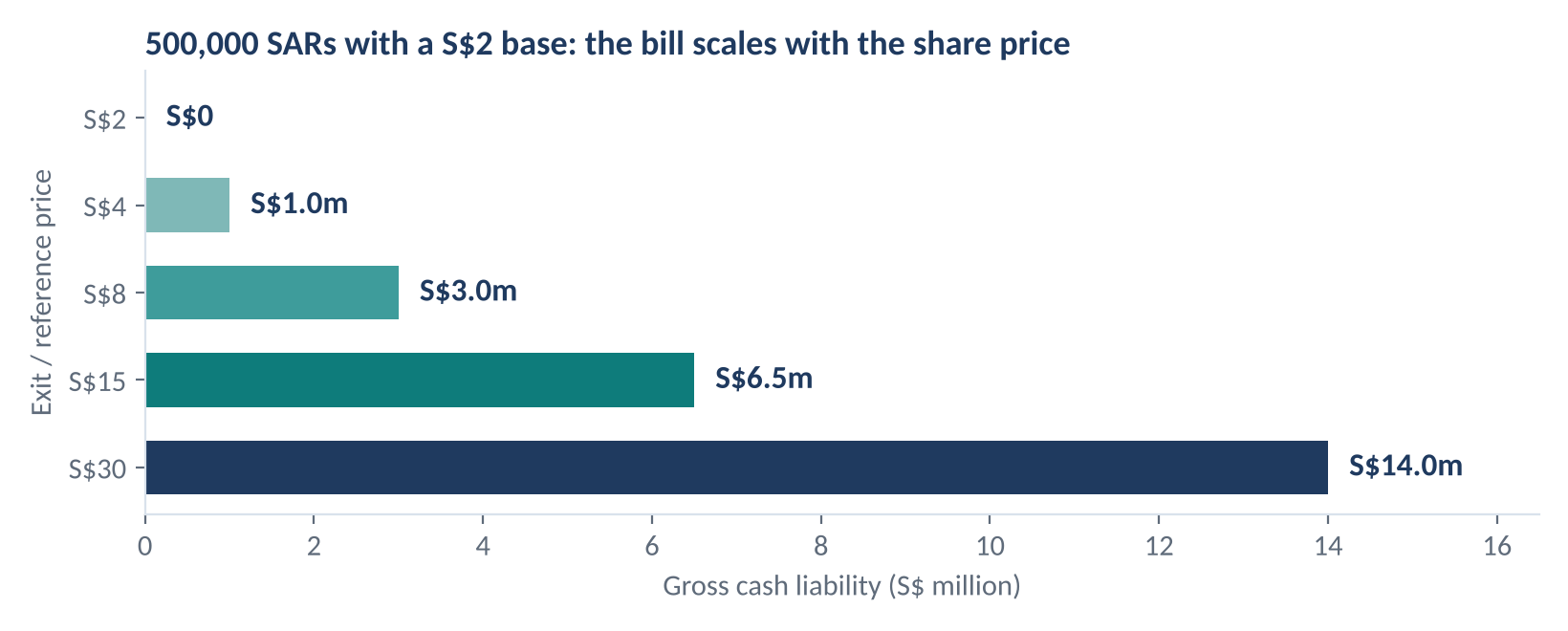
Example: 500,000 SARs with a S$2 base. The company that celebrates a S$30 share price may, in the same breath, find it owes S$14 million in cash.
| Exit / reference price | Appreciation per SAR | Gross cash liability |
|---|---|---|
| S$2 | S$0 | S$0 |
| S$4 | S$2 | S$1.0m |
| S$8 | S$6 | S$3.0m |
| S$15 | S$13 | S$6.5m |
| S$30 | S$28 | S$14.0m |
And the dilution if it were net-share settled
At S$15 a share, a S$6.5 million obligation equals about 433,333 shares (6.5m ÷ 15). If there were 10 million fully diluted shares beforehand:
This is a simplified illustration. A real fully diluted count must include existing options, convertibles, preference rights, treasury shares and the deal mechanics.
A sample term-sheet architecture
These are illustrative drafting concepts, not execution-ready clauses.
| Term | Example | Why it matters |
|---|---|---|
| Grant | "100,000 SARs" | Defines the units |
| Reference Share | Ordinary share of Singapore Parent | Prevents preference/common ambiguity |
| Base Price | S$4.25 per SAR | Defines the appreciation starting line |
| Grant Date | Valid board approval plus participant communication complete | Accounting and legal clarity |
| Vesting | 25% per anniversary over four years | Retention |
| Cliff | First 25% after 12 months | Avoids tiny early vesting |
| Performance condition | ARR ≥ S$20m for the final 25% | Performance link |
| Exercise | Vested SARs exercisable in 90-day windows | Administration |
| Expiry | 7 years from grant | Caps the life of the award |
| Settlement | Company pays cash unless the Board elects shares | The major classification issue |
| SAR value | max(0, FMV − Base Price) × units | Core economics |
| FMV | SGX price, independent valuation or exit price, as applicable | Dispute prevention |
| Leaver | Unvested lapse; vested depends on leaver category | Retention and disputes |
| Exit | Automatic exercise at completion | Liquidity |
| Acceleration | Double trigger, or defined partial acceleration | M&A economics |
| Tax | Company may withhold or deduct required amounts | Payroll |
| Clawback | Fraud, misstatement or regulatory trigger | Governance |
| Adjustment | Stock split, bonus issue, consolidation, reconstruction | Preserves the economics |
| No shareholder rights | None until shares are actually issued | Corporate clarity |
| Transfer | Generally prohibited, except death or estate | Keeps the award personal |
| Data | Administration and overseas-processor provisions | PDPA |
| Governing law | Singapore | Conflict rules |
| Disputes | Singapore courts, or an agreed arbitration or expert mechanism | Enforcement |
What the grant letter must answer
A participant should be able to answer all of these from one letter, without trawling five documents:
|
|
The documentation stack
| Layer | What it holds |
|---|---|
| Corporate | Board resolutions; member resolutions where needed; section 161 authority; section 169 approval for directors where applicable; constitution and investor-consent review. [1] |
| Contract | Master plan; individual grant letter; acceptance; leaver schedule; exit mechanics. |
| Finance | IFRS 2 / SFRS(I) 2 memo; valuation; deferred-tax memo; forecast liability and dilution. |
| Tax | Employee classification; ESOP/ESOW versus cash-remuneration analysis; CPF; payroll; tax-clearance procedure; corporate deduction; withholding; stamp duty and GST note. [4] |
| Cross-border | Participant-country addenda; treaty analysis; securities exemptions; exchange-control forms; mobility tracking; data-transfer safeguards. |
| Intercompany | Recharge agreement; TP method; accounting entries; invoices if appropriate; local deduction analysis. [26] |
Start-up, mature private company, SGX-listed issuer
| Issue | Start-up | Mature private | SGX-listed |
|---|---|---|---|
| Price discovery | Difficult | Periodic valuations or transactions | Observable market price |
| Cash-SAR liquidity risk | Potentially severe | Usually easier to model | Potentially significant but financeable |
| Sensitivity to equity dilution | Very high | High | Constrained by public shareholders |
| Value of a clean cap table | Very high | Moderate to high | Less important |
| Securities / listing layer | SFA exemptions | SFA exemptions | SFA plus SGX rules |
| Accounting valuation | Complex | Moderate to complex | Easier: observable inputs |
| Exit-only design | Common | Common | Less necessary |
| Insider dealing and disclosure | Mostly private-law focus | Mostly private-law focus | A major governance issue |
SGX's share-scheme limits and shareholder-approval provisions make a listed company's equity SAR design noticeably more constrained than the private-company equivalent. [14]
The twelve highest-risk mistakes
| Mistake | Why it hurts |
|---|---|
| Calling it "phantom stock" without defining the payoff | Nobody can tell whether it tracks full value or appreciation. |
| Using "FMV as determined by the Board in its absolute discretion" as the whole valuation policy | Convenient at grant, combustible at exit. |
| Using the investor financing price as ordinary-share value without checking preference rights | Overstates what common holders would receive. |
| Promising cash without modelling the exit-time liability | The company can owe more than it can pay. |
| Promising shares without checking section 161 authority and the constitution | The issue may be invalid or blocked. [1] |
| Assuming cash SARs automatically fall under the ESOP/ESOW tax rules | IRAS expressly excludes pure cash phantom plans. [4] |
| Assuming share settlement means no CPF issue, and forgetting cash equalisation or subsidies | CPF Board separates shares in kind from cash paid to buy or subsidise shares. [22] |
| Forgetting tax clearance when a foreign employee leaves | Withholding and clearance duties can be missed. [20] |
| Treating the IFRS 2 expense as the corporate tax deduction | The two are different tests. [34] |
| Leaving an intercompany parent-award recharge undocumented | IRAS's 2026 TP guidance addresses share-based pay in service cost bases. [26] |
| Ignoring overseas data transfers to a global cap-table administrator | The Transfer Limitation Obligation applies. [41] |
| Using one grant template for employees, consultants and directors | Their tax, company-law and withholding profiles differ. [11] |
Questions to bring to your advisers
Bring these, instead of asking "is our SAR plan legal?"
For Singapore counsel
|
|
For your Singapore tax adviser
|
|
The fast decision tree
| Question | If YES | If NO |
|---|---|---|
| Does the participant ever receive shares? | Equity / share route: identify the issuer and share class · s 161 authority · constitution and investor approvals · SFA offer exemption · SGX rules if listed · ESOP/ESOW tax analysis · share valuation · stamp duty if existing shares are transferred | Cash SAR / phantom route: model the cash liability · IFRS 2 liability and remeasurement · general employment-remuneration tax analysis · CPF analysis for cash wages · check SFA derivative classification |
| Is the participant a director? | s 169 · conflicts · director tax and withholding review | No extra director review |
| Is the participant outside Singapore, or mobile? | Source · treaty · payroll · FX · securities · data review | Standard Singapore analysis |
| Is the issuer different from the employing company? | Group IFRS 2 · recharge · transfer pricing · corporate-tax deduction | Single-entity analysis |
REFERENCE
Frequently asked questions
Quick answers, with pointers back to the detail
Can a Singapore company grant SARs without setting up a formal ESOP?
Yes. A company can create an appreciation-based incentive by contract. Whether company-law, securities, tax, employment and accounting rules then apply depends on the terms. A cash SAR does not become an ESOP merely because its value tracks shares, and IRAS expressly excludes pure cash phantom-share plans from its ESOW definition. [4]
Must shareholders approve every cash SAR?
There is no universal Companies Act rule that every employee cash bonus or cash SAR needs shareholder approval. Board authority, the constitution and reserved matters, director-emolument rules and conflicts must still be checked. Shareholder approval becomes especially relevant where shares will be issued under section 161, or a director's office-related emoluments fall within section 169. [1]
Are SARs taxable at grant in Singapore?
Not as a general rule. The ESOP/ESOW regime generally taxes share benefits later (at exercise, vesting or when restrictions lift), and pure cash phantom plans sit outside that definition and need ordinary remuneration analysis. [4]
Is vesting the same as exercise?
No. Vesting means the conditions for keeping or exercising the right are met. Exercise is the act of crystallising an exercisable right. A plan can provide automatic settlement without any exercise.
Can vested SARs be worthless?
Yes. If the reference share is below the base price, an appreciation-only SAR has no intrinsic value even when fully vested.
Can cash SARs cause dilution?
Not legal share dilution, if settled only in cash. They can still carry substantial economic cost and accounting liabilities.
Are equity SARs cheaper in accounting terms?
Not necessarily. They often give steadier numbers because employee equity-settled awards use grant-date fair value instead of continued remeasurement, but they still produce IFRS 2 expense and can carry significant grant-date value. [5]
Can a start-up use its latest funding price as the SAR price?
It can define a contractual reference price that way. That doesn't make the price correct for IFRS 2, tax or fiduciary purposes, especially where the financing instrument carries preference rights.
Does issuing shares trigger CPF?
CPF Board guidance says shares given in kind or at a discount are not wages attracting CPF, while cash paid to buy or subsidise shares is contributable. [22]
Does a cash payout after resignation escape CPF?
Not necessarily. CPF Board says cash benefits paid after departure can stay contributable where they relate to the employment. [23]
Could a SAR payment to a non-resident director attract withholding tax?
Yes. Director remuneration has specific non-resident rules, and share-plan gains have separate reporting mechanics, so the capacity in which the person receives the award matters. [16]
Does an equity SAR require the employee to put up cash?
Not necessarily. Net-share settlement typically delivers shares worth the appreciation, with no need for the participant to fund the base price.
Can a SAR be granted over parent-company shares to a subsidiary employee?
Yes as an economic structure, but group IFRS 2 accounting, local employment tax, intercompany recharge, transfer pricing, securities and corporate-deduction questions all then need solving. [5]
Are SARs protected if the company becomes insolvent?
Don't assume so. Singapore gives preferential status to specified wage and salary claims, within limits, but whether a SAR claim qualifies depends on its legal character. Any residual unsecured claim faces ordinary insolvency risk. [43]
Glossary in plain English
| Term | Meaning |
|---|---|
| Appreciation | The increase in reference-share value above the SAR base price. |
| Base price / strike price | The starting value against which appreciation is measured. |
| Cash-settled SAR | A SAR discharged by paying money instead of delivering shares. |
| Cliff | The minimum service period before the first tranche vests. |
| Clawback | Recovery of remuneration already delivered, after specified triggers. |
| Double-trigger acceleration | Acceleration that needs both a change of control and another event, usually termination. |
| EEBR | Employee equity-based remuneration: IRAS terminology for the share-remuneration deduction rules. [25] |
| ESOP | Employee stock option plan: participants generally get options to acquire shares at an exercise price. |
| ESOW | IRAS's employee share-ownership-plan category, which specifically excludes a pure cash phantom plan with no possibility of acquiring shares. [4] |
| Exercise | The participant action that crystallises an exercisable right. |
| Fair value | An accounting measure; not necessarily the same as intrinsic value or the latest funding price. |
| Fair Market Value (FMV) | A contractual or tax valuation concept whose exact meaning depends on the governing provision. |
| Good / bad leaver | Contractual categories that decide how awards are treated after departure. |
| Grant date | The accounting and legal date on which the award is treated as granted once the applicable conditions are met; crucial to equity-settled IFRS 2 valuation. [2] |
| Intrinsic value | For a simple SAR, the positive excess of current share value over the base price. |
| Liquidity event | An event, such as a sale or IPO, that lets holders realise value. |
| Malus | Reduction or cancellation of unvested remuneration after specified adverse events. |
| NAV | Net asset value: relevant to some unlisted-share valuation contexts, but not a universal substitute for fair value. [45] |
| Net-share settlement | Delivering only enough shares to equal the SAR appreciation, instead of one share per SAR. |
| Phantom equity | Contractual synthetic equity; may track full value or just appreciation, and may never create share ownership. |
| RSU | Restricted stock unit: typically a promise to deliver the full value of a share once vesting conditions are met. |
| SAR | Stock Appreciation Right: a right to economic value linked to appreciation in a reference share or equity value. |
| SFRS(I) 2 / FRS 102 / IFRS 2 | The share-based payment accounting standards under the Singapore and international frameworks. [32] |
| Share- / equity-settled SAR | A SAR whose obligation is discharged with equity instruments, subject to the exact IFRS 2 classification of its terms. |
| Single-trigger acceleration | Vesting acceleration caused solely by a defined change of control. |
| Vesting | Satisfaction of the conditions to earn or keep the award. |
SOURCES
Sources
Numbers in square brackets in the text refer to this list. Links were cleaned of tracking parameters.
[1] Companies Act 1967, s 161 – Singapore Statutes Online — https://sso.agc.gov.sg/Act/CoA1967?ProvIds=pr161-&force_isolation=true
[2] IFRS 2 Share-based Payment (standard text) — https://www.ifrs.org/content/dam/ifrs/publications/pdf-standards/english/2022/issued/part-a/ifrs-2-share-based-payment.pdf?bypass=on
[3] Securities and Futures Act 2001 – Singapore Statutes Online — https://sso.agc.gov.sg/Act/SFA2001
[4] IRAS | Gains from the exercise of stock options — https://www.iras.gov.sg/taxes/individual-income-tax/basics-of-individual-income-tax/what-is-taxable-what-is-not/employment-income/gains-from-the-exercise-of-stock-options
[5] IFRS 2 Share-based Payment (IFRS Foundation page) — https://www.ifrs.org/issued-standards/list-of-standards/ifrs-2-share-based-payment/
[6] IRAS e-Tax Guide: Tax Treatment of Employee Stock Options and Other Forms of Employee Share Ownership Plans (30 Jan 2026) — https://www.iras.gov.sg/media/docs/default-source/e-tax/etaxguides_iit_esop_2026-01-30.pdf
[7] MOM | Paying salary — https://www.mom.gov.sg/employment-practices/salary/paying-salary
[8] Companies Act 1967, s 157 – Singapore Statutes Online — https://sso.agc.gov.sg/Act/CoA1967?ProvIds=pr157-&ViewType=Advance
[9] ACRA | Filing a return of allotment of shares — https://www.acra.gov.sg/manage/companies/shares/allotment-of-shares/
[10] ACRA | Preparing or adopting a company constitution — https://www.acra.gov.sg/register/business/registering-different-business-structures/local-company/company-constitution/
[11] Companies Act 1967, s 169 – Singapore Statutes Online — https://sso.agc.gov.sg/Act/CoA1967?ProvIds=pr169-
[12] MAS | Guide on the Tokenisation of Capital Markets Products — https://www.mas.gov.sg/-/media/mas/sectors/guidance/guide-on-the-tokenisation-of-capital-markets-products.pdf
[13] MAS | Offers of Securities and Securities-based Derivatives Contracts — https://www.mas.gov.sg/regulation/capital-markets/offers-of-securities-and-securities-based-derivatives-contracts?force_isolation=true
[14] SGX Rulebook | Mainboard Rules — https://rulebook.sgx.com/rulebook/mainboard-rules
[15] SGX Rulebook | Rule 845 — https://rulebook.sgx.com/rulebook/845
[16] IRAS | Tax obligations for non-resident directors — https://www.iras.gov.sg/taxes/withholding-tax/payments-to-non-resident-director/tax-obligations-for-non-resident-director
[17] IRAS | Tax obligations for non-resident professionals — https://www.iras.gov.sg/taxes/withholding-tax/payments-to-non-resident-professional-%28consultant-trainer-coach-etc-%29/tax-obligations-for-non-resident-professional
[18] IRAS | Employment income (salary, bonus, director's fee, commission and others) — https://www.iras.gov.sg/taxes/individual-income-tax/basics-of-individual-income-tax/what-is-taxable-what-is-not/employment-income/salary-bonus-director%27s-fee-commission-and-others
[19] IRAS | Reporting employee earnings (IR8A, Appendix 8A/8B) and the Auto-Inclusion Scheme — https://www.iras.gov.sg/taxes/individual-income-tax/employers/auto-inclusion-scheme-%28ais%29-for-employment-income/reporting-employee-earnings-%28ir8a-appendix-8a-appendix-8b%29
[20] IRAS | Tax clearance for non-Singapore citizen employees — https://www.iras.gov.sg/taxes/individual-income-tax/employees/scenario-based-faqs-for-working-in-singapore-and-abroad/tax-clearance-for-non-singapore-citizen-employees
[21] CPF Board | What constitutes wages for CPF contributions — https://www.cpf.gov.sg/employer/employer-obligations/what-constitutes-wages-for-cpf-contributions
[22] CPF Board | Are CPF contributions payable on stocks or shares offered to my employees? — https://www.cpf.gov.sg/service/article/are-cpf-contributions-payable-on-stocks-or-shares-offered-to-my-employees
[23] CPF Board | Are CPF contributions payable on cash benefits given to my employee when he leaves his employment? — https://www.cpf.gov.sg/service/article/are-cpf-contributions-payable-on-cash-benefits-given-to-my-employee-when-he-leaves-his-employment
[24] IRAS | Business expenses (company deductions) — https://www.iras.gov.sg/taxes/corporate-income-tax/income-deductions-for-companies/business-expenses
[25] IRAS | Tax treatment of business expenses (A–F) — https://www.iras.gov.sg/taxes/corporate-income-tax/income-deductions-for-companies/business-expenses/tax-treatment-of-business-expenses-%28a-f%29/
[26] IRAS | Transfer pricing — https://www.iras.gov.sg/taxes/international-tax/transfer-pricing
[27] IRAS | Transfer pricing (corporate income tax – specific topics) — https://www.iras.gov.sg/taxes/corporate-income-tax/specific-topics/transfer-pricing
[28] IRAS | GST: General guide for businesses — https://www.iras.gov.sg/docs/default-source/e-tax/etaxguide_gst_gst-general-guide-for-businesses%281%29.pdf
[29] IRAS | GST – finance sector — https://www.iras.gov.sg/taxes/goods-services-tax-%28gst%29/specific-business-sectors/finance
[30] IRAS | Stamp duty rates — https://www.iras.gov.sg/quick-links/tax-rates/stamp-duty
[31] IRAS | Stamp duty basics for shares — https://www.iras.gov.sg/taxes/stamp-duty/for-shares/basics-of-stamp-duty-for-shares/learning-the-basics-for-shares
[32] ACRA | Guide to accounting standards — https://www.acra.gov.sg/regulations/accounting-standards-financial-reporting-surveillance/accounting-standards/
[33] IFRS for SMEs | Module 26 – Share-based Payment — https://www.ifrs.org/content/dam/ifrs/supporting-implementation/smes/module-26.pdf
[34] IAS 12 Income Taxes — https://www.ifrs.org/content/dam/ifrs/publications/pdf-standards/english/2022/issued/part-a/ias-12-income-taxes.pdf?bypass=on
[35] Income Tax Department (India) | Objective and scope of the New Act — https://www.incometax.gov.in/iec/foportal/help/all-topics/e-filing-services/objective-and-scope-new-act
[36] Income Tax Department (India) | Section 17 (Income-tax Act 2025) — https://www.incometaxindia.gov.in/w/section-17-225
[37] Income Tax Department (India) | Section 392 (Income-tax Act 2025) — https://wmstatic-prd.incometaxindia.gov.in/web/guest/w/section-392-5
[38] Income Tax Department (India) | Singapore – synthesised text of the treaty — https://wm.incometaxindia.gov.in/w/singapore-synthesised-text-1
[39] Reserve Bank of India | Overseas investment framework — https://www.rbi.org.in/scripts/bs_viewcontent.aspx?Id=4024
[40] PDPC | Advisory Guidelines on the PDPA for Selected Topics — https://www.pdpc.gov.sg/-/media/Files/PDPC/PDF-Files/Advisory-Guidelines/AG-on-Selected-Topics/Advisory-Guidelines-on-PDPA-for-Selected-Topics-310322.ashx?la=en
[41] PDPC | Advisory Guidelines on Key Concepts in the PDPA — https://www.pdpc.gov.sg/-/media/Files/PDPC/PDF-Files/Advisory-Guidelines/AG-on-Key-Concepts/Advisory-Guidelines-on-Key-Concepts-in-the-PDPA-17-May-2022.pdf
[42] PDPC | Guidance by topic — https://www.pdpc.gov.sg/organisations/resources/guidance-by-topic
[43] Insolvency, Restructuring and Dissolution Act 2018, s 203 – Singapore Statutes Online — https://sso.agc.gov.sg/Act/IRDA2018?ProvIds=pr203-
[44] Insolvency, Restructuring and Dissolution Act 2018 – subsidiary legislation S 621/2020 – Singapore Statutes Online — https://sso.agc.gov.sg/SL/IRDA2018-S621-2020?DocDate=20200728&ProvIds=pr2-&ValidDate=20200730
[45] IRAS | Explanatory notes on Appendix 8B for YA 2026 — https://www.iras.gov.sg/docs/default-source/individual-income-tax/employers/explanatory-notes-on-appendix-8b-for-ya2026.pdf
This guide is general information, not legal, tax or accounting advice. Rates, thresholds and guidance cited reflect the underlying source's position as described there; confirm against the current primary source before relying on any figure.