
Deep research, clear legal explanations, practical examples and references.
Research material current to November 2026. General information only; confirm current law, facts and professional guidance before relying on it.
0% UAE personal income tax on employment income |
9% federal corporate tax rate on taxable income above AED 375,000 |
3+ legal systems: mainland, DIFC, ADGM and other free zones |
1 Jan 2026 new federal capital-markets laws in force |
The UAE has no single rulebook for "SARs", and the label does not decide the treatment; the plumbing does. So rather than asking "what are the rules for SARs?", ask these four questions about any particular award:
1 What exactly was promised? |
2 Who owes the promise? |
3 How can it be settled? |
4 What event turns it into value? |
The answers settle most of what follows. The UAE adds a fifth, silent question that must be asked first: in which legal system does the issuer, and the employer, sit?
What this guide covers
The guide is current to 17 November 2026. It looks at SARs granted by a UAE entity (an onshore LLC or joint stock company, a DIFC or ADGM company, or another free-zone entity) to employees, directors and consultants; at private, start-up and listed issuers; at cash and share settlement; at awards by a foreign parent to staff of a UAE subsidiary; and, as an illustration, at a UAE-India mobility scenario. UAE federal legislation and the Ministry of Finance, Federal Tax Authority (FTA), DIFC, ADGM and accounting-standard sources come first; Indian sources are used only for the India example. [19,1,15]
SAR here means Stock Appreciation Right. Nothing to do with Suspicious Activity Reports, Special Administrative Regions, or radar.
How to read it
| Part | What you will get | Read it if you are… |
|---|---|---|
| 1 The mental model | The SAR formula, the settlement types and six tempting myths | New to SARs |
| 2 How SARs work | Lifecycle, valuation, dilution, cash exposure, leavers, exits | Designing a plan |
| 3 Corporate and securities law | Mainland, DIFC, ADGM, approvals, directors, capital-markets law | Counsel, company secretary |
| 4 Tax, labour law and more | Corporate tax, Article 36, gratuity, deductions, WPS, VAT | HR, payroll, tax |
| 5 Accounting | Worked IFRS 2 journal entries for cash and equity SARs | Finance team |
| 6 Cross-border and risk | Mobility, the India case, data, insolvency, disputes | Group and mobility teams |
| 7 Playbook | Steps, term sheet, checklists, mistakes, questions for advisers | Everyone, before launch |
| FAQ and Glossary | Quick answers and plain-English definitions | Anyone who skipped ahead |
PART 1
The mental model
One formula, four settlement styles, six myths to drop
The payoff in one line
Take a holder with 10,000 SARs, a base price of AED 40, and a reference share worth AED 95 on exercise. The gain per SAR is AED 55, so:
AED 55 gain per SAR |
× 10,000 vested SARs |
AED 550,000 SAR value |
How that AED 550,000 reaches the holder is a design choice. It could be:
paid entirely in cash;
delivered as roughly 5,789 shares (AED 550,000 ÷ AED 95);
split between shares and cash, for example to round off fractions; or
reshaped by caps, hurdles, exit multiples, performance conditions or valuation adjustments written into the plan.
Four ways to settle, four different consequences
Almost every downstream question starts from how the SAR is settled:
| Type | Holder receives | Typical corporate effect | Accounting starting point |
|---|---|---|---|
| Cash-settled | Cash equal to the appreciation | No shares needed; creates a cash obligation of the employer | A liability, remeasured through profit or loss |
| Equity-settled | Shares worth the appreciation | Share issue or transfer; approvals, pre-emption and register updates matter | An equity award, if the IFRS 2 conditions are met |
| Issuer-choice | Whatever the company elects: cash or shares | Turns on whether the company in substance has a present cash obligation | Fact-specific under IFRS 2 |
| Holder-choice | Whatever the holder elects | Often the most complex of the four | Possible compound instrument or liability consequences |
IFRS 2 itself uses cash SARs as its textbook example of a cash-settled award. Such awards are carried at fair value and remeasured at every reporting date and on settlement, with each change going through profit or loss. [35]
Six tempting shortcuts that are wrong
Each of these sounds sensible. Each can lead to a bad plan.
| The shortcut | Why it fails |
|---|---|
| "No income tax in the UAE, so SARs are tax-free." | True for the employee's UAE tax on salary. It says nothing about the employer's corporate-tax deduction, labour-law consequences, accounting, or tax in the employee's home country if they are mobile. [19,28] |
| "A SAR is just a bonus, so labour law does not care." | Federal labour law separates "wage" from "basic wage", regulates deductions and drives end-of-service gratuity. How the SAR is drafted decides which bucket it lands in. [15,16] |
| "Free-zone companies can ignore federal law." | The 2025 amendments to the Commercial Companies Law say free-zone companies are UAE juridical persons and that the law reaches their activity on the mainland. DIFC and ADGM keep their own regimes; other free zones vary. [6,2] |
| "No shares, so no securities law." | A purely contractual, non-transferable cash bonus may sit outside securities regulation, but that is a conclusion to reach by analysis, not an assumption. The federal capital-markets regime was rewritten on 1 January 2026 and reaches further than before. [8,12] |
| "Share settlement always means dilution." | Shares can be newly issued, taken from treasury or transferred by an existing holder. Only a fresh issue grows issued share capital, and a net-share SAR delivers far fewer shares than an option for the same upside (Part 2). |
| "If IFRS 2 says equity-settled, tax must agree." | The UAE corporate-tax computation starts from accounting income, then applies adjustments. An IFRS 2 label is a starting point, not a tax answer. [20,22] |
PART 2
How SARs work
From grant to payout: the lifecycle, valuation, dilution, cash exposure and exits
The lifecycle in five stages
Grant Award letter and plan rules |
Vest Time and performance conditions |
Trigger Exercise, exit or fixed date |
Settle Cash, shares or a mix |
Leave Good leaver, bad leaver, exit |
Each stage is a place where the plan can go wrong, and where law attaches consequences. The grant fixes the base price and who owes the promise. Vesting decides when accounting expense accrues. The trigger decides when value is crystallised. Settlement decides what the company must find (cash or shares). The leaver terms decide what happens when the employment ends, which in the UAE also engages labour law.
The terms every SAR needs to define
| Term | What to decide | UAE angle |
|---|---|---|
| Reference share | Which company's share value drives the SAR (issuer, parent, a subsidiary) | Group awards raise recharge and corporate-tax questions |
| Base price | The starting line the share must beat | Set from an independent valuation if the company is private |
| Vesting | Service period, performance hurdles, cliff or staged | Drives the IFRS 2 expense pattern (Part 5) |
| Trigger | Exercise window, exit event, or a fixed payment date | A fixed date looks more like wages; an exit trigger looks more like a bonus |
| Settlement | Cash, shares, issuer-choice or holder-choice | Decides approvals, pre-emption and the accounting class |
| Caps and floors | Maximum payout, minimum value, exit multiples | Helps budget the cash liability |
| Leaver terms | Resignation, dismissal, death, disability, retirement | Must not claw back earned wages or breach end-of-service rules |
| Change of control | Acceleration, roll-over or cash-out | Align with the shareholders' agreement drag and tag terms |
| Clawback | Misconduct, restatement, breach | Subject to the limits on deductions from wages (Part 4) |
| Governing law and forum | Which law and which court or arbitral seat | Mainland, DIFC and ADGM courts differ; see Part 6 |
Valuation: what is the share worth?
A listed company has a market price. A private or start-up issuer does not, and the base price and the payout both depend on a defensible value. In practice that means an independent valuation at grant and at each settlement or reporting date, using methods such as recent funding rounds, discounted cash flow, market multiples or option-pricing models. For a cash SAR the value must also be refreshed at every reporting date, because IFRS 2 remeasures the liability. [35]
Dilution: option versus net-share SAR
If a SAR is equity-settled, the usual route is net-share settlement: the holder pays nothing and receives shares worth only the gain. Compare that with an ordinary option, where the holder pays the strike and receives all the shares.
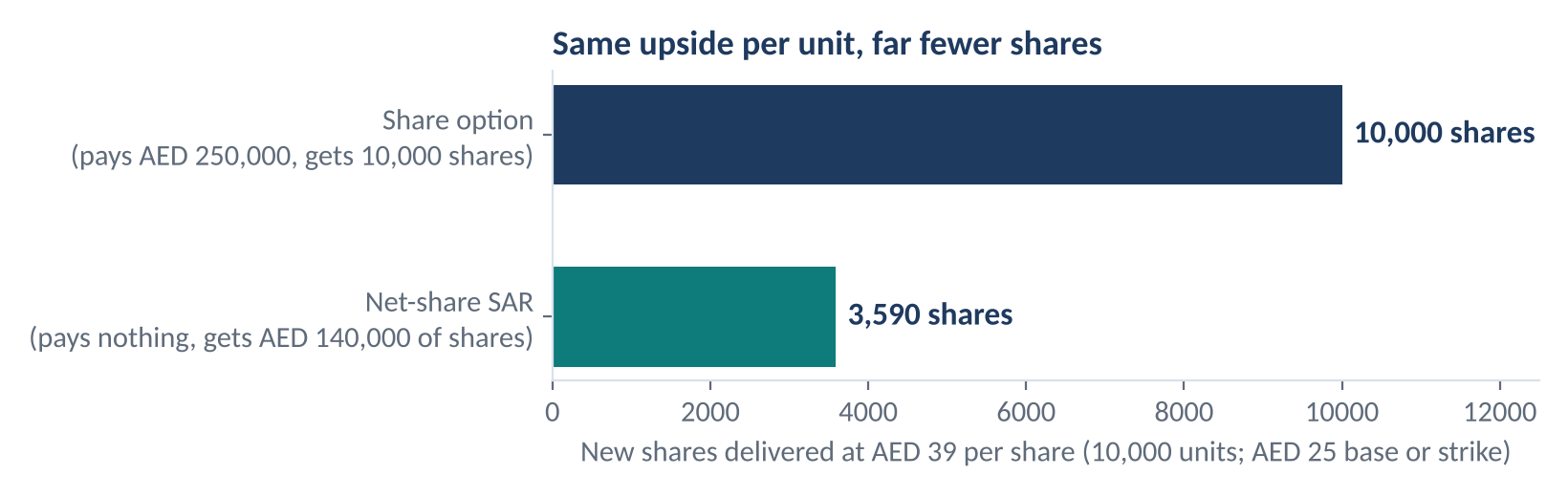
With a base of AED 25 and a share worth AED 39 on exercise, 10,000 options deliver 10,000 shares (against AED 250,000 paid in), while 10,000 net-share SARs deliver about 3,590 shares (AED 140,000 ÷ AED 39). The holder's economic gain is the same, but the cap table moves much less.
Cash exposure: the bill that surprises finance teams
A cash SAR has no cap on the company's side unless the plan adds one. The cost rises with the share price, which is exactly when the company is doing well and may be least liquid (for example just before a funding round).
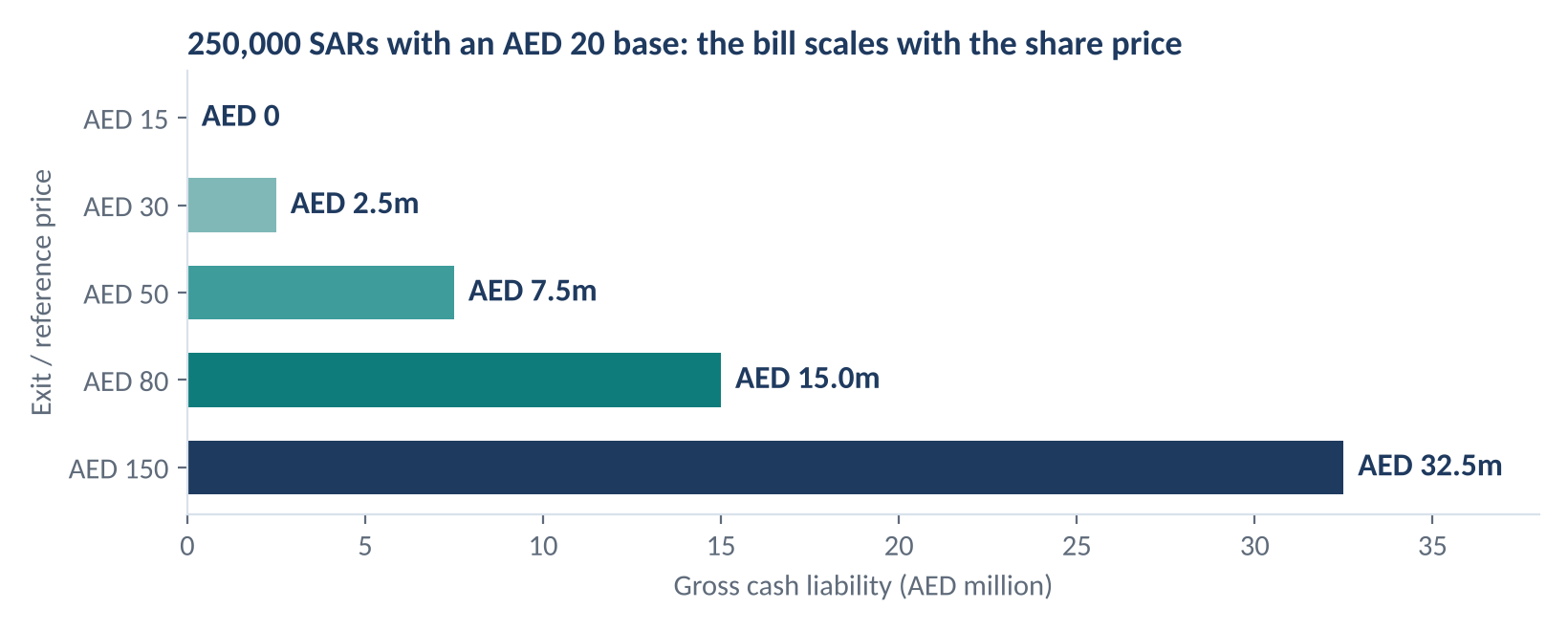
The chart uses 250,000 SARs with an AED 20 base. At AED 50 the gross liability is AED 7.5 million; at AED 150 it is AED 32.5 million. Three ways to manage it:
cap the payout per SAR or in total;
settle in shares (or a share-cash mix) so the company does not need to find all the cash;
link payment to a liquidity event (a sale or listing) so cash arrives when value is realised, and say clearly what happens if no event occurs.
Leavers: good, bad and everything in between
| Situation | Common SAR treatment | UAE caution |
|---|---|---|
| Good leaver (retirement, redundancy, death, disability) | Keep vested SARs; time-pro-rate or accelerate unvested ones | Ensure end-of-service benefits are calculated on basic wage as the law requires, not on the SAR payout |
| Bad leaver (dismissal for cause, breach) | Forfeit unvested, and sometimes vested, SARs | Forfeiting amounts that count as earned wage can conflict with wage-protection rules; draft SARs as incentives, not earned pay. [15] |
| Resignation | Keep vested SARs, forfeit unvested ones, perhaps a shorter exercise window | Make sure the plan, not the employment contract, sets the terms, and that both say the same thing |
| Competing after exit | Forfeit or repay | Post-employment restrictions must be reasonable; keep forfeiture clauses proportionate |
Exits: sale, listing or nothing
Most private-company SARs are really exit-linked bonuses. The plan should say what counts as an exit (sale of the company, sale of a majority, listing), how value is measured (deal price, listing price, or an independent valuation), and what happens if the company never exits. Without that last clause, holders can be left with a promise that has no trigger.
PART 3
Corporate and securities law
Which legal system, which approvals, and when securities rules bite
The UAE is three legal systems and more
Before any SAR drafting, identify the issuer's home regime. The 2025 amendments to the federal Commercial Companies Law (CCL) confirm that free-zone companies are UAE juridical persons and that the CCL reaches their activity on the mainland, but DIFC and ADGM keep their own company, securities and employment laws. [6,2]
| Regime | Company law | Securities regulator | What it means for SARs |
|---|---|---|---|
| Mainland | CCL (Federal Decree-Law 32 of 2021, as amended by Decree-Law 20 of 2025) | Ministry of Economy for private companies; the Capital Market Authority (CMA, successor to the SCA) for public ones | Cash SARs are contractual; share-settled SARs need company-law steps and may meet securities rules |
| DIFC | DIFC Companies Law | Dubai Financial Services Authority (DFSA) | More flexible company mechanics; DFSA offer and exemption rules; DIFC employment law and DEWS |
| ADGM | ADGM Companies Regulations | Financial Services Regulatory Authority (FSRA) | Similar flexibility; FSRA offer and exemption rules; ADGM employment regulations |
| Other free zones | Each zone's own regulations, plus the CCL for mainland activity | Zone authority; federal bodies for public offers | Check the zone's share-class and employment rules before copying a mainland plan |
Mainland: choosing the vehicle
Limited liability company (LLC)
The LLC is the commonest mainland vehicle for private and start-up businesses. Three features matter for SARs. First, a cash SAR needs no share issue: it is a contract between the company and the employee, approved through the company's ordinary governance. Second, the 2025 amendments (replacing Article 76) expressly permit different classes of quotas or shares, which opens the door to employee classes and ESOP-style structures that were awkward before. [2,3] Third, pre-emption rights remain the default, although constitutional documents may now carve them out or waive them. [4]
Other LLC points to check against the current text of the law: the cap on the number of partners, the formalities for changing the memorandum (including notarisation), and whether shares can be issued for services rather than for a valued contribution. Commentary I reviewed indicates that "sweat equity" is not available, which is one reason SARs (which create no shares) are attractive on the mainland. Treat that as a point to confirm rather than a settled answer. [1]
Private joint stock company (PrJSC)
PrJSCs follow the CCL provisions for joint stock companies in many respects and are further regulated by Ministerial Decision 137 of 2024, which took effect in August 2024 and replaced earlier decisions. [5] The 2025 amendments cut the statutory lock-up on PrJSC share transfers from two years to one year (with scope for a further reduction by ministerial decision) and exempted PrJSCs from it during a private placement or a listing. [7,3] For SARs, the lock-up matters if the plan delivers shares that are then sold.
Public joint stock company (PJSC) and listed issuers
A listed company must also satisfy the capital-markets regulator's rules on employee incentive schemes, which historically required shareholder approval, limited the share pool and spaced successive schemes. The regulator was restructured on 1 January 2026 (see below), so confirm which instrument now carries those limits. A cash SAR that creates no new shares is often easier to run in a listed company than an equity plan, but it still needs board and, for directors, shareholder-level governance. [8]
Directors, managers and conflicts
SARs granted to directors and managers need extra care. In an LLC, the general assembly's competence includes appointing managers and fixing their remuneration, so a SAR for a manager should be approved at that level. [1] In joint stock companies, directors' pay is subject to statutory limits tied to profit (confirm the current percentage), and conflict-of-interest rules apply when a director votes on their own award. The corporate-tax rules add a separate layer: payments to directors and officers must reflect market value to be deductible (Part 4). [25]
Securities law: the 2026 reset
On 1 January 2026 two federal decree-laws came into force: Decree-Law 32 of 2025 (the Capital Market Authority) and Decree-Law 33 of 2025 (regulation of the capital market). Together they repealed Federal Law 4 of 2000, reconstituted the Securities and Commodities Authority as the Capital Market Authority (CMA) and replaced the older framework with a broader, statute-driven regime. [8,9] Commentary notes a wider definition of regulated activities and an express reach to certain foreign entities and activities aimed at onshore UAE investors, and says in-scope persons must regularise their position within one year of 1 January 2026. [12,11]
For SARs, three questions arise:
Is a cash SAR a "security" or another regulated product? A non-transferable contractual right paid in cash by the employer to its own employee is usually far from a public-market instrument. But the new definitions are broad, so the analysis should be recorded, not assumed. I could not confirm from the sources reached whether the new law carves out employee cash incentives expressly. [10]
Does share settlement amount to an offer of securities? Delivering shares to employees can be an offer. Whether an exemption for offers to employees or a private-placement route applies depends on the issuer's form and the CMA's current rules.
Is the issuer or the award foreign? A parent outside the UAE granting awards to UAE staff, or a UAE group granting awards abroad, can trigger other regimes (Part 6).
DIFC and ADGM: flexible mechanics, regulator-led rules
In the DIFC, an offer of securities to the public generally requires a DFSA-approved prospectus unless an exemption applies, and the person relying on an exempt offer must make sure the criteria in the Markets Rules are observed strictly. [13,14] ADGM has its own offers regime under the FSRA. In both centres, a cash SAR that is a contractual bonus is usually a labour and tax question first, and a securities question only if the instrument is transferable or marketed.
Approvals and filings by structure
| Structure | Typical approvals | Typical filings |
|---|---|---|
| Cash SAR, mainland LLC | Board or manager approval; general assembly for managers' remuneration | Payroll records; no share filing |
| Equity SAR, mainland LLC | Partners' approval; pre-emption waiver or carve-out; constitutional change for any new class | Updated memorandum; notarisation; registry and licence updates |
| Equity SAR, PrJSC | Board and shareholders; compliance with Ministerial Decision 137 of 2024 | Share register entries; registry filings |
| SAR, listed PJSC | Board, shareholders, regulator rules on schemes | Market and regulator disclosures |
| SAR, DIFC or ADGM company | Board; articles; any exemption conditions | Registrar filings; regulator notifications where required |
A plan that works for one row will not automatically work for another. Moving a company between regimes (for example from a free zone to the mainland, or the reverse) can reopen all of these steps.
Shareholder-level documents
Whatever the settlement type, line the SAR plan up with the shareholders' agreement: drag and tag rights, pre-emption, reserved matters and information rights. A SAR holder usually has no vote, no dividend and no information right until shares are delivered, and the plan should say so in plain words. It should also state whether the holder is bound by the shareholders' agreement on receiving shares.
PART 4
Tax, labour law and everything around them
The employee side is simple; the employer side and the labour-law side are not
The employee: no UAE income tax on salary
The UAE does not tax employment income of individuals. A SAR payout to an employee who is UAE-resident is therefore not subject to UAE income tax or payroll withholding, whether paid in cash or shares. What changes the picture is where else the person is taxable. UAE tax residency is set by Cabinet Decision 85 of 2022 (in force from 1 March 2023): for a natural person the main tests are physical presence of 183 days or more in a consecutive 12-month period, or a shorter presence plus a permanent home, nationality or other qualifying link. [28,29] A tax residency certificate is what a foreign tax authority or treaty claim will usually ask for.
The employer: corporate tax
9% rate on taxable income above AED 375,000 |
0% up to AED 375,000 |
0% qualifying income of a Qualifying Free Zone Person |
15% top-up for in-scope large groups (DMTT) |
The federal Corporate Tax Law (Federal Decree-Law 47 of 2022) taxes businesses, not employees' salaries. [19,20] For a company granting SARs, the question is whether the cost is deductible and when. The building blocks:
Starting point. Taxable income begins with accounting income under the financial reporting standards used, then applies adjustments. So the IFRS 2 charge in Part 5 is where the tax computation starts. [22,20]
Wholly and exclusively. Expenditure is deductible if incurred wholly and exclusively for the taxable person's business and not capital in nature (Article 28). A genuine employee incentive normally meets this. [21,20]
Employee benefits. The FTA's guide on determining taxable income (31 July 2024) says employee benefit costs are generally deductible whether paid in cash or in kind, on the accrual basis under IFRS, except private pension contributions (deductible only when paid, up to 15% of salary). [23,24]
How much is at stake? Take the cash-settled example in Part 5, where the final payout is AED 246,400:
That is meaningful but modest next to the cost of the award itself. For a Qualifying Free Zone Person whose income is taxed at 0%, the deduction may be worth nothing at all. The big money in SAR design is rarely the tax deduction; it is the cash liability, the labour-law treatment and the employee's home-country tax.
Directors, officers and the connected-persons rule
Article 36 limits deductions for payments to connected persons (which include owners, directors and officers). Such payments are deductible only to the extent they reflect market value and are incurred wholly and exclusively for the business; Article 55 requires disclosure of related transactions in the tax return. [25,27] On 29 April 2026 the FTA issued Public Clarification CTP010, which says that only natural persons can be directors or officers and that substance matters more than title, so a senior executive who runs the business can be an "officer" whatever their job title. [26,25] For SARs, a generous award to a founder-director needs benchmarking evidence.
Large multinational groups
Groups with consolidated revenue of EUR 750 million or more in at least two of the four preceding years are subject to the UAE Domestic Minimum Top-up Tax (Cabinet Decision 142 of 2024), effective for financial years starting on or after 1 January 2025, which brings the effective rate up to 15%. [30] Share-based pay can move the effective tax rate calculation, so in-scope groups should ask their Pillar Two team how SAR expense and deferred tax are treated.
Labour law: the part people forget
Federal Decree-Law 33 of 2021 draws a line that matters for every UAE incentive: the basic wage excludes allowances and in-kind benefits, while the wage is the basic wage plus allowances (cash or in-kind) set by the contract or the law. [16,15] Three practical consequences follow.
1. Gratuity is built on basic wage
End-of-service gratuity for mainland employees is calculated on basic wage: 21 days per year for the first five years and 30 days per year after that, subject to an overall cap. [17] A SAR payout that sits outside basic wage does not lift gratuity. Worked example: an employee with AED 20,000 monthly basic wage and six years' service gets (5 × 21 + 1 × 30) = 135 days. At AED 20,000 ÷ 30 = AED 666.67 a day that is AED 90,000, and it is the same whether or not a AED 246,400 SAR payout is made.
2. Deductions and clawback are tightly limited
The labour law permits deductions from wages only in listed cases, and the combined deductions in a month cannot exceed 50% of the wage. [18] A plan that lets the company "set off" an overpaid SAR against salary, or claw back a prior payout by deducting from pay, must fit within those limits. Recovery by a separate contractual claim is more defensible than a payroll deduction.
3. Payment mechanics and the Wage Protection System
Wages are paid through the Wage Protection System (WPS) on the mainland. Whether a SAR payout must run through it depends on whether it is a "wage"; the safe operational practice is to pay through payroll and document the characterisation. Confirm with your payroll provider and, for a large plan, with the Ministry of Human Resources and Emiratisation (MOHRE).
Free zones, DIFC and ADGM
| Where | Employment regime | End-of-service |
|---|---|---|
| Mainland | Federal Decree-Law 33 of 2021 | Gratuity on basic wage (21 and 30 days per year) |
| DIFC | DIFC Employment Law (Law 2 of 2019, as amended) | Defined-contribution DEWS replaced gratuity from 1 February 2020; employer contributions of 5.83% of basic wage for the first five years and 8.33% after that. [33,34] |
| ADGM | ADGM Employment Regulations | Own regime; check the current regulations |
| Other free zones | Varies by zone; many follow the federal law | Check the zone |
VAT, stamp duty and the small print
VAT. Salary and employee incentives are generally outside the scope of VAT because the employee is not supplying services in business. A group recharge of SAR costs from a parent to a UAE subsidiary can be a supply of services for VAT, so analyse it. Recent VAT reforms (Cabinet Decision 149 of 2026, with input-tax conditions for employee expenses effective 1 October 2026) deal with benefits in kind, not share-based pay. [31,32]
Stamp duty. I did not identify a general stamp duty on share transfers in the sources reviewed. Check local registry fees and notarisation costs for mainland transfers instead.
Regulated sectors. Banks, insurers and financial-centre firms face remuneration rules on deferral, malus and clawback that can override a standard SAR plan.
PART 5
Accounting under IFRS 2
Worked journal entries for cash-settled and equity-settled SARs
Which standard?
UAE companies generally report under IFRS, and smaller companies may use IFRS for SMEs, whose Module 26 covers share-based payment. [36,38] In either case the core ideas are the same: IFRS 2 requires the effects of share-based payments, whether settled in cash, other assets or equity instruments, to be recognised in the financial statements. [35] The standard that applies to a given entity depends on its own reporting framework, so confirm it with the auditor.
Cash-settled SAR: a worked example
IFRS 2 requires a cash-settled share-based payment liability to be measured at fair value and remeasured at every reporting date and on settlement, with changes recognised in profit or loss; it names employee SARs paid in cash as an example. [35] So the cost can swing sharply even after most of the service is done.
End of Year 1
| Year 1 entry | Dr (AED) | Cr (AED) |
|---|---|---|
| Employee compensation expense | 34,000 | |
| SAR liability | 34,000 |
End of Year 2
Year 2 expense = 108,000 − 34,000 = AED 74,000.
| Year 2 entry | Dr (AED) | Cr (AED) |
|---|---|---|
| Employee compensation expense | 74,000 | |
| SAR liability | 74,000 |
Year 3: catch-up and settlement
| Year 3 catch-up | Dr (AED) | Cr (AED) |
|---|---|---|
| Employee compensation expense | 138,400 | |
| SAR liability | 138,400 |
| Settlement | Dr (AED) | Cr (AED) |
|---|---|---|
| SAR liability | 246,400 | |
| Cash | 246,400 |
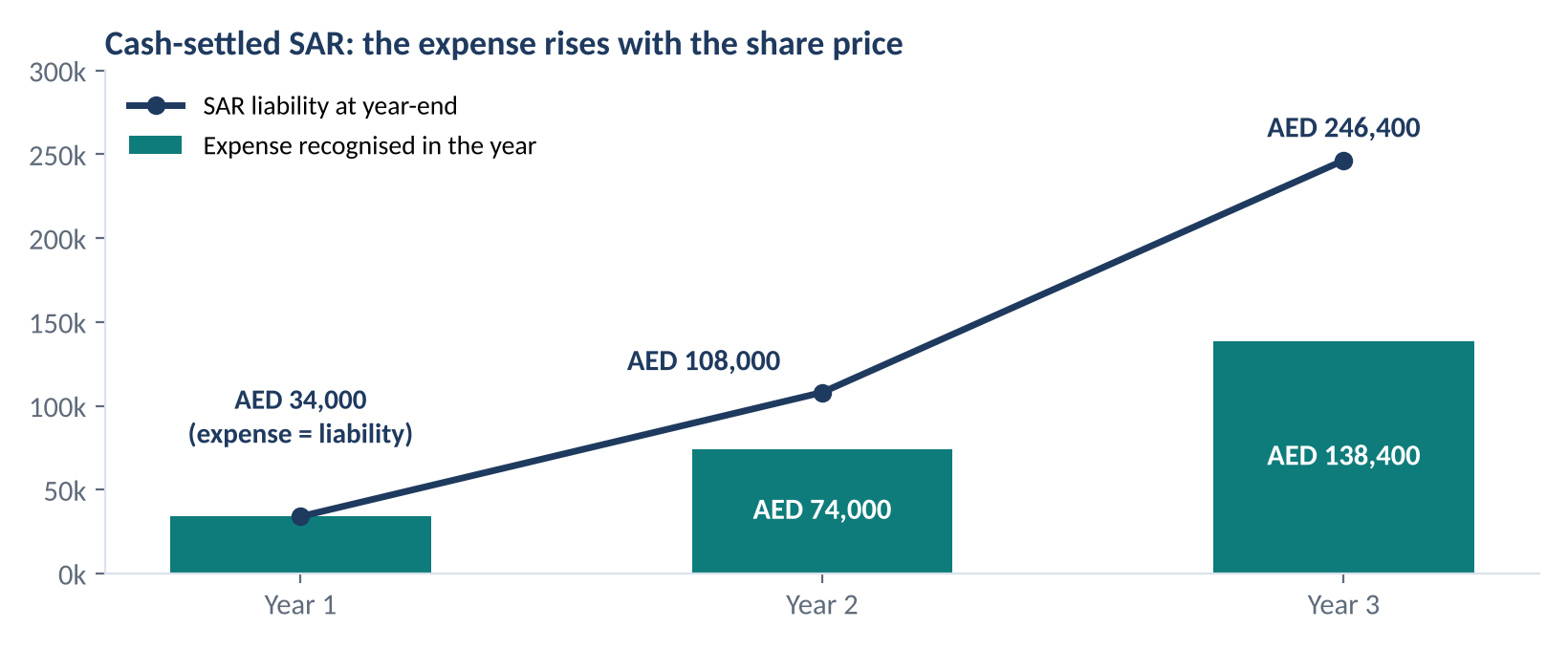
That volatility is not an accounting quirk. It is built into a cash SAR, because the company has promised a value that moves with its share price. An unexercised SAR's fair value can also exceed its intrinsic value because it still carries future upside. [35]
Equity-settled SAR: the same award, steadier numbers
For an employee equity-settled award, the service received is generally measured by the grant-date fair value of the equity instruments, subject to IFRS 2's rules on vesting and performance conditions. That value is not remeasured every period because the share price has moved. [35]
Classification still needs checking where settlement involves a variable number of shares, a cash choice for either side, group-company shares or tax-net-settlement features. IFRS 2 has specific rules on cash alternatives and modifications. [36]
| Cash-settled | Equity-settled | |
|---|---|---|
| Measured at | Fair value, re-done every reporting date | Grant-date fair value, fixed |
| Credit side | Liability | Equity reserve |
| Total cost in the examples above | AED 246,400 (follows the share price) | AED 132,000 (fixed at grant; only the service outcome changes it) |
| Volatility in profit or loss | High | Low |
Market conditions versus performance conditions
A target of "EBITDA of at least AED 40 million" is not accounted for like "share price of at least AED 80". IFRS 2 separates market conditions from other vesting conditions. A market condition can be built into grant-date fair value, so an equity-settled expense may not be reversed just because the market hurdle later fails, provided the service and non-market conditions are met. Cash awards, by contrast, keep being remeasured. [35]
Valuation inputs
A vested SAR with no optionality left may sit near intrinsic value, max(0, share value − base price). An outstanding SAR that can be exercised for years has time value, so valuation may draw on:
|
|
For a start-up, "last funding price minus base price" is therefore not automatically an IFRS 2 fair value. [35]
Deferred tax
Do not simply multiply the IFRS 2 expense by 9% and call it deferred tax. IAS 12 deals specifically with share-based payments: the deductible temporary difference depends on the amount the tax authority is expected to allow in future, which, for a cash SAR, ties back to the unresolved deductibility question in Part 4. [37] Settle the deductibility position first, then book deferred tax from that.
Group arrangements: parent issuer, subsidiary employer
Two common patterns:
A foreign parent grants parent SARs or shares → the employee works for the UAE subsidiary.
A UAE parent grants awards → the employee works for a foreign subsidiary.
IFRS 2's group rules look at which entity receives the employee's services, which entity bears the settlement obligation and whether the award is settled in cash or equity. The subsidiary's own accounts can therefore classify the award differently from the consolidated accounts. [36] The accounting must then be reconciled with the intercompany recharge, the UAE transfer-pricing and connected-person rules, and VAT on the recharge (Part 4).
Disclosures and the working-paper file
IFRS 2 requires disclosures that let users understand the nature and extent of the arrangements, how fair value was determined and the effect on profit or loss and financial position. [35] For a material plan, keep on file:
|
|
That file is not bureaucratic decoration. It is the bridge between HR's award spreadsheet and the audited financial statements.
PART 6
Cross-border issues and risk
Mobile employees, the India illustration, data, insolvency and disputes
Three common cross-border patterns
| Pattern | Typical set-up | First questions |
|---|---|---|
| Outbound | UAE parent grants SARs to employees in other countries | Local tax and social security on the payout; local securities or exchange-control rules; the UAE side is usually the easy part |
| Inbound | Foreign parent grants SARs or shares to staff of the UAE subsidiary | UAE labour characterisation; recharge, VAT and corporate-tax deduction in the UAE subsidiary; the foreign parent's own reporting |
| Mobile | An employee moves into or out of the UAE during vesting | Where the work was done; residency on the payout date; treaty position; documentation of workdays |
The mobile case is the one most often mishandled. Because the UAE does not tax salary, the tax authority that cares is nearly always the other country, and it will ask for evidence of where the employee worked and where they were resident on each relevant date.
Illustration: a UAE SAR and an Indian employee
Because many UAE employees have India links, here is a worked illustration. It is general, not advice, and Indian statutory numbering changed when the Income-tax Act 2025 replaced the 1961 Act, so I describe the concepts rather than cite section numbers. [48]
The analysis runs in three steps:
UAE. No personal income tax and no withholding on the payout. A UAE tax residency certificate may support treaty claims. [28]
India. An Indian tax resident is taxed on worldwide income, so the payout is likely to be taxable in India as salary-type income. Where the award is share-settled instead, the usual concept is a perquisite taxed when the shares are received, measured against their value, with later capital gains on sale. [49]
Relief. If the UAE taxes nothing there is no foreign tax to credit, so India's tax is effectively final. The India-UAE double-tax agreement's employment article and the apportionment of the payout between the two years in the UAE and the year in India should be checked; a simple service-based split would attribute one-third of AED 600,000 (AED 200,000) to the Indian year, but residency-based taxation can reach the whole sum.
| Scenario | UAE tax | India tax |
|---|---|---|
| UAE-resident throughout, works in the UAE | None | None, unless the person is also resident in India |
| Moves UAE → India before payout | None | Likely on the payout as a resident; part may be argued as earned in the UAE, but there is no UAE tax to credit |
| Moves India → UAE before payout | None | India may tax the part earned while working in India, even if the person has left |
| Indian subsidiary employee gets UAE-parent shares | None | Perquisite on receipt; capital gains on sale; foreign-asset disclosure |
Indian exchange control and reporting
Indian exchange-control rules allow resident individuals who are employees or directors of an Indian office, branch or group entity to acquire shares of an overseas entity under an employee stock ownership or benefit scheme, provided the benefits are offered globally on a uniform basis. The consideration paid counts toward the Liberalised Remittance Scheme limit, and Indian residents must disclose foreign assets in their tax return. [46,47] A pure cash SAR acquires no overseas shares, so the exchange-control question is different; confirm it with Indian counsel before launch.
Data protection
SAR administration moves personal data: names, identity numbers, compensation, tax status, often to a plan administrator, a valuer and a parent company abroad. The UAE has several data regimes, and the one that applies follows the employer's location.
| Regime | Applies to | Points for SAR administration |
|---|---|---|
| Federal PDPL (Federal Decree-Law 45 of 2021) | Mainland and non-free-zone businesses | In force since January 2022, but the Executive Regulations that should detail transfers were still unpublished in the commentary I reviewed. Articles 22 and 23 govern transfers abroad. [44,45] |
| DIFC Data Protection Law (Law 5 of 2020) | DIFC entities | Own transfer rules and safeguards; not re-verified for this guide |
| ADGM Data Protection Regulations (2021) | ADGM entities | Own transfer rules and safeguards; not re-verified for this guide |
A mainland parent sharing employee data with a DIFC subsidiary, or the reverse, should treat it as a cross-border transfer needing contractual protections. [44] Put a data-processing clause in the plan and the administrator agreement, and tell employees what is shared and why.
Insolvency: where does a SAR holder rank?
The federal bankruptcy regime (Federal Decree-Law 51 of 2023) took effect on 1 May 2024. [41] Article 179 ranks creditors as secured, then privileged, then ordinary; privileged debts include employee wages and salaries, ahead of ordinary unsecured debts. [39,40] DIFC and ADGM have separate insolvency regimes (DIFC Law 1 of 2019 and the ADGM Insolvency Regulations 2022). [39]
| SAR type | Likely position | Why |
|---|---|---|
| Cash SAR already payable | Possibly an ordinary unsecured claim, or a privileged one if it counts as wages | Depends on whether the payout is characterised as wage; draft carefully |
| Cash SAR not yet triggered | Contingent claim | May be hard to value or prove in an insolvency |
| Equity-settled, shares delivered | Ranks as a shareholder | Shareholders are paid after creditors |
| Equity-settled, shares not delivered | A claim for damages at best | Depends on the plan terms |
In July 2026 the Cabinet triggered the temporary "Emergency Financial Crisis" provisions in Chapter V (Articles 251 to 257) of the bankruptcy law. Among other measures, directors and managers can pay outstanding wages without liability for preferring them, and a debtor can obtain priority financing with court consent. [42,43] These apply only where the crisis caused the insolvency, but they show that employee-pay claims are treated as a priority.
Disputes, governing law and forum
Mainland employment disputes go through the labour authority and then the labour courts. A plan governed by foreign law will not displace mandatory UAE labour protections for staff working on the mainland.
DIFC and ADGM have their own courts and employment rules; parties can also choose arbitration.
Language. Proceedings in onshore courts are in Arabic, so keep an accurate Arabic version or translation of key plan documents.
Choose a forum on purpose, and make the SAR plan and the employment contract point the same way.
PART 7
The playbook
Eight steps from idea to payout, with a term sheet, checklists and the questions to ask your advisers
Eight steps
1 Goal |
2 Regime |
3 Settle |
4 Terms |
5 Tax, labour |
6 Cost |
7 Approve |
8 Run |
| Step | What to do | Output |
|---|---|---|
| 1. Set the goal | Retention, exit alignment, sales incentive? Who is in, who is out, how big is the pool? | One-page brief |
| 2. Pick the regime | Mainland LLC, PrJSC, PJSC, DIFC, ADGM or another free zone? Is the issuer regulated? | Regime note |
| 3. Choose settlement | Cash, net-share, issuer-choice? Decide with finance and corporate counsel together | Settlement memo |
| 4. Design terms | Base price, vesting, trigger, caps, leaver terms, change of control, clawback | Term sheet |
| 5. Test tax and labour | Corporate-tax position, connected persons, wage versus basic wage, deductions, home-country tax | Tax and labour memo |
| 6. Model cost | Cash exposure at several share prices; IFRS 2 expense; dilution; funding | Cost model |
| 7. Approve and paper | Board, shareholders, regulator steps; plan rules, award letters, employee consent | Signed plan |
| 8. Run and report | Valuation cycle, payroll, records, disclosures, annual review | Operating calendar |
Which structure fits which company?
| If you are… | Consider | Watch for |
|---|---|---|
| A mainland LLC start-up | Cash or exit-linked SARs; later a share class under the 2025 amendments | Pre-emption default, partner cap, notarised changes |
| A PrJSC preparing to list | Equity-settled awards within the PrJSC rules; lock-up now shorter | Ministerial Decision 137 of 2024; regulator rules on schemes |
| A listed PJSC | Cash SARs for senior staff; equity plan if shareholders approve | Scheme limits; director participation; disclosures |
| A DIFC or ADGM company | Flexible share classes or SARs; check exempt-offer conditions | Regulator rules; DEWS or ADGM end-of-service regime |
| A foreign group's UAE subsidiary | Parent awards with a recharge agreement | Recharge, VAT, deduction; labour characterisation |
| A regulated firm | Awards consistent with remuneration rules | Deferral, malus, clawback; controller thresholds |
One-page term sheet
| Term | Example wording to decide |
|---|---|
| Issuer and employer | UAE Co (issuer); the employing entity named separately if different |
| Participants | Named employees; directors only with shareholder-level approval |
| Number of SARs | Individual grant plus total pool as a percentage of share capital |
| Base price | Fair market value at grant, set by an independent valuation |
| Vesting | Three years, cliff or monthly; performance conditions stated |
| Trigger | Exit event or fixed date; exercise window of defined length |
| Settlement | Cash, net-share or mix; who decides; rounding |
| Cap | A maximum gain per SAR or in total |
| Leavers | Good and bad leaver definitions; treatment of vested and unvested SARs |
| Wage status | Stated to be a discretionary incentive, not wage, and excluded from gratuity |
| Clawback | Misconduct and restatement; recovery by claim, not payroll deduction |
| Tax | Employee responsible for home-country tax; company reports as required |
| Law and forum | Chosen law, courts or arbitral seat; Arabic version where needed |
Checklists
Before launch
|
|
Every year
|
|
Ten mistakes that keep recurring
| Mistake | Better approach |
|---|---|
| Copying a plan from another jurisdiction | Start from the UAE regime and the issuer's form |
| Treating the SAR as wage by accident | Draft it as a discretionary incentive under a separate plan |
| Uncapped cash SARs with no funding plan | Cap, share-settle or tie to a liquidity event |
| No valuation process | Independent valuer; method stated in the plan |
| Ignoring pre-emption on share delivery | Waive or carve out in the constitution first |
| Assuming tax follows accounting | Take and record an explicit tax position |
| Overpaying founders and directors | Benchmark; document market value for connected persons |
| Payroll clawback of a payout | Recover by contractual claim; respect deduction limits |
| Forgetting the employee's home country | Track workdays and residency; get local advice |
| Changing the plan mid-way without accounting input | Test every modification under IFRS 2 first |
Questions to ask your advisers
Corporate counsel
Which regime governs us, and does anything change if we move?
Do we need to amend our constitution for a new class or for pre-emption?
Does share delivery count as an offer of securities, and is there an exemption?
Tax adviser
On what basis do we deduct the cost, and what is our documented position?
Does the connected-persons rule catch any participant?
Are we in the large-group minimum-tax regime, and how does it treat the expense?
Employment counsel and finance
Is the payout a wage, and does it touch gratuity, payroll or the deduction limits?
Will the auditor treat the award as cash-settled or equity-settled?
How will we fund and report the liability at each year-end?
REFERENCE
Frequently asked questions
Quick answers, with pointers back to the detail
Can a UAE company grant SARs without a formal ESOP?
Yes. A SAR can be created by contract. Whether company law, securities rules, labour law, tax and accounting then apply depends on the terms. A cash SAR that creates no shares is the lightest route; equity settlement brings in company-law steps. [1]
Do employees pay income tax on SARs in the UAE?
Not in the UAE, which does not tax employment income of individuals. Tax can still arise in another country if the employee is resident or worked there. [28]
Does the employer get a corporate-tax deduction?
Probably yes for a genuine incentive (Article 28, wholly and exclusively for business), but the timing for share-based pay is not addressed in the FTA guide summaries I reviewed. Take and document a position. [21,23]
Are SARs part of 'wage' for gratuity?
Gratuity is built on basic wage, which excludes allowances. A SAR drafted as a discretionary incentive outside basic wage does not raise gratuity. [16,17]
Can we claw back a SAR payout through payroll?
Only within the labour law's list of permitted deductions and the 50% monthly cap. Recovery by a separate contractual claim is safer. [18]
Do free-zone companies follow the Commercial Companies Law?
The 2025 amendments say free-zone companies are UAE juridical persons and that the law reaches their mainland activity. DIFC and ADGM keep their own regimes. [6,2]
Can an LLC now issue different share classes?
The amendments replacing Article 76 expressly permit different classes of quotas or shares in mainland companies, which supports employee classes. [2,3]
Do pre-emption rights apply when we deliver shares?
They remain the default on the mainland, but constitutional documents may now carve them out or waive them. [4]
Did the securities law change?
Yes. Decree-Laws 32 and 33 of 2025 took effect on 1 January 2026 and replaced the earlier federal securities law, turning the SCA into the Capital Market Authority. [8,9]
Is a cash SAR a security?
A non-transferable contractual cash bonus is usually far from a market instrument, but the new definitions are broad, so record the analysis rather than assume it. [10]
Are payments to directors treated differently?
Yes. Article 36 of the Corporate Tax Law allows deduction of payments to connected persons, including directors and officers, only up to market value, and CTP010 (29 April 2026) explains who counts. [25,27]
Does DIFC differ on end-of-service?
Yes. The DIFC replaced gratuity with the defined-contribution DEWS from 1 February 2020, with contributions based on basic wage. [33]
Can a SAR over parent shares be given to a UAE subsidiary's employee?
Yes as an economic structure, but group IFRS 2 accounting, recharge, VAT, corporate-tax deduction, labour characterisation and any foreign-law requirements all need checking. [36,31]
Where does a SAR holder rank in insolvency?
Wages and salaries are privileged; whether a SAR claim counts depends on its legal character. Equity holders rank behind creditors. [39,40]
Can an Indian-resident employee receive UAE SARs?
Yes, but India will tax the payout as a resident, and exchange-control and reporting rules apply to share-settled awards. See the Part 6 illustration. [46,48]
Glossary in plain English
| Term | Meaning |
|---|---|
| Appreciation | The increase in reference-share value above the SAR base price. |
| Base price | The starting value against which appreciation is measured. |
| Basic wage | Under federal labour law, the wage excluding allowances and in-kind benefits; the base for gratuity. |
| Capital Market Authority (CMA) | The federal securities regulator since 1 January 2026, successor to the SCA. |
| Cash-settled SAR | A SAR discharged by paying money instead of delivering shares. |
| CCL | The Commercial Companies Law, Federal Decree-Law 32 of 2021, as amended by Decree-Law 20 of 2025. |
| Cliff | The minimum service period before the first tranche vests. |
| Clawback | Recovery of remuneration already delivered, after specified triggers. |
| Connected person | Under Article 36 of the Corporate Tax Law, a person (including an owner, director or officer) whose payments must reflect market value to be deductible. |
| DEWS | The DIFC Employee Workplace Savings scheme, which replaced end-of-service gratuity in the DIFC. |
| DIFC / ADGM | The Dubai International Financial Centre and the Abu Dhabi Global Market: financial free zones with their own laws and regulators (DFSA and FSRA). |
| DMTT | Domestic Minimum Top-up Tax: the UAE's 15% minimum tax for large multinational groups. |
| Equity-settled SAR | A SAR whose obligation is discharged with equity instruments, subject to the exact IFRS 2 classification of its terms. |
| FTA | The Federal Tax Authority. |
| Gratuity | End-of-service payment under mainland labour law, calculated on basic wage. |
| Good / bad leaver | Contractual categories that decide how awards are treated after departure. |
| IFRS 2 | The international share-based payment standard. |
| Intrinsic value | For a simple SAR, the positive excess of current share value over the base price. |
| Liquidity event | An event, such as a sale or listing, that lets holders realise value. |
| LLC / PrJSC / PJSC | Limited liability company, private joint stock company and public joint stock company: the main mainland company forms. |
| MOHRE | The Ministry of Human Resources and Emiratisation. |
| Net-share settlement | Delivering only enough shares to equal the SAR appreciation, instead of one share per SAR. |
| Phantom equity | Contractual synthetic equity; may track full value or just appreciation, and may never create share ownership. |
| Pre-emption | The right of existing holders to be offered new shares before others. |
| QFZP | Qualifying Free Zone Person: an entity that can be taxed at 0% on qualifying income. |
| RSU | Restricted stock unit: typically a promise to deliver the full value of a share once vesting conditions are met. |
| SAR | Stock Appreciation Right: a right to economic value linked to appreciation in a reference share or equity value. |
| Vesting | Satisfaction of the conditions to earn or keep the award. |
| WPS | The Wage Protection System through which mainland wages are paid and monitored. |
SOURCES
Sources
Numbers in square brackets in the text refer to this list. Law-firm and adviser articles are used as secondary support where the official text was not retrievable.
[1] Federal Decree-Law 32 of 2021 on Commercial Companies (official text, UAE Legislation) — https://uaelegislation.gov.ae/en/legislations/1542/download
[2] Horizon Law | Federal Decree-Law 20 of 2025 (April 2026) — https://www.horizlaw.ae/insights/federal-decree-law-no-20-of-2025
[3] Cleary Gottlieb | UAE Companies Law Update 2025: multiple share classes and other modernised tools — https://www.clearygottlieb.com/news-and-insights/publication-listing/uae-companies-law-update-2025
[4] Middle East Briefing | UAE CCL amendments: corporate structuring and M&A implications — https://www.middleeastbriefing.com/news/uaes-commercial-companies-law-amendments-corporate-structuring-and-ma-implications/
[5] Cleary Gottlieb | UAE Government clarifies rules applicable to private joint stock companies (Ministerial Decision 137 of 2024) — https://clearygottlieb.com/-/media/files/alert-memos-2024/the-united-arab-emirates-government-clarifies-rules-applicable-to-private-joint-stock-companies.pdf
[6] Chambers (Galadari) | Modernising UAE company law: key amendments to the CCL in 2025 — https://chambers.com/articles/modernising-uae-company-law-key-amendments-to-the-commercial-companies-law-in-2025
[7] Gulfbase | UAE Commercial Companies Law changes to boost competitiveness (8 Jan 2026) — https://www.gulfbase.com/news/uae-commercial-companies-law-changes-to-boost-competitiveness/213738
[8] Cleary Gottlieb | Key takeaways from the new UAE capital markets law (20 Jan 2026) — https://www.clearygottlieb.com/-/media/files/alert-memos-2026/key-takeaways-from-the-new-uae-capital-markets-law.pdf
[9] King & Spalding | A new era for UAE federal securities regulation: the 2025 CMA decree-laws — https://www.kslaw.com/news-and-insights/a-new-era-for-uae-federal-securities-regulation-the-2025-cma-decree-laws-february-2026
[10] Federal Decree-Law 33 of 2025 on the Regulation of the Capital Market (official text, UAE Legislation) — https://uaelegislation.gov.ae/en/legislations/4002/download
[11] HAS Law Firm (Legal 500) | Implications of the UAE's new securities and investment laws — https://www.legal500.com/developments/thought-leadership/the-implications-of-the-uaes-new-securities-and-investment-laws/
[12] Middle East Briefing | UAE capital markets overhaul: investor protection and market growth — https://www.middleeastbriefing.com/news/uae-capital-markets-overhaul-investor-protection-and-growth/
[13] DFSA | Markets Brief: Exempt Offers and the Financial Promotion Rules — https://dfsa.ae/download_file/1190/463
[14] CMS | Expert guide to private placement of equity securities: DIFC — https://cms.law/en/int/expert-guides/cms-expert-guide-to-the-private-placement-of-equity-securities/uae-dubai-international-financial-centre
[15] Federal Decree-Law 33 of 2021 on the Regulation of Labour Relations (official text, UAE Legislation) — https://uaelegislation.gov.ae/en/legislations/1541/download
[16] Legal Advice ME | Federal Decree-Law 33 of 2021 (definitions of wage and basic wage) — https://legaladviceme.com/legislation/159/uae-federal-decree-law-33-2021-regulation-of-labor-relations
[17] Dubai Development Authority | Labour Law summary (gratuity) — https://dda.gov.ae/-/media/218BD60807934D8F888B472B2FDB78E7.pdf
[18] Addleshaw Goddard | Lawful salary deductions and reductions under UAE Labour Law (2026) — https://www.addleshawgoddard.com/en/insights/insights-briefings/2026/employment/safeguarding-payroll-turbulent-times-lawful-salary-deductions-reductions-uae-labour-law/
[19] Ministry of Finance | Corporate Tax — https://mof.gov.ae/corporate-tax/
[20] Hadef & Partners | Federal Decree-Law 47 of 2022 (Corporate Tax Law) summary — https://hadefpartners.com/news-insights/insights/federal-decree-law-no-47-of-2022-on-the-taxation-of-corporations-and-businesses-corporate-tax-law/
[21] Crowe | Deductible expenses under the UAE federal Corporate Tax Law — https://crowe.com/ae/news/deductible-expenses-under-the--uae-federal-corporate-tax-law
[22] Ministry of Finance | Ministerial Decision 134 of 2023 on the general rules for determining taxable income — https://mof.gov.ae/wp-content/uploads/2023/05/Ministerial-Decision-No.-134-of-2023-on-the-on-the-General-Rules-for-Determining-Taxable-Income-for-Corporate-Tax-Purposes.pdf?fm=pdf
[23] Deloitte | FTA Guide on Determination of Taxable Income (31 July 2024) — https://www.deloitte.com/middle-east/en/services/tax/perspectives/fta-guide-on-determination-of-taxable-income.html
[24] PwC | UAE CT: Determination of Taxable Income guide (20 Aug 2024) — https://www.pwc.com/m1/en/services/tax/middle-east-tax-news-alerts/2024/uae-ct-determination-of-taxable-income-guide.html
[25] KPMG | Clarification of 'director' and 'officer' under Article 36 (CTP010) — https://kpmg.com/ae/en/insights/tax-insights/clarification-of-the-terms-director-and-officer-under-article-36-of-the-uae-corporate-tax-law.html
[26] Crowe | Navigating the FTA's clarification on connected persons — https://www.crowe.com/ae/news/navigating-the-ftas-clarification-on-connected-persons
[27] Alvarez & Marsal | UAE Corporate Tax: clarification on connected persons (30 Apr 2026) — https://www.alvarezandmarsal.com/node/94606
[28] Crowe | The new UAE tax residency rules (Cabinet Decision 85 of 2022) — https://crowe.com/ae/news/the-new-uae-tax-residency-rules
[29] Sovereign Group | UAE brings Resolution on Tax Residency into force — https://www.sovereigngroup.com/news/uae-brings-resolution-on-tax-residency-into-force/
[30] PwC | UAE implements Pillar Two from 1 January 2025 (Cabinet Decision 142 of 2024) — https://www.pwc.com/m1/en/services/tax/me-tax-legal-news/2025/uae-implements-pillar-two.html
[31] KPMG | Conditions for input VAT recovery on employee expenses (effective 1 October 2026) — https://kpmg.com/ae/en/insights/tax-insights/conditions-for-input-vat-recovery-on-employee-expenses.html
[32] PwC | Cabinet Decision 149 of 2026: amendments to the UAE VAT Executive Regulation — https://www.pwc.com/m1/en/tax/documents/2026/cabinet-decision-no-149-of-2026-amendment-to-uae-vat-er.pdf
[33] Tamimi | Replacement of end of service gratuity: the DIFC Employee Workplace Savings Scheme (DEWS) — https://tamimi.com/news/replacement-of-end-of-service-gratuity-the-difc-employee-workplace-savings-scheme-dews
[34] Mondaq | Key points of the new DIFC Employee Workplace Savings Scheme — https://www.mondaq.com/employee-benefits-compensation/884798/key-points-of-the-new-difc-employee-workplace-savings-scheme
[35] IFRS 2 Share-based Payment (standard text, IFRS Foundation) — https://www.ifrs.org/content/dam/ifrs/publications/pdf-standards/english/2022/issued/part-a/ifrs-2-share-based-payment.pdf?bypass=on
[36] IFRS 2 Share-based Payment (IFRS Foundation standard page) — https://www.ifrs.org/issued-standards/list-of-standards/ifrs-2-share-based-payment/
[37] IAS 12 Income Taxes (standard text, IFRS Foundation) — https://www.ifrs.org/content/dam/ifrs/publications/pdf-standards/english/2022/issued/part-a/ias-12-income-taxes.pdf?bypass=on
[38] IFRS for SMEs | Module 26: Share-based Payment — https://www.ifrs.org/content/dam/ifrs/supporting-implementation/smes/module-26.pdf
[39] Chambers | Insolvency 2025: UAE (Article 179 priority of claims) — https://practiceguides.chambers.com/practice-guides/insolvency-2025/uae
[40] Chambers | Existing employment contracts under Federal Decree-Law 51 of 2023 — https://chambers.com/articles/existing-employment-contracts-under-financial-restructure-and-bankruptcy-federal-decree-law-no-51-o
[41] Global Law Experts | Corporate insolvency in Dubai (Decree-Law 51 of 2023 effective 1 May 2024) — https://globallawexperts.com/corporate-insolvency-in-dubai-restructuring-bankruptcy-and-creditor-rights/
[42] DLA Piper | Emergency Financial Crisis declared (July 2026) — https://www.dlapiper.com/insights/publications/2026/07/emergency-financial-crisis-declared
[43] Latham & Watkins | UAE implements the provisions of Chapter V of the UAE Bankruptcy Law (3 July 2026) — https://www.lw.com/en/insights/uae-implements-the-provisions-of-chapter-v-of-the-uae-bankruptcy-law
[44] Kayrouz & Associates | Cross-border data transfers under UAE law in 2026 — https://www.kayrouzandassociates.com/insights/cross-border-data-transfers-under-uae-law-in-2026
[45] US International Trade Administration | UAE allows cross-border data flows of personal data (PDPL Arts 22-23) — https://www.trade.gov/market-intelligence/united-arab-emirates-allows-cross-border-data-flows-personal-data
[46] AZB & Partners | Offshore ESOPs to Indian employees: a regulatory overview (20 Aug 2024) — https://www.azbpartners.com/bank/offshore-esops-to-indian-employees-a-regulatory-overview/
[47] Nishith Desai | ESOP reporting under the new overseas investment regime — https://nishithdesai.com/generateHTML/8456/3
[48] Income Tax Department (India) | Objective and scope of the New Act — https://www.incometax.gov.in/iec/foportal/help/all-topics/e-filing-services/objective-and-scope-new-act
[49] Income Tax Department (India) | Section 17 (Income-tax Act 2025) — https://www.incometaxindia.gov.in/w/section-17-225
This guide is general information, not legal, tax or accounting advice. Rates, thresholds and guidance cited reflect each source's position as described there; confirm against the current primary text and take advice before acting.